November 29, 2025 · Kuba Rogut
Ever have a movie make you jump, even when nothing scary is on screen? Or feel your heart swell during a triumphant moment? That's the power of non-diegetic sound.
Simply put, it’s any sound that exists outside the world of the story—sound the characters can't hear, but you, the audience, can. It’s added on top of the action, a secret layer meant just for you.
Think of it as a direct line from the creator to the audience. It’s the invisible soundtrack that tells you how to feel, giving you context that the characters themselves don't have.
This covers everything from the orchestral score in a blockbuster film to an omniscient narrator's voiceover. When the hero lands the final punch, he isn’t hearing that epic, swelling music. That’s purely for your benefit, to make the moment feel as huge as it should.
The easiest way to get a handle on this is to ask a simple question: can the characters in the scene hear this sound? If the answer is yes, it's diegetic. If the answer is no, it’s non-diegetic.
We’ve already covered the flip side of this coin, and you can get a full rundown on what is diegetic sound in our complete guide. Understanding the contrast is key. Diegetic sound pulls you into the reality of the story with things like dialogue, clanking keys, and rain hitting a window. Non-diegetic sound, on the other hand, pulls you out just enough to shape your emotional journey.
A filmmaker uses non-diegetic sound to give the audience emotional information that the characters don't have. It's the ultimate tool for building suspense, creating irony, or foreshadowing events to come.
To make this crystal clear, let's break down the core differences between these two powerful sound design tools.
The table below offers a simple, side-by-side look at how these two types of sound function.
| Characteristic | Diegetic Sound | Non-Diegetic Sound |
|---|---|---|
| Origin | From within the story's world | Added externally for the audience |
| Character Awareness | Characters can hear it | Characters cannot hear it |
| Primary Purpose | To create realism and immersion | To evoke emotion and add commentary |
| Common Examples | Dialogue, footsteps, on-screen radio | Musical score, narration, sound effects for emphasis |
Essentially, one builds the world, and the other tells you how to feel about it. By using them together, creators can build a rich, immersive, and emotionally resonant experience.
Non-diegetic sound is far more than just audio layered on top of a scene. It’s a direct line from the creator to the audience, a secret language that shapes how we feel and what we understand. It's the storyteller’s way of whispering in our ear, making sure a scene doesn’t just happen, but that it lands.
Think about it. A thrilling car chase with no music? It’s just traffic. The pounding score is what tells your heart to race. This is achieved by playing three critical roles: building an emotional framework, delivering crucial information, and establishing a consistent atmosphere.
The most obvious job of non-diegetic sound is to steer our emotions. A filmmaker can use a sweeping, romantic orchestra to tell us that a simple glance between two people is the start of a legendary love story. On the flip side, a low, dissonant hum can make a peaceful-looking suburban street feel like the most dangerous place on Earth.
This is so effective because it bypasses our logical brain and speaks directly to our gut. These audio cues are like an emotional blueprint for the scene, telling us whether to feel joy, suspense, sadness, or fear. It’s the invisible hand that ensures the emotional arc of the story is felt, not just observed. You can learn more about how the right audio transforms a scene in our guide to cinematic sound effects.
Sometimes, sound is used to give the audience information the characters don't have. The most common example is voiceover narration, where a storyteller can fill in historical context, untangle a complex plot point, or let us in on a character's private thoughts. Think of any historical epic where a narrator sets the stage by explaining the political turmoil of the time.
This isn't just an old-school trick, either. A 2019 analysis found that 42% of English-language films released since 2000 used some form of non-diegetic narration. That's a huge jump from just 22% back in the 1970s, showing just how valuable this tool has become for modern filmmakers.
By speaking directly to the audience, non-diegetic narration can fill in narrative gaps, streamline exposition, and offer a unique perspective that enriches the entire story.
Finally, all these non-diegetic elements work in concert to build a distinct and memorable atmosphere that defines the entire project. This isn’t just about the emotion of a single scene; it's about the overall feel of the world you’re experiencing.
In the end, these sounds are never just background noise. They are deliberate, strategic choices—an unseen character working behind the scenes to control the narrative and shape your entire experience.
When we talk about non-diegetic sound, the musical score is the undisputed heavy hitter. It's the emotional blueprint of a film, a secret channel that speaks directly to the audience, completely unheard by the characters on screen. The score is what tells you to be scared, to feel a surge of triumph, or to let your heart break.
This isn't just art; it's a finely tuned craft. Composers are masters of psychological influence, using music to get a very specific reaction from you. In many ways, they're co-authors of the story, filling in emotional gaps that visuals and dialogue simply can't reach on their own.
Think about the two iconic notes from Jaws. We, the audience, feel that mounting dread, but the swimmers on screen are completely oblivious. That simple, low, and repetitive theme from John Williams mimics a predatory heartbeat, tapping into a primal fear. That’s non-diegetic sound doing its job perfectly.
Legendary composers like Hans Zimmer achieve this by carefully manipulating a few key musical elements:
A film score acts as an invisible narrator, guiding the audience's emotional journey. The same scene can feel heroic, tragic, or comedic simply by changing the non-diegetic music layered on top of it.
The commercial impact of getting this emotional guidance right is huge. The film industry knows this well; a 2021 survey found that 68% of U.S. moviegoers said a film's soundtrack directly influenced their overall enjoyment. What's more, films with acclaimed scores have seen a 15-20% boost in box office revenue compared to similar movies without them. It’s clear proof that what the characters can't hear has a massive impact on what audiences are willing to pay to experience. Discover more about the powerful connection between sound and audience emotion to see just how deep this goes.
At the end of the day, a score's primary job is to serve the story. And it isn't just for blockbuster films; understanding non-diegetic sound is a vital part of effective storytelling in marketing, gaming, and podcasting. The music you choose will fundamentally define how your audience connects with your content.
For independent creators, finding the perfect music is a crucial step. The good news is, you don't need a Hollywood-sized budget to get high-quality tracks anymore. By understanding what is royalty-free music, you can tap into massive libraries of professional scores and give your project the emotional weight it deserves. This opens the door for you to build your own emotional blueprint, making sure your story truly hits home.
To really get a feel for how non-diegetic sound works, let's look at some iconic examples from film, games, and podcasts. These moments show how sound that exists only for the audience becomes a crucial storytelling tool, creating experiences that simply wouldn't be the same without it.
Once you know what to listen for, you’ll start noticing it everywhere. It's always a deliberate choice, a way for the creator to pull you deeper into the world they've built.
When you think of suspense, what's the first sound that comes to mind? For most people, it's the score from Steven Spielberg’s 1975 classic, Jaws. John Williams’ two-note theme is the ultimate example of non-diegetic sound. That ominous "dun-dun" is a direct warning to us, the audience, that the shark is near. The characters are completely oblivious, happily splashing away, which makes the tension almost unbearable. The music is a private alert from the filmmaker: danger is coming.
Then you have David Fincher's 1999 masterpiece, Fight Club. The narrator’s voiceover isn’t just commentary; it’s a non-diegetic internal monologue that lets us into his chaotic mind. This technique gives us a front-row seat to his psychological unraveling, layering the film with a dark, comedic irony that the dialogue alone could never capture. We're in on the story's big secret long before he is.
A well-placed non-diegetic sound cue creates dramatic irony by giving the audience privileged information. This knowledge gap between us and the characters is a powerful way to build suspense and emotional investment.
Video games are masters of non-diegetic sound, using it as a direct line of communication with the player. The characters on screen can't hear the soundtrack, but for us, it’s a vital part of the experience.
This entire audio layer basically functions as a user interface, shaping how you play and heightening the emotional stakes without ever shattering the illusion of the game world.
In the world of audio-only storytelling, non-diegetic sound is everything. Narrative podcasts, particularly in true crime and fiction, rely on it to paint a picture in the listener's mind. A short, sharp musical sting, for example, can punctuate a shocking reveal or smoothly transition between different scenes or timelines.
Beyond that, creators use subtle, atmospheric soundscapes to set the emotional tone. A faint, unsettling drone playing just beneath a narrator's description of an old, abandoned house instantly puts you on edge. It’s the audio equivalent of cinematic lighting—a sound that exists entirely outside the story's reality, but completely defines the mood.
You might think of non-diegetic sound as a modern filmmaking trick, but its origins are as old as cinema itself. Long before movies could talk, live musicians in theaters were the original storytellers of sound. Picture an organist watching the silent film unfold, playing music in real-time to cue the audience's emotions—ratcheting up the tension, swelling with romance, or adding a comical flourish.
This was the very first kind of musical score, and it existed solely for the audience. The characters on screen were oblivious to it. These live accompaniments were the first real proof that what the characters couldn't hear was just as powerful as what the audience could see.
When synchronized sound arrived in the late 1920s, it changed everything. It wasn't just about adding dialogue; it gave composers a whole new canvas to work with. Visionaries like Max Steiner, whose score for King Kong (1933) is legendary, showed the world what was possible. He didn't just write music to go along with the action; he used it to shape the narrative, elevating a monster movie into a heartbreaking epic.
This was the era that cemented the non-diegetic score as a core part of Hollywood's storytelling language. It became so essential that one study found over 85% of major studio films released between 1935 and 1950 had a dedicated score. By the 1960s, its dominance was nearly total, with 97% of top-grossing films in the U.S. using background music or narration. You can dive deeper into the foundations of cinematic sound on StudioBinder.
The jump from a live organist to a full orchestra wasn't just a technological upgrade—it was a narrative one. Composers were learning to build entire emotional worlds that existed only for the viewer.
From those early days, non-diegetic sound grew into the sophisticated tool we see everywhere today. It’s no longer just about the music. It now includes intricate sound design, voice-over narration, and all sorts of stylistic effects that have become fundamental to how we tell stories in film, games, and beyond.
It’s one thing to know what non-diegetic sound is, but it's a whole different ball game to use it effectively. Let's walk through a practical workflow that any creator can use to elevate their projects, whether it’s a short film, a podcast, or even a game level. The entire process really boils down to one simple starting point: identifying the core purpose of your scene.
Before you touch a single audio file, you have to define the emotional takeaway. What do you want the audience to feel? Is this a moment of heart-pounding tension, quiet hope, deep sadness, or pure excitement? That single decision becomes your North Star, guiding every sound choice you make from here on out. Your goal is to support the story, not steal the spotlight from the dialogue or action.
Integrating non-diegetic sound is all about careful selection and refinement. You're hunting for that perfect audio layer that speaks directly to the viewer's subconscious.
Here’s a simple, repeatable workflow to get you started:
The tools we have for this have come a long way, but the core idea of using external sound to shape emotion has been around since the beginning of cinema.
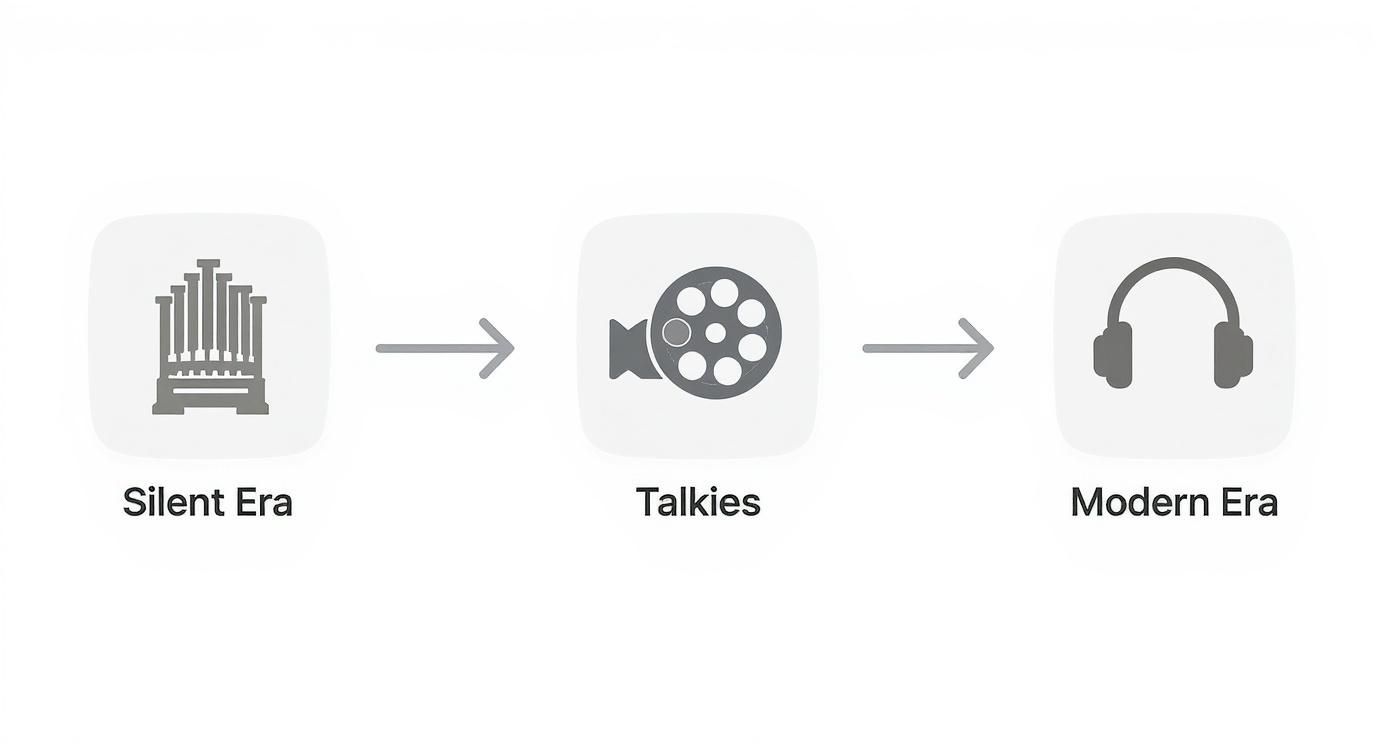
From live organs accompanying silent films to the sophisticated digital tools we have today, the mission has always been the same: to make the audience feel something.
Thankfully, modern tools have made this process incredibly intuitive. For instance, a platform like SFX Engine allows you to translate a creative idea directly into sound without getting lost in endless folders of generic files.
Let's say you're scoring a tense scene where the main character is sneaking around. Instead of just browsing random "suspense" tracks, you can get specific. Try searching for an "uneasy ambient drone" or a "subtle rhythmic pulse." This kind of targeted search saves a ton of time and delivers results that feel custom-made for your scene.
Pro Tip: When you start mixing, bring your non-diegetic sound in at a very low volume and slowly raise it until it just clicks. Often, the most effective non-diegetic sound is felt more than it's consciously heard, blending right into the emotional fabric of the scene.
Once you’ve layered your chosen audio into your video editor or DAW, the final step is to balance the levels. You need to make sure your non-diegetic elements sit comfortably underneath the dialogue and any other critical diegetic sounds. By following this simple framework, you can start using non-diegetic sound as the powerful, professional storytelling tool it's meant to be.
As you start working more with sound design, you'll naturally run into a few tricky questions. Let's clear up some of the most common points of confusion so you can feel confident about what non-diegetic sound really is.
Absolutely, and filmmakers love to play with this. The technique is often called trans-diegetic sound, where audio crosses the line between the two worlds.
Imagine a scene where a dramatic score starts playing (non-diegetic), and then we see a character put on their headphones. Suddenly, the music is revealed to be coming from their device, making it diegetic. This is a brilliant way to pull an audience deeper into a character's personal experience.
This is a very common misconception. A sound effect is only non-diegetic if the characters in the story can't hear it.
Footsteps on pavement, a phone ringing, a car door slamming—those are all diegetic because they exist in the story's world. A non-diegetic sound effect is something added for pure audience impact, like a stylized "whoosh" when the camera pans quickly or an over-the-top punch sound that's far more dramatic than the real thing.
Most of the time, yes. A classic narrator is an unseen voice speaking directly to the audience, existing outside the film's reality.
But there are fun exceptions. Think of The Princess Bride, where the grandfather is reading a story to his grandson. His voice is a diegetic narrator because he’s a character within the scene, speaking to another character.
The acid test is simple: "Can the characters hear this?" If the answer is a firm "no," you're working with a non-diegetic sound designed solely for the audience.
For any creator, getting a handle on how different sounds and frequencies affect a listener is a huge advantage. It lets you make audio choices that are not just cool, but intentional. This concept is explored in detail within the principles of sound therapy for relaxation.
Ready to stop searching for the perfect sound and start creating it? With SFX Engine, you can generate custom, royalty-free sound effects and background music just by typing a description. Try SFX Engine for free and bring your project to life.