February 15, 2026 · Kuba Rogut
So, what’s the secret sauce behind a viral sound meme? It's all about understanding what makes a piece of audio truly infectious. The best ones blend relatable human moments with surprising audio twists and have perfect looping potential. It's this combination that can turn a simple clip into a cultural touchstone that creators can't wait to use and share.
Ever been scrolling through TikTok or Reels and suddenly, the same sound clip is everywhere? It could be a weird sneeze, a snippet from a movie, or a simple musical riff. I can tell you from experience, it’s rarely an accident. Viral sounds are often engineered, either intentionally or by pure chance, with specific psychological triggers that make them stick in our brains.
To make your own viral sound memes, you first need to get a handle on these triggers. It’s a mindset shift—stop being a passive listener and start analyzing why certain audio just works.
At its heart, a viral sound plugs directly into a universal human experience or emotion. It’s either incredibly relatable, so absurd it's hilarious, or just deeply satisfying to hear. These sounds act as pre-made emotional templates, giving people a shortcut to express themselves and making it much easier to jump on a trend.
This is a big reason why audio punches so far above its weight. The world of viral sound effects has exploded, and platforms like TikTok have shown that trending audio can boost engagement by 40-50% compared to just visuals. Interestingly, the biggest hits usually bubble up from organic, user-generated content, not some big-budget brand campaign.
The most powerful viral sounds are born from shared experiences. Just think about the "Oh no, oh no, oh no no no no" sound. It became the go-to soundtrack for any moment of impending disaster, whether it was a cake sliding off the counter or a dog tracking mud through the house. It works because the emotion is instantly understood by everyone.
A sound truly becomes a meme when thousands of people can hear it and think, "That's so me."
Pro Tip: I've found that the best sounds are often discovered, not created from scratch. Keep your ears open for funny bits of conversation, unique noises in your environment, or even the weird rhythm of an everyday object. Your next viral hit might be hiding in plain sight.
Humor is a massive driver of virality, especially when it comes from somewhere unexpected. A sound that starts off normal and then takes a sharp left turn creates a kind of delightful mental whiplash that makes people laugh and hit the share button.
Here are a few classic ways to create that twist:
To get a real feel for how these elements come together, it helps to break them down.
This table breaks down the core characteristics that give a sound its viral potential. Looking at these elements side-by-side really clarifies what you should be aiming for.
| Element | Description | Example |
|---|---|---|
| Relatability | The sound taps into a common feeling, situation, or reaction. | The "Emotional Damage" guy for moments of verbal burns. |
| Versatility | It can be applied to a wide variety of contexts and scenarios. | The "It's Corn!" song applied to anything someone loves. |
| Loopability | The sound seamlessly repeats, making it perfect for short-form video. | A catchy musical hook or a phrase that ends where it begins. |
| Memorability | It's short, catchy, and gets stuck in your head easily. | The "My money don't jiggle jiggle" rap. |
| Surprise Factor | An unexpected noise, cut-off, or twist that grabs attention. | The dramatic "And the award for best actor goes to..." |
Understanding these building blocks is one thing, but seeing them in the wild is another.
To really get what makes a sound meme take off, you have to analyze trends as they happen. Using a TikTok Story Viewer is a great way to see what's popular right now, offering a direct window into current viral content. This kind of active observation is the best research you can do—it lets you see the patterns in action before you even think about hitting record.
The best viral sounds aren't cooked up in a pro studio. They’re found out in the wild. If you want to make a sound that catches fire, you have to start listening differently. Stop just scrolling and start actively hunting for audio gold in your everyday life.
Think of yourself as a sound detective. The ideas that really connect come from real, unscripted moments—a weird phrase someone drops in conversation, the specific rhythm of a construction site, or a cat making a bizarre noise. These organic sounds have an authenticity that's almost impossible to fake, and people feel it instantly.
You're trying to bottle a feeling. The goal is to capture a moment so perfectly that thousands of people hear it and think, "That is so me." That's the secret sauce.
Beyond what's right in front of you, the shared cultural scrapbook is a goldmine. Nostalgia is an absolute powerhouse. A sound that yanks people back to a beloved '90s cartoon, an old-school video game, or a classic movie line creates an immediate bond.
Keep an eye out for these sources:
These shared experiences are a shortcut. The emotional heavy lifting is already done because the memory is baked into your audience's brains. All you have to do is serve it up in a fresh, clever way.
My biggest win came when I stopped trying to invent a funny sound and just started documenting them. I recorded my friend's absolutely ridiculous laugh, threw a simple beat under it, and it became one of my most-used clips. The best stuff is usually hiding in plain sight.
Okay, so you've got an idea. Now what? In the old days, you’d spend hours digging through massive sound libraries or struggling to record the perfect effect yourself. It was a huge pain. Today, the path from concept to reality is a whole lot shorter.
This is where AI sound generators completely change the game. Instead of searching for "a tiny dragon sneezing," you just type that as a prompt. A few seconds later, you have a totally unique, custom sound effect. This means you can rapidly prototype ideas and test out different audio concepts for your meme with zero friction.
Let's say your idea is "a rusty robot trying to sing opera." Good luck finding that in a stock library. But with AI, not only is it possible, you can generate a dozen variations until one is just right. This gives your content a signature feel that helps it stand out. And the best part? These sounds are usually royalty-free, which saves you from a massive legal headache later on. If you want to play around with this, you can learn more about how a free AI audio generator can help you whip up custom effects from a simple text description.
Look, not every idea is going to be a banger, and that’s fine. The trick is to polish your concept until it’s as potent as possible. A killer viral sound is almost always short, punchy, and you know it the second you hear it.
Here’s a quick gut-check for your audio idea:
Before you invest a ton of time in production, do a quick and dirty test. Play the raw sound for a friend with zero context. If they laugh or have a genuine reaction, you might be onto something. That first, unfiltered response is often the best sign you've found a winner.
Let's be honest: a brilliant idea can fall flat with terrible audio. If your sound meme is a mess of background hum, muffled dialogue, or weird echoes, people will scroll right past it. Clean, punchy sound is non-negotiable. It commands attention and gives your content a professional edge, making it feel instantly more credible and shareable.
The good news? You don't need a high-end recording studio. The smartphone in your pocket is more than capable, as long as you know how to use it right. The real secret is controlling your recording environment to capture the cleanest audio possible from the very start.
Before you even think about hitting record, just stop and listen. Our brains are amazing at filtering out low-level background noise, but a microphone isn't so forgiving. It will pick up everything—the whir of your fridge, the faint sound of traffic, the echo bouncing off bare walls.
To nail your raw audio, focus on these simple but crucial steps:
These small adjustments make a world of difference. It's always easier to work with a clean recording than to try and salvage a noisy, echo-filled mess in post-production. If you're ready to upgrade your gear, our guide on choosing the best microphone for video recording has some great, practical advice.
With your core audio recorded, it's time to add the layers that make it pop. This is where AI sound generators become your secret weapon for creating a truly unique soundscape. Instead of wasting hours scrolling through stock libraries for a generic "whoosh" or "bonk," you can generate the exact sound you're imagining in a matter of seconds.
Let's say you need something super specific, like "a tiny goblin giggling while stealing a cookie." An AI tool like SFX Engine can create that custom sound from a simple text prompt. This is a game-changer. It gives your meme a signature quality that nobody else can replicate, and it's completely royalty-free.
This tech has also massively sped up the creative workflow. We're seeing pro audio producers who use AI sound generation tools report 3-5x faster content creation timelines. They can jump on new trends in hours, not days. If you want to see just how fast things move, you can explore the latest TikTok insights to get a feel for the pace.
Great sound design is all about the art of layering. Think of it like cooking: your main recording is the base ingredient, and the AI-generated effects are the spices that bring the whole dish to life. The goal is to blend everything together so it feels like one cohesive, impactful experience.
Start by importing your clean vocal track and your custom sound effects into a simple editing app. Make sure to place the effects on separate audio tracks—this gives you total control over their timing and volume. If your meme has a surprise reveal, for example, you can drop in a dramatic "dun dun dun" effect that syncs perfectly with the visual gag.
Key Takeaway: Don't just pile sounds on top of each other. Give each audio element its own space to breathe. Sometimes, a well-placed moment of silence right before a punchline hits harder than any loud noise ever could.
Once your layers are in place, a few final tweaks can make your audio shine on any device, from cheap phone speakers to high-end headphones.
By combining clean recording habits with the creative power of AI and a few simple polishing techniques, you can produce audio that doesn't just sound professional—it has the punch to stop scrollers dead in their tracks.
You've got a killer sound. Awesome. But that's only half the battle. Now comes the part where you build a visual world around it, and this is where so many creators drop the ball. A one-size-fits-all approach to editing is a death sentence for a meme.
Think of it like this: your sound is the punchline, but the video edit is the setup and delivery. A sloppy cut, the wrong format, or even slightly off timing can completely neuter the joke before it lands. Your mission is to wrap that audio in a visual package that feels like it was born on whatever platform you're posting to. That’s how you get the endless rewatches that the algorithms crave.
The secret sauce of a truly addictive sound meme is the synchronization. There's something almost primal and deeply satisfying about seeing a visual action hit exactly on an audio cue—a head turn timed perfectly to a beat drop, a jump cut on a specific word. That precision is what separates a polished, intentional video from amateur hour.
Just as important is the perfect loop. You know the ones—the video ends at the very same microsecond it began, creating this hypnotic, seamless cycle. It tricks people into watching two, three, maybe four times before their brain even registers it's a loop. This is gold for your metrics, as it skyrockets your watch time and signals to the algorithm that your content is sticky and engaging.
Getting the audio right is the foundation for all of this. Before you even open your video editor, your sound needs to be clean and punchy.
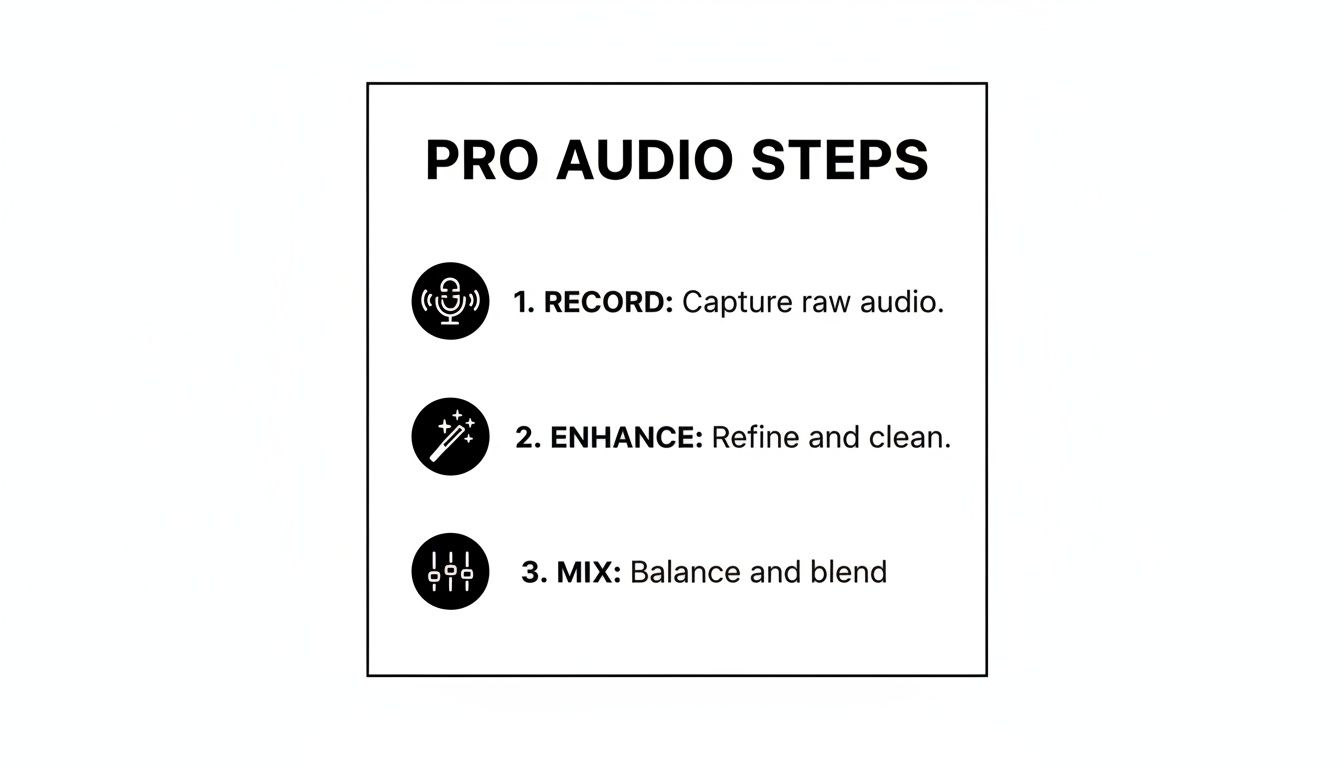
This process—recording clean, enhancing with effects, and mixing for clarity—ensures your audio has the impact it needs to carry the visual edit.
You wouldn't wear a tuxedo to a beach party. So why would you post the exact same video file to TikTok, Reels, and Shorts? Each platform is its own ecosystem with unique rules, audience expectations, and algorithmic quirks. Ignoring this is the fastest way to get your content buried.
Platforms like Tiktok, for instance, are the native habitat for this kind of content, and playing by its rules is non-negotiable.
Here’s a quick-reference guide to help you format your memes correctly for the major players.
| Platform | Optimal Length | Aspect Ratio | Key Feature to Use |
|---|---|---|---|
| TikTok | 7-15 seconds | 9:16 | Native text, stickers, and trending filters |
| Instagram Reels | 15-30 seconds | 9:16 | Aesthetically pleasing visuals, interactive stickers |
| YouTube Shorts | Under 60 seconds | 9:16 | Fast-paced cuts, bold and clear text overlays |
This table gives you the basics, but the real magic comes from going the extra mile.
My Pro Tip: Don't just export one video and upload it everywhere. Seriously, take the extra five minutes. Re-edit or at least re-format natively within each app. Use TikTok's trending text-to-speech voice. Add an Instagram poll sticker. These tiny, platform-specific tweaks tell the algorithm you're a native speaker, not a tourist.
A shocking number of people scroll through their feeds with the sound completely off. This means your on-screen text isn't just a fun little add-on; it's your frontline soldier in the battle for attention. It has to do the heavy lifting.
Effective text and captions serve three crucial jobs:
Treat your on-screen text like a headline. It needs to be bold, brief, and compelling enough to make a scroller stop, get curious, and tap that unmute button. Mastering the interplay between visuals and sound is a craft, and for a deeper dive, exploring TikTok sound effects tips can give you a real edge. Get the edit, sync, and captions right, and you’re not just making a video—you’re engineering a meme for maximum impact.
Alright, you've created a masterpiece. The sound is perfect. But here's the hard truth: a great sound sitting on your phone is just a file. The real work begins now—launching it into the digital wild and getting the algorithms to notice. This is where strategy takes over.
Think of it like this: your launch is all about giving the algorithm a bunch of strong, early signals that people love what you've made. We're talking likes, shares, and especially comments and watch time. You have to feed the machine what it wants, right from the jump.
Your caption isn't just a label; it's bait. Its sole purpose is to get people talking in the comments. A video that racks up a ton of comments in the first hour is like a giant flashing green light for the algorithm.
So, how do you do it? Stop making statements and start asking questions.
See the difference? One is passive, the other is an open invitation. You’re asking people to share a story, to connect with the feeling you've created. That's how you get real, meaningful comments that spark a chain reaction.
Hashtags are basically the GPS for your content, guiding it to the right people. I see so many creators either throw in a dozen massive tags like #fyp or use hyper-niche ones no one is searching for. The key is balance.
I stick to a simple three-tier system that works wonders:
#memes or #funnysound. It's your lottery ticket for massive exposure, but don't bet the farm on it.#dogmemes or #funnydoggo. This targets the audience most likely to engage deeply.#AwkwardSneezeSound. This is crucial because it groups together every single video made with your audio, making it easy to track your trend.This mix gives you a shot at broad reach while ensuring you hit the core audience that will champion your sound from the start.
You can have the best sound meme in the world, but if you post it when your audience is asleep, you might as well have shouted it into the void. Timing isn't just important; it's everything.
You have to drop your content when people are actually on their phones, mindlessly scrolling and ready to be entertained. For most audiences, that means commute times, lunch breaks, and late evenings.
But don't just guess. Dive into your analytics. On TikTok, the "Follower activity" tab is your best friend. Find your peak time and then post 30-60 minutes before it hits. This gives the algorithm enough time to test the waters with a small group before pushing it out to the masses right as they're logging on.
This is especially true if you're tapping into something nostalgic. It's wild, but statistical analysis has shown that well-timed nostalgic content with the right sound effects can get 2.3x more shares than similar videos with generic music. If you want to see the data for yourself, you can learn more about how trending sounds amplify memes.
You hit "post." Now what? Get to work. The first 60 minutes are make-or-break. The algorithm is watching your every move, and your main job is to reply to every single comment that comes in.
This is a powerhouse move for two reasons:
When you nail your launch—from a caption that hooks to timing that's on the money—you're not just crossing your fingers and hoping to go viral. You're building the foundation for it, brick by strategic brick.
If you're diving into the world of sound memes, you've probably got a few questions buzzing around. It's totally normal, especially when you're just starting out. Let's clear up some of the most common things creators wonder about.
This is a big one, and the short answer is a hard no. Grabbing copyrighted audio from a hit song, a movie, or a TV show without a license is playing with fire. It's a fast track to getting your content muted, taken down, or even getting a strike against your account. Imagine your masterpiece getting pulled right as it's taking off—all for a preventable legal snag.
Your best bet? Stick to audio you create yourself or sounds from a royalty-free source. It’s the only way to be sure you're in the clear.
Honestly, the peace of mind you get from knowing your creation is 100% yours is priceless. When you use an AI tool for sound effects, for instance, you typically get a commercial license for every sound you generate. That means you can monetize your content without ever looking over your shoulder for a copyright claim.
While there's no set formula, the first 24 to 72 hours are make-or-break. Think of it as your content's audition for the algorithm. During this window, platforms are watching closely for early signs of engagement to decide if your meme is worth showing to a massive audience.
Here’s what the algorithms are looking for:
If you can get a strong burst of activity on these metrics in the first day or two, you’ve got a real shot at triggering that viral snowball effect. It's all about that initial push.
Absolutely. If you've created a truly original sound that blows up on a platform like TikTok, you might become eligible for payouts directly from their creator fund. It's a direct line from your audio's popularity to your bank account.
But the real money often comes from the doors that a viral hit opens. A viral sound shines a massive spotlight on you and your brand. Suddenly, you're on the radar for big-name brand partnerships and sponsored content deals. Companies are desperate to work with creators who just get the culture, and nothing proves that better than a viral sound with your name on it.
Ready to create the kind of unique, high-quality audio that makes content unforgettable? Stop scrolling through generic sound libraries and start generating the exact effects you need. With SFX Engine, you can craft custom, royalty-free audio from a simple text prompt in seconds. Get started for free today and give your sound memes the professional edge they need to go viral.