December 10, 2025 · Kuba Rogut
So, you need to use music in your next commercial project. Whether it's for a YouTube ad, an indie film, or a new podcast, you can't just grab a song you like and drop it in. Doing so could land you in serious legal trouble. Licensing music is all about getting the right permissions from the copyright holders, and it usually means securing two distinct rights: one for the song itself and one for the specific recording you want to use.
Jumping into music licensing for the first time can feel like you're trying to learn a whole new language. There are a lot of specific terms, different players, and confusing rules. But getting a handle on the basics is the most important step you can take to legally and confidently use music in your work.
Here’s the first thing to burn into your memory: buying a song on iTunes or streaming it on Spotify gives you a license for personal listening only. It gives you absolutely no right to use that track in your company’s marketing video. Commercial use is a completely different ballgame.
The entire system is built on a crucial divide in how music is copyrighted. Every single song has two separate copyrights attached to it:
Because of this split, you almost always need to get permission from two different places to use one song. This is a fundamental concept that trips up a lot of creators and is the source of most licensing headaches.
To get a track properly licensed, you need to know what kind of permission you're asking for. The specific licenses you'll need will depend entirely on how and where you plan to use the music.
A Synchronization (Sync) License is probably the one you'll hear about most. It gives you the right to "sync" the musical composition with visual media. Think films, TV shows, video games, or commercials. You get this from the music publisher.
A Master Use License goes hand-in-hand with the sync license. This one gives you permission to use the actual sound recording. If you want that iconic original version of a song, you'll need this from the record label.
A Performance License is needed whenever music is played in public. This includes broadcasts on TV and radio, but it also covers streaming online or playing music in a physical business. Organizations like ASCAP, BMI, and SESAC handle these, collecting royalties for songwriters and publishers.
A Mechanical License grants the right to reproduce and distribute a song in an audio-only format. This is essential if you're recording a cover of someone else's song and want to release it on a CD, vinyl, or as a digital download.
By 2023, the global value of music copyright—which includes both recordings and compositions—hit a staggering USD 45.5 billion. That's an 11% jump from the year before and makes the music copyright business 38% larger than the entire global movie box office. It’s a powerful reminder of music's massive economic footprint in the entertainment world. You can learn more about these music copyright findings here.
For a quick reference, here's how the essential licenses break down:
Navigating the different types of licenses can be confusing. This table provides a simple overview of the most common licenses you'll encounter, what they allow you to do, and who you need to contact to get them.
| License Type | What It Covers | Who Grants It |
|---|---|---|
| Sync License | Pairing the musical composition (notes, lyrics) with visual media like film, ads, or games. | Music Publisher |
| Master Use License | Using a specific sound recording (the "master") in your visual media project. | Record Label |
| Performance License | Public performance or broadcast of a song (TV, radio, streaming, live venues). | Performance Rights Organization (PRO) |
| Mechanical License | Reproducing and distributing a song in an audio-only format (e.g., a cover song on a CD or download). | Music Publisher or a dedicated agency |
Think of this table as your cheat sheet. When in doubt, refer back to it to make sure you're pursuing the right permissions from the right people.
Beyond the different types of licenses, you’ll also run into two primary ways they are sold: rights-managed and royalty-free. Getting this difference is key to managing your budget and avoiding legal surprises down the road.
A rights-managed license is custom-built for your project. The fee is calculated based on a bunch of factors: how long you'll use the music (term), where it will be seen (territory), and whether you're the only one who can use it (exclusivity). This is the standard model for popular, chart-topping songs. It offers precision but can be complex and expensive.
On the other hand, royalty-free music offers a much more straightforward path. You typically pay a single, one-time fee for a broad license. This allows you to use the track across multiple projects without having to pay extra royalties for every view or play. Don't get confused by the name—it doesn't mean the music is free. It just means it's free from recurring royalty payments.
Platforms like SFX Engine are built on this model, offering vast libraries of royalty-free music and sound effects with clear commercial licenses. For many creators, this is the most cost-effective and headache-free way to get high-quality audio for their projects.
So, you’ve found the perfect track. Now what? Licensing music isn't a one-and-done deal; it's a process. And without a solid plan, you can easily get lost in a maze of emails, dead ends, and legal headaches that put your entire project at risk.
Let's walk through a practical, step-by-step approach to get you from discovery to outreach the right way.
This flowchart gives you a bird's-eye view of how music rights travel from the creator all the way to you, the end-user.
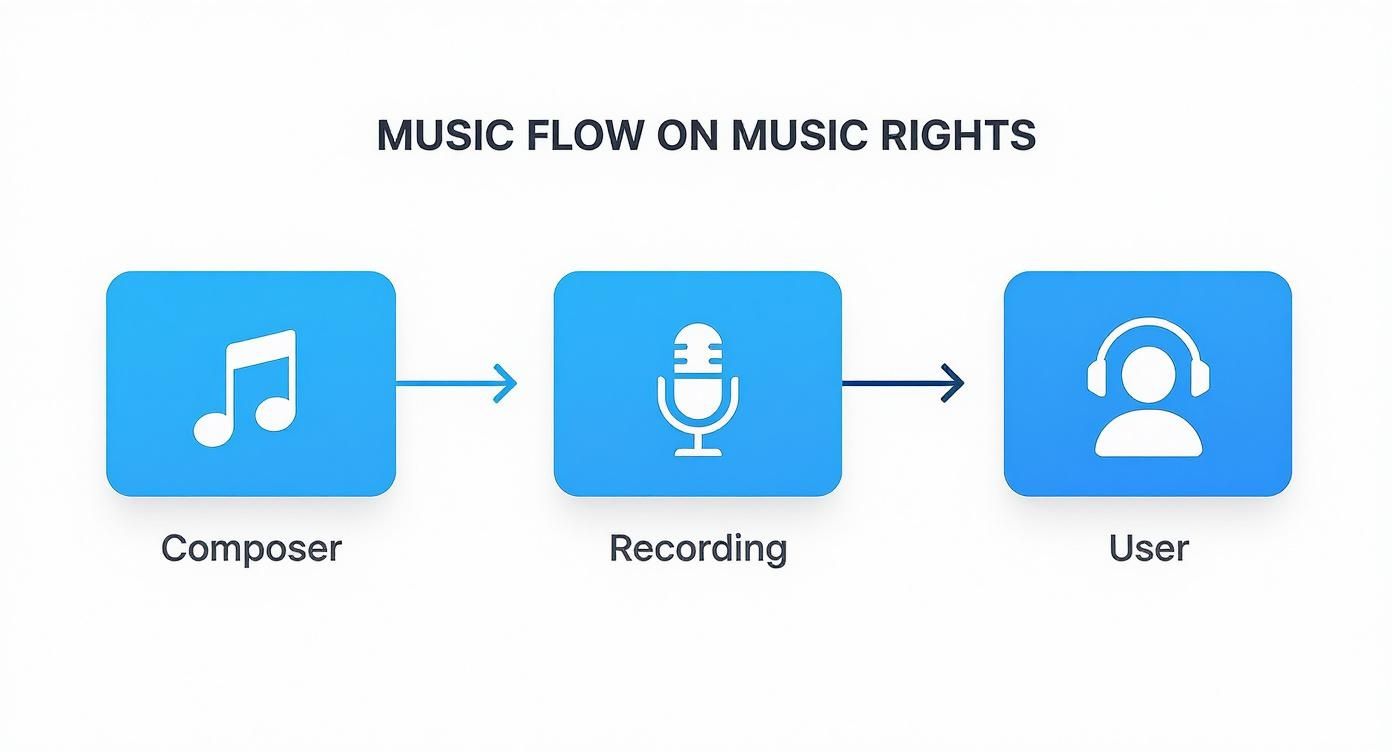
As you can see, the journey from the composer’s idea to the final recording involves multiple rights holders, and you need to clear the path with each one for your project to be legally sound.
First things first: you have to play detective. Before you can even think about asking for permission, you need to know exactly who holds the keys. Remember, every song has two sides—the composition (held by the publisher) and the master recording (held by the record label). You need a license from both.
So, where do you start looking? The Performance Rights Organizations (PROs) are your best friends here.
Just type the song title into these databases, and they'll tell you who the publishers are. Finding the master rights holder is usually simpler—a quick search on Spotify or even Wikipedia for the song's official release details will typically name the record label.
Pro Tip: Open a spreadsheet right now. Seriously. For every single track you're considering, log the song title, artist, writers, publishers, and the record label. This little bit of organization upfront will save you from a world of chaos later.
Once you know who to contact, it's time to draft your opening email. This first message sets the tone for the entire negotiation. A vague, unprofessional email is the fastest way to get ignored. You want to be clear, direct, and give them everything they need to give you a quote.
Think of it as a project brief. You're not haggling over price just yet; you're simply gathering the information you need to move forward.
Here’s a quick checklist of what your email absolutely must include:
There’s a reason this process is so formal. The global value of music copyright was estimated at a staggering $39.6 billion in 2021, and the U.S. market alone grew by 8% to $4.9 billion in just the first half of that year. With that much money on the line, you can bet rights holders are incredibly careful about how their assets are used.
And while getting the license is key, remember that an artist's success also depends on getting their music out there. For musicians, choosing a music promotion service is just as important as managing their rights, as it directly impacts how many licensing opportunities they might get.
By following this straightforward workflow, you show publishers and labels that you're a professional who respects their business. This not only makes it easier for them to give you a quote but also starts the negotiation off on the right foot.
So, you’ve sent your pitch and received a quote. Now the real dance begins. Securing a license is all about the art of negotiation, where you find that sweet spot between your creative vision and your budget.
Don't think of it as a battle. It’s more of a collaboration. The rights holder wants to make a deal, and you need their music. The goal is to land on terms that feel fair to everyone involved.
That initial quote you get? It's almost never the final price—it’s just a starting point. Several key factors can dramatically shift the cost, and understanding them is your biggest advantage.
Scope of Use: This is the big one. A license for a web-only social media ad will be a fraction of the cost of one for a national TV commercial. Be crystal clear about exactly where and how you plan to use the music.
Term (Duration): How long do you need the rights for? A license for a three-month marketing campaign is far cheaper than a license "in perpetuity" (forever). If you only need the track for a specific product launch, don’t pay for a lifetime of rights.
Territory: Where in the world will your project be seen? A license restricted to North America will be much more affordable than a worldwide deal. If your audience is local, define that and avoid paying for global rights you'll never use.
Exclusivity: This is a big-ticket item. Do you need to be the only company in your industry using this specific song for a while? An exclusive license can be a powerful marketing move, but it comes with a hefty price tag. For most projects, a standard, non-exclusive license is the way to go.
Pro Tip from the Trenches: Always ask for a rate card or a cost breakdown if you can get one. Seeing how each element—like adding broadcast rights or extending the term by a year—affects the price gives you a much clearer picture of where your money is going.
When it comes to licensing popular music, the costs can be all over the map. You might license an indie artist's track for a small podcast for just a few hundred dollars. On the other hand, a well-known hit for a major advertising campaign can easily run from $50,000 to over $500,000 when you combine the sync and master license fees.
The artist's fame, the song's cultural significance, and your project's visibility all play a huge role. A Super Bowl ad will naturally command a much higher fee than a video for an internal company meeting. Remember, you're almost always negotiating with two separate parties: the publisher for the composition and the record label for the master recording. Budget for both.
Once you’ve shaken hands on the terms, you'll get a formal licensing agreement. This is a binding legal document, so read it—and then read it again. While getting a lawyer to review it is always the smartest move, you need to know what to look for yourself.
Here's a quick checklist of what to zero in on:
To get a better handle on these documents, it helps to understand some general contract law principles. Never sign anything until you're 100% confident it perfectly reflects the deal you negotiated.
Let's be honest: trying to untangle sync and master licenses can be a massive headache. If you're a creator working against a tight deadline or a business with a real-world budget, licensing a famous song is often a non-starter. It’s just too complicated, time-consuming, and expensive.
This is exactly why royalty-free music libraries have become the go-to solution for so many commercial projects. They offer a much simpler path forward.
First, we need to clear up a common misconception. The term "royalty-free" is one of the most misunderstood in the entire industry. It does not mean the music is free. What it does mean is that you’re free from paying ongoing royalties to the creator every time the music is played. You pay one upfront fee for a license, and that’s it. This model is predictable, straightforward, and incredibly cost-effective.
The biggest win here is simplicity. Instead of hunting down and negotiating with multiple publishers, record labels, and lawyers, you’re dealing with a single platform. This completely changes the game when you're licensing music for commercial use, transforming a month-long legal saga into something you can knock out in a few minutes.
Here’s a quick rundown of the perks:
The global music licensing market was valued at around USD 4.5 billion in 2024 and is expected to hit USD 5.1 billion in 2025. This explosion shows just how much demand there is for accessible, legally safe music for all kinds of digital projects. You can dig into more stats about the growth of the music licensing market on deepmarketinsights.com.
Let's put this into practice. Say you need a piece of background music for a new corporate training video.
If you wanted to use a well-known song, you'd first have to figure out who owns the publishing rights and who owns the master recording. Then, you'd need to contact both parties, negotiate two separate fees (which could be thousands of dollars each), and wade through two dense legal agreements. The whole ordeal could easily take weeks, if not months.
Now, compare that to the royalty-free approach. You log into a music library, type "inspirational corporate" into the search bar, and listen to a few options. Once you find the perfect one, you just click to purchase the license or download it with your subscription. Done. The whole thing is self-serve, instant, and legally airtight.
This streamlined workflow is exactly why royalty-free has become the default for so many creators. And things are only getting better. For instance, you can now explore a free AI audio generator to create totally unique soundscapes without any licensing hurdles at all. For anyone needing custom audio on demand, this is the next frontier in high-quality, accessible sound.
It’s easy to get music licensing wrong. In fact, it’s one of those areas where even the most well-intentioned creators can stumble into serious legal and financial trouble. A single misstep can put your entire project, budget, and even your brand's reputation on the line.
Knowing what not to do is just as important as knowing the right steps to take. Let's walk through the most common mistakes I see people make, so you can sidestep them completely.

Many of the biggest blunders come from assumptions that seem logical but are legal minefields. Getting ahead of these issues is the key to making your process for licensing music for commercial use a smooth, compliant, and stress-free part of your production.
This is probably the most frequent mistake out there: equating "royalty-free" with "totally free." As we've covered, royalty-free simply means you don't owe recurring payments (royalties) for using the track. It absolutely does not mean there are no rules.
Every single royalty-free license has its own terms. Some might restrict use in TV ads, while others could require you to credit the artist in a specific way. Never, ever assume one license fits all commercial uses. You have to read the fine print.
Public domain music is another tricky area. People think that because a Beethoven composition is old, they can use any recording of it. Not true. The composition itself may be out of copyright, but the sound recording of a modern orchestra playing it is a completely separate, copyrighted work.
A song's composition may be in the public domain, but the modern recording of it is almost certainly not. Using a symphony's new recording of a Beethoven piece without a license is a direct path to copyright infringement.
Think you can bypass a hefty license fee for a famous song by using a cover version instead? It’s a nice idea, but it's not that simple. The cover artist may have recorded their own version, but they didn't write the original song.
To use that cover, you still need to get a sync license from the original songwriter's publisher. You might avoid the master license from the original record label, but you'll need permission from the artist who actually performed the cover. You’re still negotiating with two different rights holders.
This is the cardinal sin of music licensing. You've done the hard work, found the publisher, and signed a sync license for the composition. You're ready to go, right? Wrong. You've only cleared half the rights.
If you don't also get a master use license from the record label (or whoever owns the recording), you have absolutely no right to use that specific audio track in your project. This mistake is a guaranteed way to get a cease-and-desist letter, a copyright claim, or even a lawsuit.
Here's how to avoid it:
To help you stay on the right track, here's a quick rundown of common mistakes and how to handle them properly.
| Common Mistake | Potential Consequence | The Correct Approach |
|---|---|---|
| Assuming "royalty-free" means you can use the music anywhere, for anything. | Lawsuit for violating the license terms; video takedowns. | Read the specific license agreement carefully. Verify it covers your intended use (e.g., paid ads, broadcast). |
| Using a modern recording of a classical "public domain" piece. | Copyright infringement claim from the orchestra or record label that owns the recording. | Either find a recording that is also verifiably in the public domain or secure a master license for the modern performance. |
| Licensing a cover song without permission from the original songwriter. | Sync infringement claim from the song's publisher. | Secure a sync license from the original publisher and a master license from the cover artist/label. |
| Forgetting to get a master license after securing the sync license. | Infringement claim from the record label; forced removal of the music from your project. | Always secure two licenses for pre-existing songs: one for the composition (sync) and one for the recording (master). |
Following the correct approach isn't just about avoiding trouble; it’s about being a professional and respecting the artists whose work elevates your own.
Getting an automated copyright claim on a YouTube or Instagram video is frustrating, but ignoring it is a huge mistake. One claim might get your video muted or demonetized. A few of them can get your entire channel shut down for good.
These automated systems don't care about your intentions. Even if you have the proper license, a bot might still flag your content by mistake. If you've done everything correctly, don't panic—file a dispute immediately and provide your license documentation.
For many creators, the best way to avoid this headache is to build a library of audio from trusted sources. Using platforms that offer free sound effects for videos and music with crystal-clear commercial terms can save you a world of trouble down the road.
Diving into music licensing can feel like wading into a swamp of legalese and confusing terms. It's a world filled with nuances that trip up even seasoned creators. To help you find solid ground, let's clear up some of the most common questions and misconceptions I hear all the time.
There's no simple answer to this one—it’s the classic "it depends." The cost to license a well-known track can swing from a few thousand dollars for a niche indie song in a web-only video to well over $500,000 for a global hit in a Super Bowl ad. Honestly, every single deal is a custom negotiation, so forget about finding a standard rate card.
So, what drives the price? It really boils down to a few key things:
For a recognizable song from a major artist in a big national campaign, you should expect the combined sync and master license fees to climb well into the six-figure range. It’s a serious investment.
This is one of the most stubborn—and dangerous—myths out there. Let me be crystal clear: no. There is no "10-second rule," no "30-second rule," or any other magic number that makes using copyrighted music legal without a license. That idea is a complete fabrication.
The legal doctrine of "Fair Use" is an incredibly complex defense used in court; it's not a right you can just claim. More importantly, it almost never applies to commercial work. The moment you use a piece of music to promote a product, service, or brand, you've pretty much lost any shot at a fair use argument.
The bottom line is this: using any recognizable snippet of a copyrighted song in your commercial project without permission is copyright infringement. It doesn't matter if it's three seconds or thirty. You always need to assume a license is required.
Rolling the dice and using unlicensed music is a terrible gamble. The fallout can range from a major headache to a full-blown financial disaster for your business. It's just not worth the risk.
On the legal side, you and your company could be slapped with a copyright infringement lawsuit. Statutory damages for a single act of infringement can run from a few hundred dollars to as much as $150,000, and that’s before you factor in the other party's legal fees, which you could be ordered to pay as well.
But even before it gets to a courtroom, you'll feel the pain. Platforms like YouTube and Instagram have sophisticated Content ID systems that sniff this stuff out automatically. Your video will almost certainly get a copyright strike, which could mean it gets muted, demonetized, or taken down completely. For a business, that’s wasted time, wasted marketing spend, a hit to your brand's reputation, and a massive potential liability.
This is a great question because it gets to the heart of who actually holds the keys to the music. While they both deal with music rights, publishers and Performing Rights Organizations (PROs) have very different jobs. Knowing who does what is critical.
A music publisher is in the business of the composition itself—the melody and lyrics. They represent the songwriter and are the ones who actually grant you permission to reproduce the song. When you need a sync license for a commercial or a mechanical license to record a cover, you go to the publisher.
A Performing Rights Organization (PRO)—think ASCAP, BMI, or SESAC—is essentially a collection agency for performance royalties. They collect fees from businesses that play music publicly (like radio stations, TV networks, restaurants, and bars) and then pay those royalties out to songwriters and publishers. You get the license to put the song in your video from the publisher, not the PRO.
Ready to skip the legal headaches and find high-quality audio for your projects instantly? At SFX Engine, we provide a massive library of royalty-free music and sound effects, all with clear commercial licenses included. Find the perfect sound for your film, podcast, or game in minutes. Explore SFX Engine and start creating today.