December 25, 2025 · Kuba Rogut

Ever wonder who makes the sound of a hero's cape swooshing through the air or the crunch of leaves under a character's boots? That's the work of a Foley artist, one of the unsung heroes of film, television, and video games. They are the sound magicians who bring a story's world to life by creating and performing everyday sounds in perfect sync with the on-screen action.
Let's ditch the textbook definitions. Here’s the reality: most of the sounds you hear in a movie weren't actually captured during filming. On-set audio is often messy, full of unwanted noise from crew, equipment, and the environment. That’s where the Foley artist steps in.
Their job is to rebuild the sonic world of a scene from scratch in a post-production studio. This is where art meets technique. Foley artists are performers first and foremost, using their bodies and a vast collection of props to physically act out the sounds. They watch the picture and time every footstep, rustle of clothing, and clink of a glass to match the action perfectly.
The artform gets its name from Jack Foley, a true pioneer who developed many of these techniques at Universal Studios way back in the 1920s. By the 1940s, his methods of performing sounds live to picture became the industry standard, replacing clunky, generic sound libraries with a far more organic and believable approach. For a deeper dive, check out our guide on what is Foley sound.
A single modern feature film can have hundreds, if not thousands, of individual sounds that need to be created. It's an incredibly meticulous and labor-intensive process, with studios dedicating weeks to getting the Foley track just right.
The magic of Foley lies in its ability to be both completely artificial and utterly believable. An artist might snap celery to mimic breaking bones or flap a leather glove to simulate a bird's wings, all to make the on-screen world feel more tangible.
This work is absolutely vital for creating immersion. From the biggest blockbuster to the most detailed worlds in VR game development with Unreal Engine, Foley ensures that every single action has an authentic, believable sound, grounding the audience completely in the story.
To better understand their domain, it's helpful to break down Foley into three main categories.
| Category | Description | Examples |
|---|---|---|
| Footsteps | Arguably the most common Foley task, creating the sound of characters walking on various surfaces. | High heels on marble, boots in snow, sneakers on gravel, bare feet on wood. |
| Movement | All the "cloth" sounds created by characters' clothing and bodies as they move around. | The rustle of a jacket, the swish of a dress, a leather creak, a body falling. |
| Props | Any sound generated by a character interacting with an object in their environment. | A key turning in a lock, a glass set on a table, a sword being drawn from a sheath. |
These three areas form the foundation of the craft, allowing a Foley artist to build a rich and convincing audio landscape from the ground up.
Step onto a Foley stage for the first time, and you’ll probably be a little confused. It’s less like a sleek, modern recording studio and more like the most fascinating garage sale you've ever seen. Forget sterile, soundproofed walls and massive mixing boards; think of a warehouse floor overflowing with a prop master’s strangest treasures.
This organized chaos is the Foley artist’s toolkit. Every single object holds the potential for sound, a brush for painting an audio picture. The space itself is an instrument, intentionally designed for performance and sonic variety. It’s a place where a squeaky car door can become a medieval castle gate, or a handful of old cassette tape can mimic the rustle of autumn leaves perfectly.
So, what makes this space so unique? It's all about the combination of purpose-built features and a massive, seemingly random collection of props. A professional Foley stage is meticulously designed to provide a huge range of sounds all within a single room.
You’ll almost always find a few key things:
A core concept in Foley is knowing that what something looks like on screen rarely sounds the same in real life. The Foley artist’s job is to find what sounds right, even if the source is totally unexpected.
The artist stands in the middle of this sound playground, watching the film play on a large screen. With sensitive microphones placed just right to capture every little detail, they become a physical performer. They don’t just find the right sound; they live the action.
If a character is trudging through a snowy field, the artist might pull on a pair of heavy boots and stomp around in a shallow pit filled with cornstarch. The real magic is in the performance—matching the character's gait, their weight, their rhythm, and even their mood through physical movement. It's a reactive, physical art that demands incredible timing and an intuitive feel for how objects make noise. Every prop, from a simple jangling set of keys to a worn leather briefcase, is chosen for its specific acoustic signature, ready to bring a silent moment to life.
So, how does a Foley artist take a silent film clip and turn it into a rich, believable soundscape? It's a fascinating process that’s part technical prep and part pure physical performance. This isn't just about making noise; it's about telling a story with sound, one perfectly timed footstep or clink of a glass at a time.
The whole thing kicks off with what's called a spotting session. This is where the Foley artist, the supervising sound editor, and often the director sit down and watch the movie together. Their job is to pinpoint every single sound that needs to be created. They're making a list of every footstep, every rustle of clothing, every prop that gets picked up or put down. This list becomes the "cue sheet"—basically, the Foley artist's script for the entire project.
With the cue sheet in hand, it's time for the performance. You can think of a Foley artist as a physical actor for sound, with the film as their guide. They stand on a specially designed stage, watching the playback on a screen, and perform each sound in perfect sync with the character's actions. It’s an incredible display of timing and feel.
To keep things clean for the final mix, they often record in layers, or "passes":
This diagram shows you the basic setup of a Foley stage, where props and surfaces are used to create sounds that are captured by microphones.
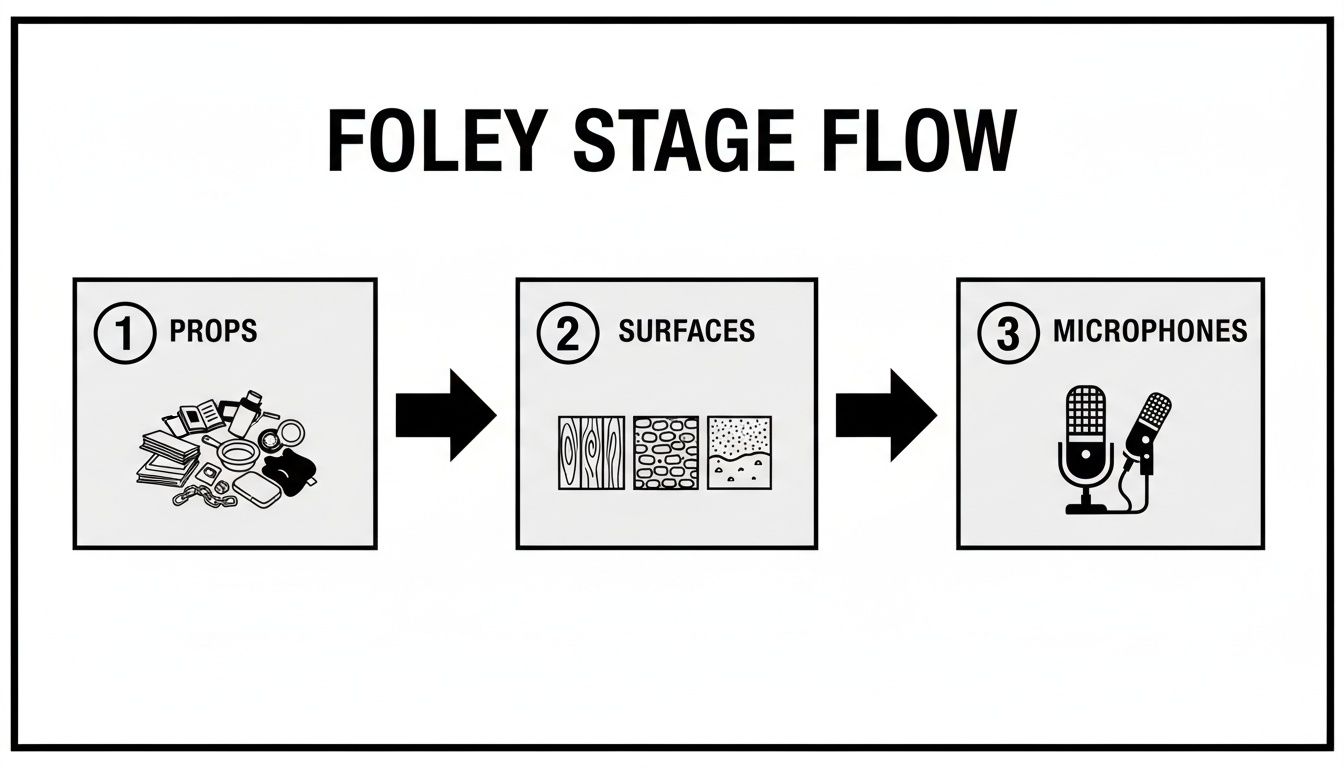
As you can see, the physical performance using props is the heart of it all, with the microphones being the final step to capture that performance as audio.
Recording in layers this way gives the sound mixer ultimate flexibility. They can adjust the volume of the footsteps, the cloth, and the props independently to get the perfect balance against the dialogue and music.
Every single sound is performed with incredible precision. For a frantic chase scene, the artist isn’t just walking quickly on the spot. They are genuinely running, breathing heavily, and physically conveying the character’s panic and exhaustion through their performance.
The real art of Foley is in the performance. A Foley artist doesn’t just copy a sound; they interpret the character’s emotions and intentions, turning them into an audio experience that pulls the audience deeper into the story.
It’s this meticulous detail—the blend of careful planning, creative thinking, and raw physical effort—that defines the craft. It’s how a visually complete scene becomes a living, breathing world, brought to life one sound at a time.

The real magic of what a Foley artist does comes down to their incredible, almost deceptive creativity. They’re masters of auditory illusion, working from a core principle: what something looks like on screen is rarely what it sounds like in real life. Their job is to find the perfect sonic match, even if it comes from a completely unexpected source.
This is where the artistry truly shines. Foley is a craft built on endless experimentation, a deep understanding of acoustics, and a studio filled with seemingly random junk. The goal isn't just to match an action on screen but to create a sound that feels emotionally right for the scene.
A Foley artist’s toolkit is packed with clever tricks designed to fool our ears into believing the impossible. This isn't about just grabbing a pre-recorded sound effect; it’s about physically performing a new one, often with a bizarre prop. This hands-on performance is a vital part of the entire audio post-production workflow, ensuring every single sound feels custom-made for the picture.
Here are a few classic examples of this ingenuity in action:
These techniques point to a fundamental truth in sound design: authenticity is all about perception, not reality. The Foley artist’s only job is to sell the illusion to the audience.
Every scene is a new puzzle to solve. How do you create the sound of a giant alien’s slimy footsteps? What does a magical spell sound like as it fizzles out? A Foley artist has to think like an inventor, constantly playing with different materials and textures to find the answer.
The most successful Foley artists are sonic chameleons. They can listen to the world, deconstruct its sounds into core components—like texture, impact, and resonance—and then rebuild them from the most unlikely sources.
This process is full of trial and error. An artist might test dozens of objects before landing on the one that sounds just right. For instance, creating a believable rainstorm might involve layering several different performances:
By layering these distinct textures, they can build a rich, complex, and totally believable soundscape from the simplest household items. It’s this unique blend of creativity, resourcefulness, and performance that makes the Foley artist such an essential storyteller in the world of audio.
The hands-on, deeply personal craft of a Foley artist is something special, and it's not going anywhere. But like every creative field, technology is opening up some fascinating new doors. Artificial intelligence and modern digital tools aren't here to replace the artist—they're here to expand the toolkit, offering new ways to work and create.
For big-budget Hollywood films, there's still no substitute for handcrafted Foley. The emotional weight and subtle imperfections a talented artist brings to a performance are what create that truly premium, believable soundscape. But the world of audio production is getting bigger and moving faster.
The global market for Foley and related services was already valued at over USD 1.3 billion in 2024, and it's only growing thanks to the explosion of streaming, animation, and gaming. While the top-tier projects will always invest in traditional Foley, a huge part of the market needs sound created quickly and affordably.
This is where AI-powered tools are really starting to shine. For indie filmmakers, solo game developers, and YouTube creators, text-to-sound generators are an absolute game-changer, giving them access to custom sounds without booking a pricey Foley stage.
This kind of tech closes the gap between a professional sound studio and a creator working on a tight budget. Suddenly, custom sound design is within reach for almost everyone.
AI isn't the end of Foley; it's an expansion of the toolkit. It allows creators to generate specific, royalty-free effects on demand, freeing up Foley artists to focus on the key performance moments that truly matter.
Instead of a replacement, we're seeing a new partnership form between traditional Foley and AI. A Foley artist might use an AI tool to quickly generate a few layers of background ambience or some generic prop sounds. That frees them up to spend their valuable time and energy perfecting the really important stuff—the main character’s footsteps, the rustle of their clothing, and the key movements that tell the story.
You can learn more about how this works in our guide on using an AI sound effect generator.
And it's not just about creation. AI is also making the post-production process much smoother. For instance, artists can now use AI-powered audio cleaning tools for clearer sound to instantly scrub background noise from their recordings.
This hybrid approach—blending authentic human performance with the speed of AI—is redrawing the boundaries of what a Foley artist can do, unlocking incredible creative potential for projects of any size.
The world of Foley is one of those fascinating, behind-the-scenes corners of filmmaking that’s full of creative hacks and incredible skill. Once you learn about it, you start to have a lot of questions. We’ve rounded up some of the most common ones to give you a clearer picture of this unique profession.
From how much you can earn to the first steps for getting started, think of this as a practical look into the life of a Foley artist.
This is a classic "it depends" situation. A Foley artist's salary can swing pretty wildly based on their experience, where they live, and whether they're in a union. The pay for a blockbuster studio film is going to be a lot different than for a small indie project.
For established, union professionals working in major hubs like Los Angeles or New York, the pay is quite good. Union rates often land in the $2,500–$2,800 per week range. If you can line up consistent, year-round projects, that could translate to an annual income of $130,000 to $145,000. On the other hand, non-union daily rates are much lower, typically falling somewhere between $200 and $400.
The good news? The U.S. Bureau of Labor Statistics projected a 29% jump in jobs for film and video editors between 2020 and 2030, which points to healthy growth for all sound professionals as streaming services keep churning out content. You can dig deeper into Foley artist salary expectations on Indeed.com.
It's easy to get these two mixed up, but their jobs are very different, even though they both work to build a film's sonic world.
A Foley artist is, at their core, a performer. Their job is to watch a scene and perform all the custom, synchronized sounds that the characters make in real-time. We're talking about the human stuff: the sound of footsteps, the rustle of a jacket, or the clink of a coffee mug being set down.
A Sound Designer, by contrast, is the architect of the entire soundscape. Their role is much, much broader. They are responsible for things like:
The simplest way to think about it is this: The Foley artist performs the small, organic, human sounds live on a stage. The sound designer builds the entire sonic universe around them.
You won't find many university degrees in Foley. This is a craft learned through practice, a keen ear, and a whole lot of hands-on experimentation. The first step is simple: just start listening. I mean really listening. Pay attention to the sounds you make every day. What does your shoe sound like on concrete versus on a wood floor? How does a cotton shirt rustle differently from a leather jacket?
Once you start noticing those details, it’s time to get your hands dirty. You don't need a high-end studio to begin.
The best way forward is to start building a portfolio of short scenes you've "Foleyed" yourself. It’s the perfect way to show you have the unique mix of creativity and technical skill this job demands.
Ready to generate custom sounds for your own projects instantly? SFX Engine offers a free, AI-powered tool to create unique, royalty-free audio effects with simple text prompts. Elevate your films, games, or podcasts by visiting https://sfxengine.com and start creating today.