January 1, 2026 · Kuba Rogut
Sound effects are the unsung heroes of game design. They're the invisible threads that weave together a game's world, providing critical feedback, guiding our every move, and forging a real emotional connection with what's happening on screen. SFX aren't just background noise; they're the lifeblood that turns a collection of pixels into a living, breathing experience.
Ever tried playing your favorite game on mute? The most intense boss fights suddenly fall flat. The world feels strangely empty, almost sterile. You start missing crucial cues that could make or break your strategy. That's because incredible audio design is what separates a good game from a truly unforgettable one.
Sound effects are a direct line of communication between the game and the player, often delivering information faster than any visual ever could. Think about it: the soft click of a hidden lever, the guttural growl of an enemy just around the corner, or the triumphant chime of a level-up—these are all meticulously designed pieces of information that shape your entire experience.
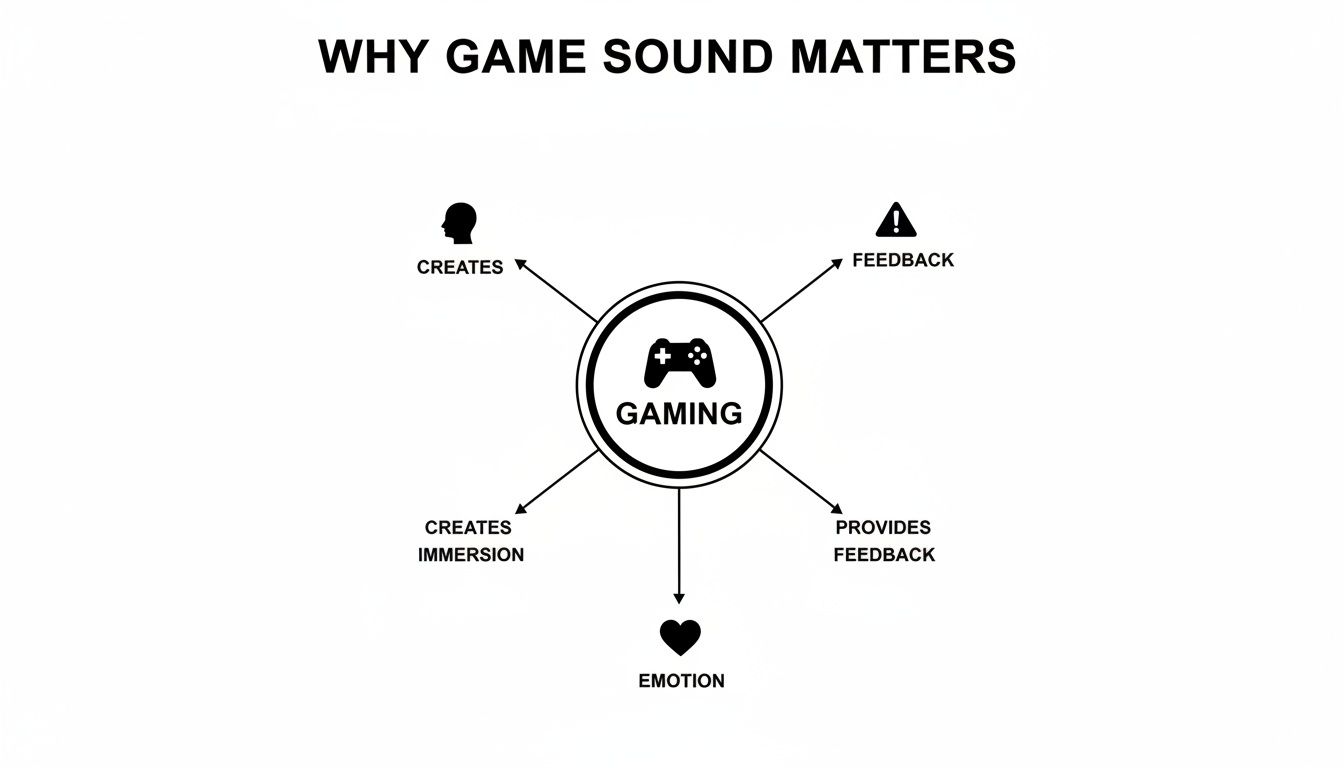
As the diagram shows, these three pillars—immersion, feedback, and emotion—work in concert to build a compelling and cohesive world. This makes sound effects an absolutely indispensable part of modern game development.
The power of sound is deeply psychological. It bypasses our rational brain and taps straight into our instincts, triggering immediate, visceral reactions. When a game's audio is dialed in perfectly, the effect is undeniable.
Let’s break down the main functions of SFX into a simple table to see how they directly shape the player's journey.
| Function | Impact on Player Experience | Example |
|---|---|---|
| Immersion | Makes the game world feel real, tangible, and believable. | The sound of rain hitting a tin roof, distant city sirens, or footsteps crunching on snow. |
| Feedback | Confirms player actions and communicates game states instantly. | The satisfying thwack of a successful melee hit or the jarring buzz of a failed puzzle attempt. |
| Guidance | Subtly directs player attention and signals important events or dangers. | A faint, ominous hum that grows louder as you approach a hidden threat or a treasure chest's glow. |
| Emotion | Sets the mood and drives the player's emotional response to the narrative. | A tense, low-frequency drone during a stealth section or a bright, cheerful melody in a safe town. |
Each of these roles is essential for creating a game that feels complete and polished. They work together to pull the player deeper into the experience, making every moment more meaningful.
To truly appreciate the artistry of game audio we've discussed, having quality gear is a must. You can find a range of essential gaming accessories, especially good headphones, that will bring out the rich, immersive soundscapes of modern titles.
Sound effects are the unseen architects of a game's world, creating an atmosphere that visuals alone simply can't touch. Think of them as auditory scenery—the sonic paint that turns a static environment into a living, breathing place.
The foundation is built with ambient sounds. The whisper of wind through a forest, the deep thrum of a starship's core, the distant clamor of a medieval market—these are the subtle layers that convince our brains we are actually there. They're not always in the spotlight, but their impact is huge.
While ambient audio sets the scene, it’s the small, intimate sounds—often called Foley effects—that truly sell the illusion. These are the everyday noises we barely notice in real life, but their absence in a game creates an eerie, disconnected feeling.
Take the simple act of walking. The crunch of boots on gravel tells a completely different story than the soft pad of footsteps on a carpeted floor or the metallic clang in an industrial corridor. Every sound reinforces the player’s physical connection to the world, making their presence feel real and tangible.
These subtle audio details are the key to achieving "presence," that magical state where the line between the player and the character starts to fade. Without them, you’re just a spectator looking at a screen.
This is precisely why sound effects matter in games so much. They don’t just show you a world; they make you feel like you’re a part of it.
A truly immersive soundscape is never static. It reacts, changes, and tells its own story. In The Last of Us, the oppressive silence is frequently broken by the terrifying clicks of a distant Infected, immediately cranking up the tension and warning you of a threat you can't even see. The world itself is communicating.
Subnautica is another perfect example. Its underwater world is a symphony of atmospheric audio—the muffled gurgles, the haunting calls of alien creatures echoing from the deep, and the groan of your submarine under pressure. The sound design creates a powerful mix of awe and absolute dread. It's not just background noise; it's an active character. If you're curious about how these experiences are crafted, you can dive deeper into the various elements of sound in game design.
Building a world with sound is all about layering these different elements to create a rich, convincing whole:
When these pieces come together, a game world stops being a place you visit and becomes a place you inhabit.

While immersive soundscapes pull us deep into a game's world, sound effects serve a much more practical purpose: they're a fundamental part of the gameplay itself, directly shaping a player's skill and success. In competitive games, audio isn't just about atmosphere—it's raw information.
You can almost think of SFX as a sixth sense. The tell-tale click of an enemy reloading, the faint whoosh of an incoming arrow, or the subtle beep of a hidden mine are all critical pieces of data. Our brains process these audio cues almost instantly, giving us the chance to make split-second decisions that visuals alone simply can't support.
High-stakes competitive games like Valorant and Call of Duty are built from the ground up on this principle. The entire gameplay loop banks on players using precise audio information to get a tactical leg up. A player's ability to pinpoint an opponent’s location by the sound of their footsteps is just as vital as their aim.
This transforms sound design from a purely artistic choice into a genuine performance-enhancing tool. Players aren't just hearing the game; they are actively using its sounds to anticipate threats, coordinate with their team, and ultimately, secure a win.
Sound effects turn a player from a passive observer into an active participant who can react to dangers they can't even see. This is why sound effects matter in games: they provide an invisible layer of information that sharpens instincts and rewards situational awareness.
And this isn't just a feeling players have. Research backs it up. A landmark 2007 study on the classic shooter DOOM discovered that gamers scored nearly twice as many points when playing with the game’s sound on—weapon fire, enemy screams, and all—compared to playing in total silence. It’s a clear demonstration of how audio dramatically affects player performance, sharpening reactions and embedding threat cues into muscle memory.
Certain sounds have become standard for driving player performance and giving crucial feedback when things get heated.
Every one of these sounds is deliberately designed to be instantly recognizable, even in the middle of a chaotic firefight. For serious players, learning to listen for and interpret these cues is a massive part of climbing the skill ladder. If you're building a game, our guide on sound design tips for game developers can help you craft audio that truly makes a difference.
It turns out that great sound design does more than just pull you into the game world; it taps directly into your brain's reward system. Game developers have become masters of auditory psychology, using specific sounds to hook us, create addictive feedback loops, and keep us coming back for more. These carefully designed SFX are a huge reason why sound effects matter in games, turning simple button presses into genuinely satisfying moments.
Think about the triumphant fanfare when you level up or the classic cha-ching of grabbing coins. These aren't just fluff. They’re engineered to trigger a tiny release of dopamine, the chemical that makes us feel good. It’s a simple but powerful form of positive reinforcement that conditions us to repeat the action that earned the reward.
The same principle works in reverse, too. That dissonant crunch when you take damage or the grating buzz of a wrong answer creates a negative feedback loop. Our brains are wired to avoid things that sound unpleasant, making SFX a surprisingly effective way to teach game mechanics without ever showing a single line of text.
This entire system of audio conditioning is built on a straightforward idea: reward good actions and discourage bad ones. Designers have a whole palette of sonic textures they use to guide us.
Positive Reinforcement: Crisp, melodic, or resonant sounds signal success. That sparkling jingle when you solve a puzzle or the chunky, satisfying thwack of a critical hit? That’s your brain getting a little audio cookie, confirming you did something right.
Negative Reinforcement: Abrasive, discordant, or flat sounds tell you you've messed up. A dull thud when your attack gets blocked or a low hum that signals danger are clear cues to change your strategy.
It's a remarkably effective way to teach. A well-designed soundscape can subtly show a player the rules of the game, making the learning process feel natural and intuitive instead of like a boring tutorial.
This psychological hook has a real, measurable impact on player retention—especially in the fast-paced world of mobile gaming where every second of engagement matters. Take Clash of Clans, a game with over 500 million downloads. The triumphant trumpet blasts after a victory do more than just celebrate a win; they amplify your sense of achievement and make you want to jump right into another match.
The data backs this up. Games with emotionally engaging audio can see player session times increase by up to 20-30%. All it takes is perfectly syncing rewarding actions with satisfying sounds, like the simple 'pop' of collecting a coin. If you want to dive deeper, you can learn more about how sound shapes game success on roggas.com. This proves that satisfying sounds aren't just a nice feature—they're a powerful business tool.
Knowing why sound effects are important is just the first step. The real challenge—and where the artistry comes in—is actually getting them to work inside the game itself. This is where creative vision meets technical execution, making sure every footstep, explosion, and whisper lands with perfect timing and clarity.
It all starts with the audio mix. Think of it like being the sound engineer at a live concert. You have dozens of instruments and vocals, and your job is to balance their volume levels so the audience can hear everything clearly. In a game, the "instruments" are the enemy gunfire, the character's dialogue, the swelling musical score, and the chirping birds in the background. A good mix ensures the most vital information—like an incoming threat or a critical alert—punches through the noise.
To create truly iconic sounds, designers rarely use a single recording. Instead, they rely on a technique called layering. That terrifying monster roar you hear? It probably isn't just one sound. It might be a lion's growl pitched down, combined with the screech of scraping metal and a deep, gut-rumbling bass frequency. Layering is how designers craft a sonic signature that is entirely unique to their world.
But the real magic isn't just in the sounds themselves, but in how they react to the player. Modern games don't just play static audio clips; they use dynamic systems to make the world feel genuinely alive.
A dynamic audio system is what makes a game world feel truly interactive. It’s the difference between a static backdrop and a living environment that acknowledges the player's every action and location.
This is the system that automatically muffles everything the moment you dive underwater. It’s what seamlessly changes your character's footsteps from a soft thump on grass to a sharp clack on a marble floor. By making the soundscape constantly adapt to what you're doing and where you are, the game maintains a deep, unbroken sense of immersion. This technical finesse is what turns a simple collection of sound files into a cohesive and unforgettable experience.
For most developers, finding the perfect sound effect feels like a needle-in-a-haystack problem. You can spend hours digging through massive, expensive audio libraries, only to find a sound that’s already been used in a dozen other games. The alternative—recording custom Foley from scratch—is a whole other beast, demanding specialized gear and serious expertise. It often feels like you have to choose between generic sounds or a busted budget.
This is where a unique audio identity really matters, and it’s a huge reason why sound effects matter in games. A generic sword clang gets the job done, sure. But a sound that's designed specifically for your game becomes part of its signature. Thankfully, you don't have to be a professional sound designer with a Hollywood-sized budget to make that happen anymore.
AI-powered sound generation has completely changed the game for creators. Instead of hunting for the right pre-made effect, you can now create brand-new, totally unique sounds just by typing what you want. Tools like SFX Engine put this power right at your fingertips, offering a nearly bottomless well of creative potential.
Want "a heavy, magical sword impact with a crackling energy finish"? Just describe it, and the AI will build it from the ground up. Need subtle variations for footsteps on gravel versus mud? You can generate dozens in seconds.
The screenshot below shows just how simple it is. You type in a text prompt, and the AI turns it into a ready-to-use sound file.
This kind of technology opens up high-quality audio design for everyone. It gives solo devs and small studios the ability to create a sonic landscape that can stand toe-to-toe with big-budget productions.
When you prioritize immersive audio, you're essentially getting a performance multiplier for your game. An AI tool can generate infinite royalty-free variations of everything from weapon clashes to ambient winds, all with commercial licenses included. For creators who need high-impact audio without the massive upfront cost, a flexible credit system makes it accessible. As you start building your audio assets, it's a good idea to keep them organized. You can get some great ideas by checking out a well-structured game sound effects library. This approach elevates the entire experience, ensuring every sound pulls the player deeper into the world you've built.
If you're just getting into game development, or even if you've been at it for a while, audio can seem like its own mysterious world. Let's clear up some of the most common questions people have about sound effects.
Think of it this way: music is the emotional wallpaper of your game. It sets the overarching mood—whether it’s epic, tense, or whimsical. It's the big picture.
Sound effects, on the other hand, are the interactive elements in the room. They’re the click of a switch, the thud of a closing door, the crunch of leaves underfoot. SFX are tied directly to what’s happening on screen, giving players tangible, real-time feedback. You need both to make a world feel complete.
In today's competitive market? It’s a massive uphill battle. A game without sound is just a collection of silent animations. It completely guts the experience of its soul.
Players rely on audio for crucial gameplay cues, and without it, the world feels hollow and dead. Bad sound can make an otherwise brilliant game feel cheap, unfinished, or just plain frustrating.
Neglecting audio is like filming a blockbuster movie in complete silence. It fundamentally misunderstands what makes the experience powerful and pulls people in.
More than you'd think, even if it's subconscious. Most players won't sit there and consciously analyze the sound of a footstep on gravel, but their brains are absolutely processing it. That single sound tells them about the environment, their character's speed, and maybe even what’s lurking nearby.
It's one of those things you don't notice until it's bad, or missing entirely.
Interestingly, while plenty of people play with the volume down, the players who leave it on are often your most dedicated fans. Research shows that while only 8% of players keep the game audio fully on, these are the same users who are 2-3 times more likely to play every day. They also tend to have 20-40% longer sessions. That engagement often translates to more in-app purchases, too. You can dig into the numbers yourself and see how sound preferences impact player engagement on tapresearch.com.
There are a few well-trodden paths for sourcing audio, and each has its own trade-offs.
Ready to stop searching for the perfect sound and start creating it? With SFX Engine, you can generate endless, high-quality, and commercially licensed sound effects from simple text prompts. Give your project the unique audio it deserves. Try it for free today at https://sfxengine.com.