January 24, 2026 · Kuba Rogut
If you're serious about podcasting in 2026, you know that your microphone isn't just a piece of gear—it's the heart of your sound. Getting it right often comes down to a balance between pure vocal quality and how easily the mic fits into your workflow. Names like the Shure MV7+, Rode PodMic USB, and Universal Audio Sphere DLX are all over the best-of lists for a reason, but they serve very different masters. One is a plug-and-play powerhouse, another is a workhorse for busy setups, and the last is a sound-shaper’s dream. The best choice for you really hinges on your recording space and how you like to work.
Let's be blunt: choosing the right microphone is the single biggest decision you'll make for your podcast's audio. By 2026, the days of "good enough" audio are long gone. The market is flooded with fantastic options for every kind of podcaster, whether you're a solo storyteller in a treated closet or part of a lively multi-host show. Your listeners have come to expect rich, clear sound, and your mic is the first step in delivering that.
This isn't just anecdotal, either. The entire industry is leveling up. The podcast equipment market was valued at $3.7 billion in 2025 and is on track to hit $7.2 billion by 2033. That growth is fueled by creators investing in better gear to stand out in a crowded space. You can dig into the numbers and trends over at htfmarketinsights.com.
My goal here is to cut through the noise and technical specs. I'll help you focus on the differences that actually make a difference for your show.
Before we dive deep into the reviews, this table is your cheat sheet. I’ve laid out my top picks to give you a quick sense of where each one fits, so you can immediately see which models might work for your setup and budget. Think of this as your starting point for finding the best microphones for podcast 2026.
Your microphone is not just a piece of equipment; it's the bridge between your voice and your listener's ear. Selecting the right one ensures your message is heard exactly as you intend, without distractions from poor audio quality.
Here’s a quick-glance comparison of the models you should have on your radar this year.
| Microphone Model (2026 Edition) | Type (USB/XLR) | Best For | Price Tier | Key Differentiator |
|---|---|---|---|---|
| Shure MV7+ | Hybrid (USB/XLR) | Solo hosts & streamers | Mid-Tier | Onboard DSP and Auto Level Mode |
| Rode PodMic USB | Hybrid (USB/XLR) | Multi-host setups | Budget-Friendly | Excellent off-axis noise rejection |
| Neumann U 87 Ai | XLR (Condenser) | Professional studio narration | Premium | Unmatched vocal warmth and detail |
| Universal Audio Sphere DLX | XLR (Condenser) | Advanced audio producers | High-End | 38 classic mic emulations |
| Samson Q2U | Hybrid (USB/XLR) | Beginners on a budget | Entry-Level | All-in-one value package |
This table gives you the 30,000-foot view. Now, let’s get into the specifics of what makes each of these microphones a worthy contender.
Before you can pick the right microphone for your podcast in 2026, you need to get a handle on the tech that makes them tick. This isn't about memorizing specs; it's about understanding how a mic's design will actually perform in your specific recording space and fit into your workflow. Get this part right, and you’ll save yourself a ton of headaches in editing.
Let's start with the classic dilemma every podcaster faces: dynamic versus condenser. People often ask which is "better," but the real question is, which one is right for your room?
Dynamic microphones are the workhorses of the podcasting world, and for good reason—they're incredibly forgiving. Think of them as being laser-focused, designed to capture sound from directly in front of them while rejecting a lot of the noise from the sides and back.
This makes them a lifesaver in untreated spaces, like your spare bedroom or home office. They’ll help isolate your voice from the hum of your computer fan, the rumble of an air conditioner, or the natural echo of your walls. If your recording environment is less than perfect, a dynamic mic is your best friend.
On the flip side, condenser microphones are all about sensitivity. They are engineered to capture a wide range of frequencies with stunning detail and nuance, which is why they’re the go-to choice in professional recording studios for both music and voice-over. This sensitivity gives vocals a crisp, airy quality that sounds fantastic.
But that sensitivity is also their Achilles' heel in a typical home podcasting setup. A condenser mic hears everything—the refrigerator humming down the hall, the traffic outside, and every tiny reflection of sound in your room. To get the most out of them, they really need a quiet, acoustically treated space to shine.
For most podcasters starting out or recording in a standard room, a dynamic microphone is the safer, more practical choice. It provides a clean, broadcast-ready sound with minimal fuss, directly addressing the most common audio challenge: background noise.
The next big decision is how the microphone connects to your recording device. For years, the rule was simple: USB for beginners, XLR for pros. By 2026, those lines have blurred completely.
Here’s a more modern way to look at it:
Many of the best microphones for podcast 2026 are now hybrid models, offering both USB and XLR outputs on the same device. This gives you the best of both worlds: USB for quick solo sessions and XLR when you need to integrate into a bigger studio setup. To really get a grip on modern mic tech, it helps to understand the basics of how sound becomes data, like how VoIP technology converts voice into digital data.
The single biggest leap forward in microphone tech lately has been the integration of Digital Signal Processing (DSP) and AI-powered tools right inside the mic itself. This is a massive game-changer for podcasters.
These "smart" mics can now handle tasks in real-time that used to require hours of work in post-production. We’re talking about features like AI-driven noise reduction that intelligently filters out background sounds, automatic level adjustment to prevent clipping, and onboard EQs to shape your tone. This tech dramatically cuts down on editing time and makes it easier than ever to capture polished, professional audio from the moment you hit record.
Alright, let's get past the spec sheets and dive into how these top contenders actually perform head-to-head. Picking one of the best microphones for podcast 2026 isn’t about finding a single "best" mic—it's about finding the right mic for your voice, your recording space, and the style of your show. We're going to focus on the things that make a real difference during your daily recording grind.
We'll be looking at vocal warmth, how well a mic ignores annoying background noise, its build quality, and how painless it is to get set up and sounding great. This practical approach is what really matters. After all, the demand for high-quality gear is exploding, with the microphone market projected to grow from $3.69 billion this year to a staggering $5.41 billion by 2032. That growth is fueled by creators like you who are pushing for better sound.
Shure took what everyone loved about the original MV7 and cranked it up a notch. The MV7+ has cemented its place as the workhorse for solo podcasters and streamers who need both pro-quality sound and dead-simple operation. Its biggest advantage is the dual USB/XLR output, which gives you a clear upgrade path. Start by plugging it straight into your computer, and when you're ready, you can run it through an audio interface.
But the real secret sauce is the upgraded Digital Signal Processing (DSP). Think of the Auto Level Mode as a tiny audio engineer living inside your mic. It intelligently rides the gain for you, preventing nasty digital clipping if you get excited and boosting your levels if you lean back from the mic. For anyone streaming live or who wants to spend less time editing, this feature is an absolute lifesaver. It just works.
The Bottom Line: The Shure MV7+ is for creators who want to hit "record" and trust that their audio will sound polished and professional without a ton of fiddling. It lets you focus on your content, not your gear.
Rode gets podcasters. They know most of us aren't recording in a perfectly-tuned studio, and the PodMic USB is built for that reality. This dynamic mic was engineered from the ground up to make your voice sound amazing, even if your "studio" is just a spare bedroom with a bit of echo.
How does it do it? Its tight cardioid pickup pattern is incredibly good at rejecting sound from the sides and rear. In plain English, it hones in on your voice and ignores the hum of your computer, the clack of your keyboard, and the reverb bouncing off your walls. This is also a massive advantage for multi-host shows in the same room, as it drastically reduces the "mic bleed" where you hear your co-host faintly in your own audio track. Plus, its all-metal body feels like a tank.
For the audio nerds and perfectionists out there, the Universal Audio Sphere DLX is less a microphone and more of an entire vintage mic collection in a single body. This isn't your simple plug-and-play USB mic; it's a sophisticated modeling system that connects to an audio interface via XLR.
Its magic comes from a dual-capsule design that allows it to precisely emulate the distinct character of 38 legendary microphones. Need the warm, pillowy tone of a Neumann U 47 for a storytelling podcast? Done. Want the crisp, modern sound of a Sony C-800G for a voice-over? It's just a click away in the software. Best of all, it gives you insane flexibility, letting you change your mic model—and even the polar pattern—after you’ve finished recording.
The Bottom Line: The Sphere DLX offers unrivaled sonic flexibility. It’s for advanced podcasters who want to meticulously sculpt the perfect vocal tone for every project without spending tens of thousands on physical microphones.
There's a reason you see the Neumann U 87 Ai in virtually every high-end recording studio on the planet. For capturing the pure, unadulterated human voice, its performance is simply iconic. This large-diaphragm condenser mic grabs every subtle detail, every bit of texture, and all the richness that makes a solo narration or audiobook truly come to life.
But that incredible sensitivity is a double-edged sword. The U 87 Ai will make your voice sound incredible, but it will also pick up the sound of a pin dropping two rooms away. This mic is exclusively for creators recording in a silent, acoustically treated space. It's a serious investment in uncompromising audio quality, aimed squarely at those whose final product is defined by pristine, intimate vocal performance. For anyone bringing video into the mix, our guide on the best microphone for video recording can help you navigate how those needs differ.
To cut through the noise, this table shows how these mics stack up in the real world. It moves beyond specs to compare how they perform in common podcasting environments, helping you choose based on your actual recording situation.
| Microphone Model | Untreated Room Performance | Solo Narration Clarity | Multi-Host Crosstalk Rejection | Live Streaming Suitability |
|---|---|---|---|---|
| Shure MV7+ | Very Good | Excellent | Good | Excellent |
| Rode PodMic USB | Excellent | Good | Excellent | Very Good |
| UA Sphere DLX | Fair (Requires treated space) | Superior (with modeling) | Very Good (Pattern dependent) | Good (Requires interface) |
| Neumann U 87 Ai | Poor (Requires treated space) | Superior | Fair (High sensitivity) | Fair (High sensitivity) |
As you can see, the "best" microphone really depends on where and how you're recording. A mic that's legendary for studio narration like the U 87 Ai would be a frustrating choice for a live stream in a noisy room, where the Rode PodMic USB would shine.
Picking one of the best microphones for podcast 2026 isn't about finding a single "perfect" mic. It's about finding the right tool for your specific job. The microphone that works wonders for a solo narrator in a dead-quiet studio will probably be a disaster for a lively roundtable discussion. Your podcast's format is the single most important factor driving this decision.
The podcasting boom has led to some incredible microphone tech, with specialized gear for pretty much every situation you can imagine. The global market for podcasting mics hit a $500 million valuation back in 2025 and is on track to grow by 15% CAGR through 2033. With listenership expected to reach 619.2 million worldwide by 2026, the competition for ears is fierce, and your audio quality has to be on point. You can dig into more of this data over at Archive Market Research.
To make things easier, think of it like this:
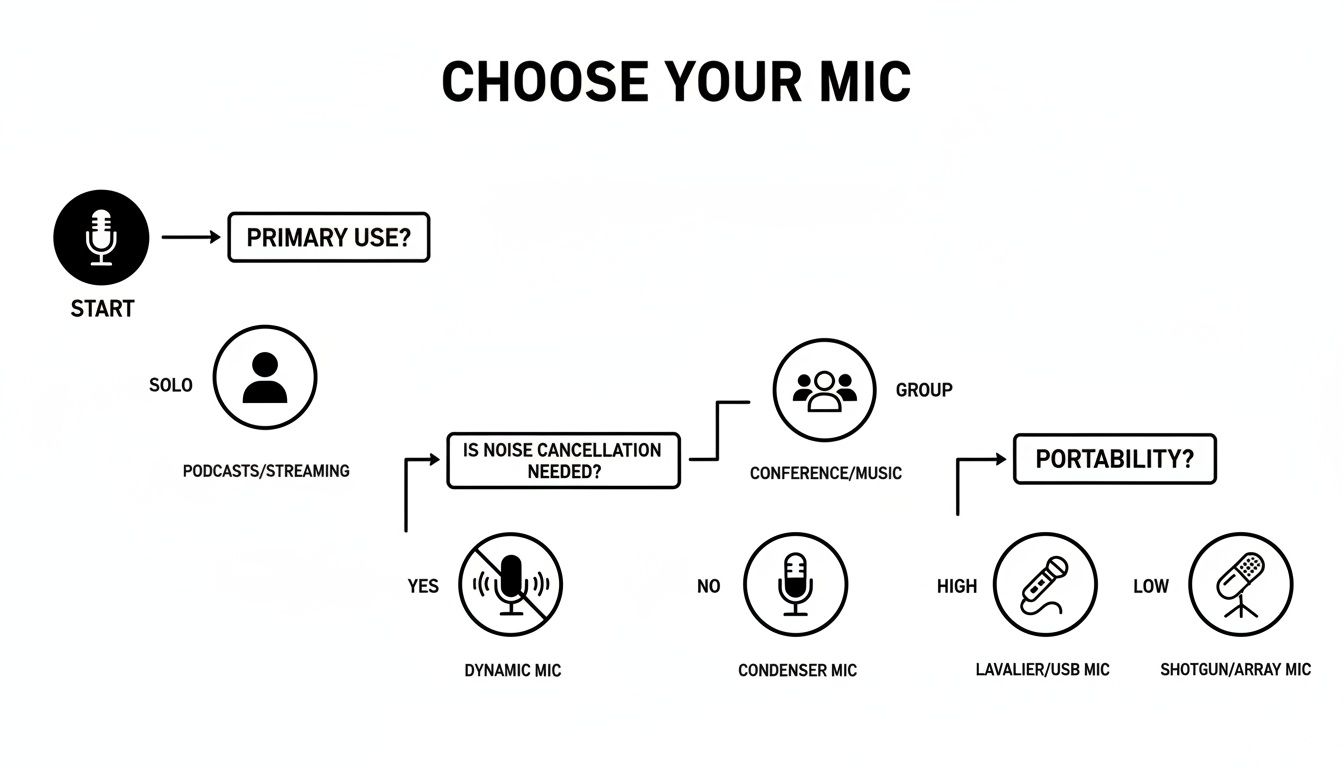
As you can see, the first question you need to answer is simple: are you recording alone or with other people? That one answer will immediately point you in the right direction.
If it's just you in a home office, treated closet, or any quiet room, your main goal is capturing all the richness and detail in your voice. This is where a great USB condenser microphone shines. Its sensitivity is a huge advantage here, picking up the subtle tones that make your delivery sound intimate and professional.
That sensitivity comes with a catch, though. You absolutely need a controlled environment. Before you spring for a condenser mic, make sure your recording space is free of background noise like whirring computer fans, rumbling air conditioners, or traffic from the street outside.
Key Insight: For the solo podcaster, a USB condenser offers the most direct route to studio-quality sound. You get high-fidelity audio capture with simple plug-and-play convenience, no external audio interface or complicated setup required.
When your podcast has multiple people recording from different locations, the final audio is only as good as its weakest link. Consistency is everything. Here, the priority shifts from capturing every last nuance to achieving rock-solid noise isolation.
Each person on the show needs a mic that does a great job of rejecting room echo and background hum. Dynamic microphones, particularly models with both USB and XLR connections, are perfect for this. They give each host a simple setup while keeping their voice crisp and clear, which makes the editor's job a whole lot easier. You can find more practical advice in our guide on how to reduce background noise from a microphone.
Getting multiple people in the same room creates a classic audio problem: mic bleed. This is when one person's mic picks up the voices of the people next to them, creating a messy, echo-filled sound that's a nightmare to edit. The only real solution is to use microphones that are really good at rejecting sound from the sides.
For this kind of show, a set of matched dynamic XLR microphones is the undisputed industry standard. Each mic gets plugged into its own channel on an audio interface or mixer.
If you're a podcaster who records outside the studio, your gear needs to be tough, portable, and resistant to handling noise. The microphone has to survive being tossed in a bag and still capture clear audio in environments you can't control.
Your best bets are either compact dynamic mics or dedicated portable recorders with good built-in microphones. These devices are built to minimize the sound of bumps, movement, and wind. Many newer portable recorders also have a "safety track" feature, which records a backup version of your audio at a lower volume. This can be a lifesaver, preventing a sudden loud noise from ruining a perfect take.
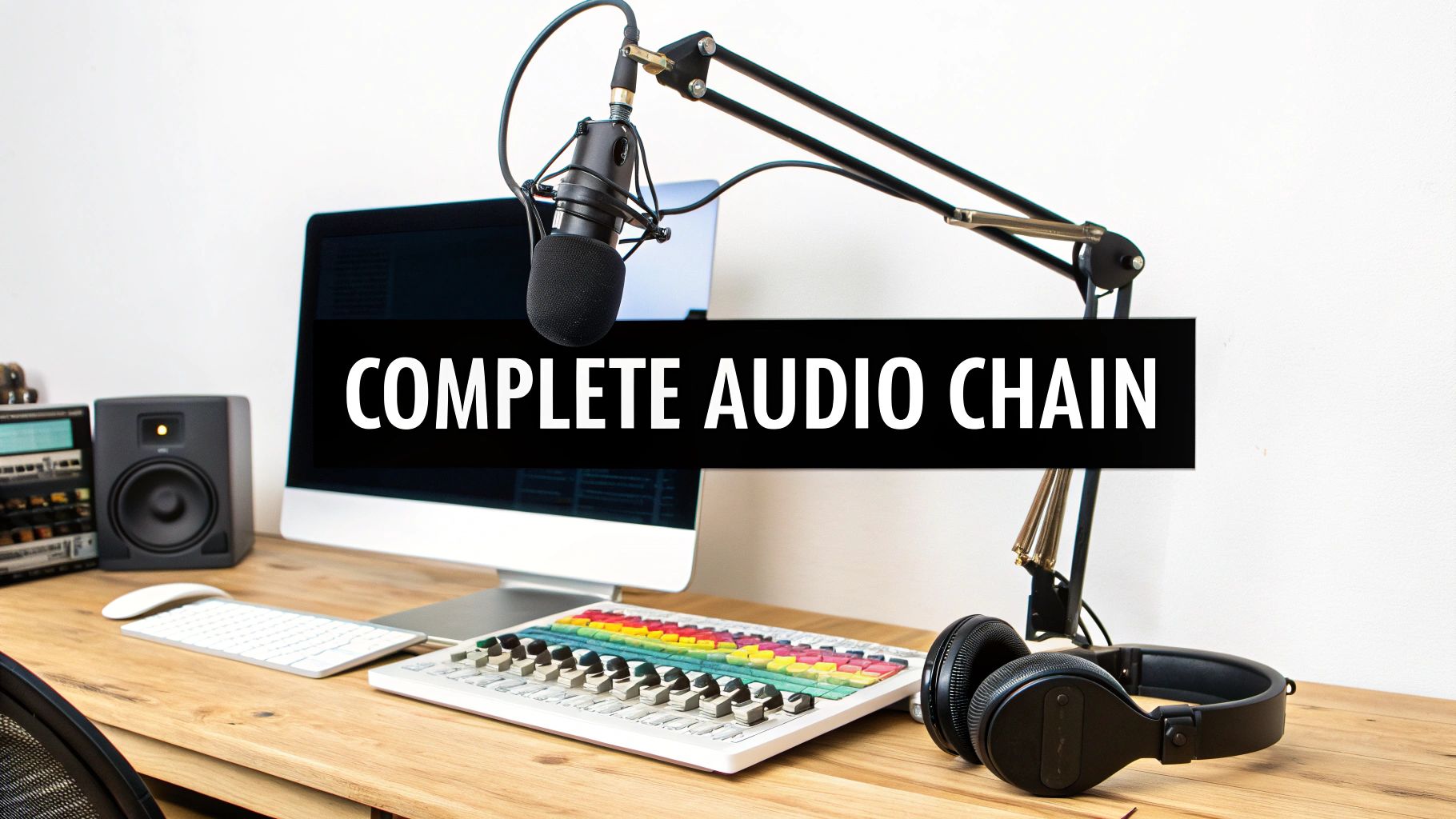
So, you’ve picked one of the best microphones for podcasting in 2026. That's a huge win, but it’s really just the starting line. A great microphone is only as good as the gear supporting it. Getting that clean, professional sound you hear on top shows is all about building a solid audio production chain, where every component works together.
Think of it like this: your microphone is the engine of a race car. It's got all the power, but without the right tires, suspension, and driver, you’re not winning any races. Your podcasting setup is the same—every piece of gear plays a role in delivering that final, polished product.
Let's get one thing straight: some accessories aren't just nice-to-haves; they're absolute necessities for broadcast-quality sound. They tackle the most common physical problems that ruin audio at the source, saving you a world of pain in post-production.
A pop filter is non-negotiable. This simple screen sits between you and the mic, softening the aggressive bursts of air from "p" and "b" sounds—the plosives that create those awful, jarring pops in your recording. Likewise, a shock mount is your mic's suspension system. It isolates it from vibrations coming through your desk or floor, killing the low-end rumble from a bumped table or footsteps.
And don't overlook the boom arm. It’s more than just a fancy stand. It lets you position the mic perfectly and keep it there, which is the secret to consistent audio levels. It also gets the mic off your desk, cutting down on even more vibration noise.
Your number one job during recording is capturing the cleanest audio possible. A pop filter and shock mount aren't for show; they're your first line of defense against the most common audio gremlins.
If you went with an XLR mic, you'll need an audio interface. This box is the crucial translator between your microphone's analog signal and your computer's digital world. More importantly, it contains a preamp to boost the mic's quiet signal to a healthy level and gives you a physical knob to dial in your recording volume, or gain.
When you're shopping for an interface, focus on the quality of the preamps—good ones give you a clean, noise-free boost. And if you're using a condenser mic, make sure the interface provides 48V phantom power.
Your headphones are just as important, but not for casual listening. You need a good pair of closed-back studio monitor headphones for two critical tasks:
Once you have that pristine audio recording, you've got the perfect canvas for creative post-production. This is your chance to transform a simple conversation into a true audio experience. For a more detailed guide on perfecting your recording environment, our article on how to build a home recording studio is a fantastic resource.
This is where your gear and your creativity finally meet. A tool like SFX Engine, for example, lets you easily generate custom, royalty-free sound effects and ambient tracks that fit your show's vibe perfectly. Imagine adding the low hum of a starship for your sci-fi podcast or the crackle of a fireplace for an intimate storytelling show. That's the kind of detail that makes your production sound incredible and keeps your listeners hooked.
Let's be honest, diving into the world of podcast gear can feel overwhelming. You're hit with specs, acronyms, and a ton of conflicting advice. Here are some of the most common questions I get from podcasters trying to find the right mic in 2026, answered straight up.
You don't have to, but if you're serious, it's where the magic really starts to happen. Once you cross that $200 threshold, you're not just paying for a brand name. You’re investing in noticeably better build quality, much-improved internal shock absorption (which kills those desk bumps), and a real step up in vocal clarity.
This is also the price point where we're seeing hybrid USB/XLR connectivity and solid onboard processing become standard. That kind of flexibility is a game-changer. For anyone building a show for the long haul, that investment means less time trying to fix noisy audio in post-production and more time creating great content.
Absolutely. Let's put an old myth to bed: the idea that "USB is for amateurs" is completely outdated. High-end USB mics today deliver audio quality that’s virtually indistinguishable from many XLR setups, especially for spoken word.
If you're a solo host or doing remote interviews, the plug-and-play simplicity of a premium USB mic is often the smartest choice. The key is to aim for a pro-grade model. They now come packed with features like zero-latency headphone jacks and powerful software controls, making them incredible all-in-one recording solutions.
For most podcasters, a top-tier USB microphone delivers fantastic audio without the extra cost and technical hurdles of an audio interface. It's the most direct route to professional sound for a huge number of creators out there.
Before you even think about upgrading your gear, take a hard look at your recording space. Your room is half the battle, and making a few simple tweaks here will give you a bigger bang for your buck than almost any new microphone.
If I had to pick just one, it's the polar pattern. While things like frequency response matter, the polar pattern dictates what the microphone actually hears. For podcasting, a cardioid pattern is king. It's designed to pick up sound directly in front of it while rejecting noise from the sides and back.
Think about it: this is exactly what you want. You need a mic that focuses only on your voice, not the hum of your computer, the air conditioner, or your dog walking around in the next room. A mic with a tight, clean cardioid pattern is your best defense against bad room acoustics and unwanted noise.
Ready to make your podcast sound incredible? With SFX Engine, you can create unique, royalty-free sound effects and background ambiences from a simple text prompt. Build the perfect sonic world for your show and give your production that professional edge. Try it for free and start designing your signature sound today.