How to Start a Podcast Your Complete Guide
Ready to launch your show? This guide on how to start a podcast covers everything from picking gear and recording to promotion and growth.
Kuba RogutPublished Updated 21 min read
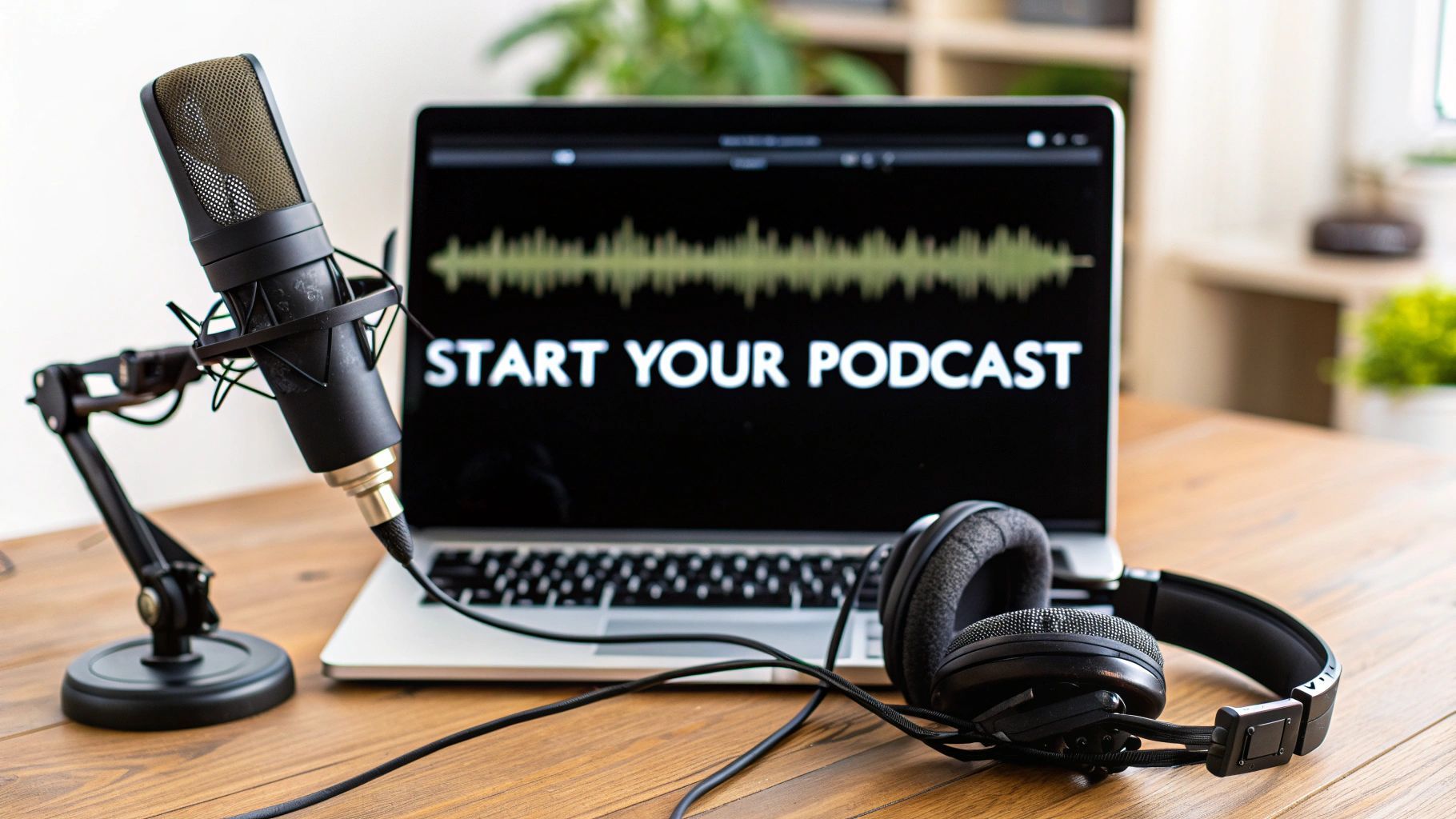
So, you've decided to start a podcast. The journey from a simple idea to a published show has a few key milestones: planning your concept, getting the right gear, recording and editing your audio, and finally, getting it out into the world.
Honestly, the most important work happens long before you hit the record button. Nailing down your plan from the start is what separates the podcasts that fizzle out from the ones that find a loyal audience.
Crafting Your Podcast Identity
Before you even glance at a microphone, you need a blueprint. What is your show really about? Who is it for? What will it actually sound like?
Skipping this foundational step is a classic rookie mistake. It’s like trying to build a house without architectural plans—it might look okay for a bit, but it’s destined to crumble. A clearly defined identity is your north star, guiding every decision you make and ensuring your show resonates with the right people from episode one.
Finding Your Unique Niche
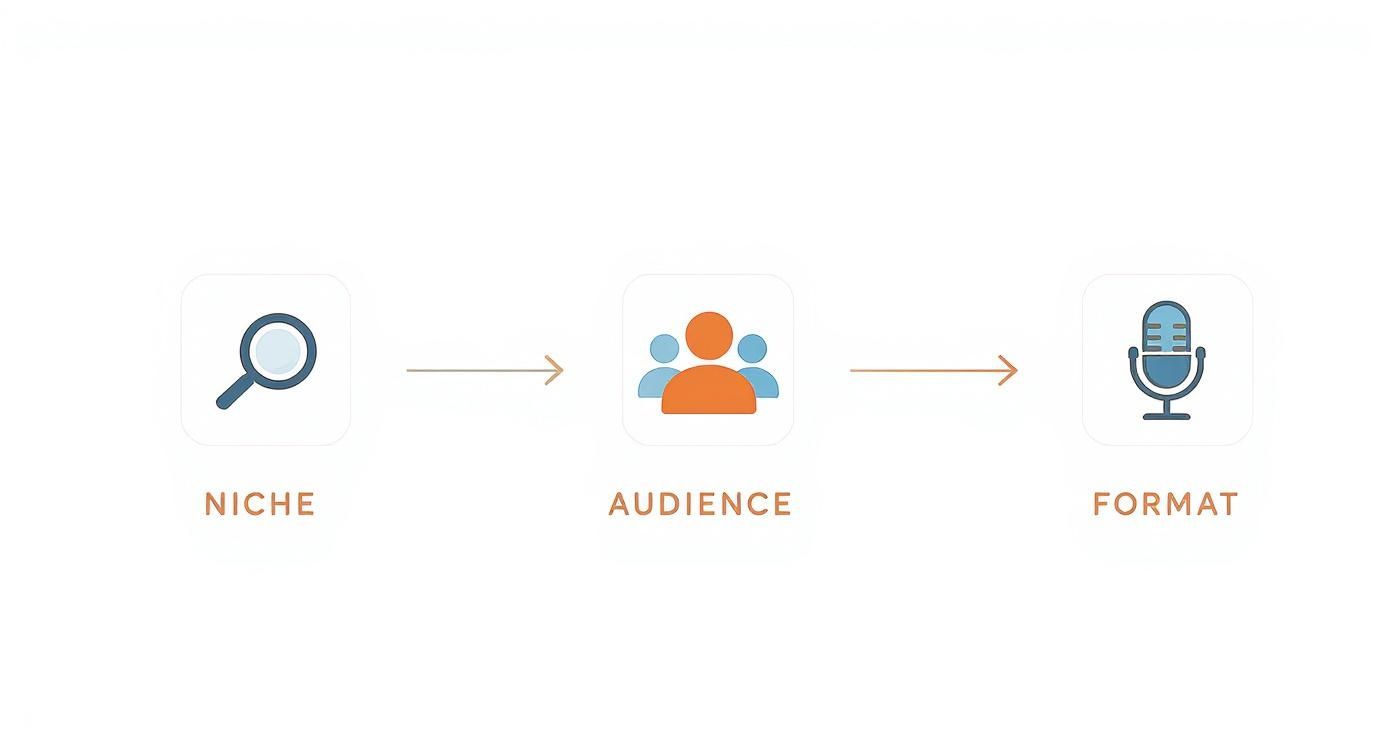
First things first, you need to find a niche you're genuinely excited about. Just as importantly, it needs to be a niche where an audience is already looking for content.
A generic idea like "a business podcast" is far too broad to gain any traction. You need to get specific. Are you making a podcast for freelance graphic designers struggling with client contracts? Or maybe it's for first-time SaaS founders trying to lock down their seed funding. That level of detail is your secret weapon.
A niche podcast doesn't just attract listeners; it attracts the right listeners. These are the people who will become your show's biggest advocates because your content speaks directly to their problems, interests, and passions.
To really zero in on your niche and understand the people in it, digging into some essential audience research tools is a game-changer. These platforms help you move beyond guesswork, giving you real data on what your potential listeners care about.
Defining Your Ideal Listener
Once you have a niche, it's time to create a detailed profile of your perfect listener—your "podcast avatar." Don't just stick to the basics like age and location. Go much deeper.
- What keeps them up at night? Think about their biggest frustrations and daily struggles that your podcast could help solve.
- What are their biggest goals? How can your show be the mentor or guide that helps them get where they want to go?
- Where do they spend their time online? This is pure gold for promotion later. Are they active in specific Reddit communities, LinkedIn groups, or niche forums?
- What other shows or creators do they follow? This gives you a ton of insight into their taste and what they expect from high-quality content.
When you know this person inside and out, creating content for them feels less like a chore and more like a conversation.
Choosing a Sustainable Show Format
Your format is the structure of your show. The most important thing is to pick something that fits your topic, your personality, and—crucially—your schedule. Be realistic about what you can commit to.
Here are the most common formats:
- Solo Host: You're the main event. This works brilliantly if you're an expert, teacher, or storyteller who can comfortably carry a show alone. The upside? Total creative freedom and simple logistics.
- Co-hosted Show: The magic here is the chemistry between two or more hosts. It's a natural fit for conversational shows, debates, or comedy where the back-and-forth adds a layer of entertainment.
- Interview Show: You feature guests who share their stories or expertise. This is a fantastic way to bring fresh perspectives to your audience and expand your professional network at the same time.
- Scripted Storytelling: Think narrative nonfiction, audio dramas, or deep-dive investigative journalism. These formats require a lot of production work but can create an incredibly immersive, "can't-stop-listening" experience.
To help tie all these ideas together, here's a quick look at the core decisions you'll be making.
Key Pre-Launch Decisions for Your Podcast
This table summarizes the essential elements you need to define before you even think about recording. Getting these right will give your show a clear focus and a much higher chance of success.
| Decision Area | Key Questions to Answer | Example |
|---|---|---|
| Podcast Niche | What specific topic will I cover? Who is this topic for? What unique angle or perspective can I offer? | Instead of "Marketing," a niche could be "Content Marketing Strategies for B2B SaaS Startups." |
| Ideal Listener | What are their demographics, goals, and pain points? Where do they get their information? What is their sense of humor? | "A 32-year-old freelance writer struggling to find high-paying clients and manage their finances." |
| Show Format | Will it be solo, co-hosted, interview-based, or scripted? How long will episodes be? How often will I publish? | "A 30-minute weekly interview show featuring successful indie game developers." |
| Content Pillars | What are the 3-5 core themes or categories my episodes will always revolve around? | For a wellness podcast: Nutrition, Mindfulness, Fitness, and Sleep Hygiene. |
| Unique Value Prop | In one sentence, why should someone listen to my show instead of another? What makes it different or better? | "The only podcast that provides actionable, 5-minute productivity hacks for busy working parents." |
| Show Name & Tone | Does the name reflect the content? Is it memorable and easy to spell? Is the tone authoritative, funny, empathetic, or raw? | A clever name like Financially Free-ish for a personal finance show with a humorous, relatable tone. |
Defining these elements upfront prevents you from drifting off-topic and helps you build a cohesive brand. A strong identity even informs your audio branding, which is a topic we cover in our guide to using sound effects for podcasts.
It's also worth thinking globally from day one. By 2025, podcasting is a truly international medium. Huge listener bases exist in countries like India (over 150 million monthly listeners), Brazil (50 million), and Nigeria (12 million). Being aware of these massive and growing markets might just influence your topic choice or cultural references, opening your show up to a much wider audience than you initially imagined.
2. Choosing Your Podcasting Gear and Software
Let’s be honest: your content can be groundbreaking, but if it sounds like you recorded it in a tin can, people will tune out. Instantly. Great audio isn't just a nice-to-have; it's the absolute bedrock of a professional-sounding podcast.
The good news? You don't need to remortgage your house to sound incredible. The world of podcasting gear can feel like a rabbit hole of technical jargon, but it really just boils down to a few key decisions. Our goal here is simple: capture your voice with warmth and clarity so your audience can focus on your message.
Your Microphone: The Heart of Your Setup
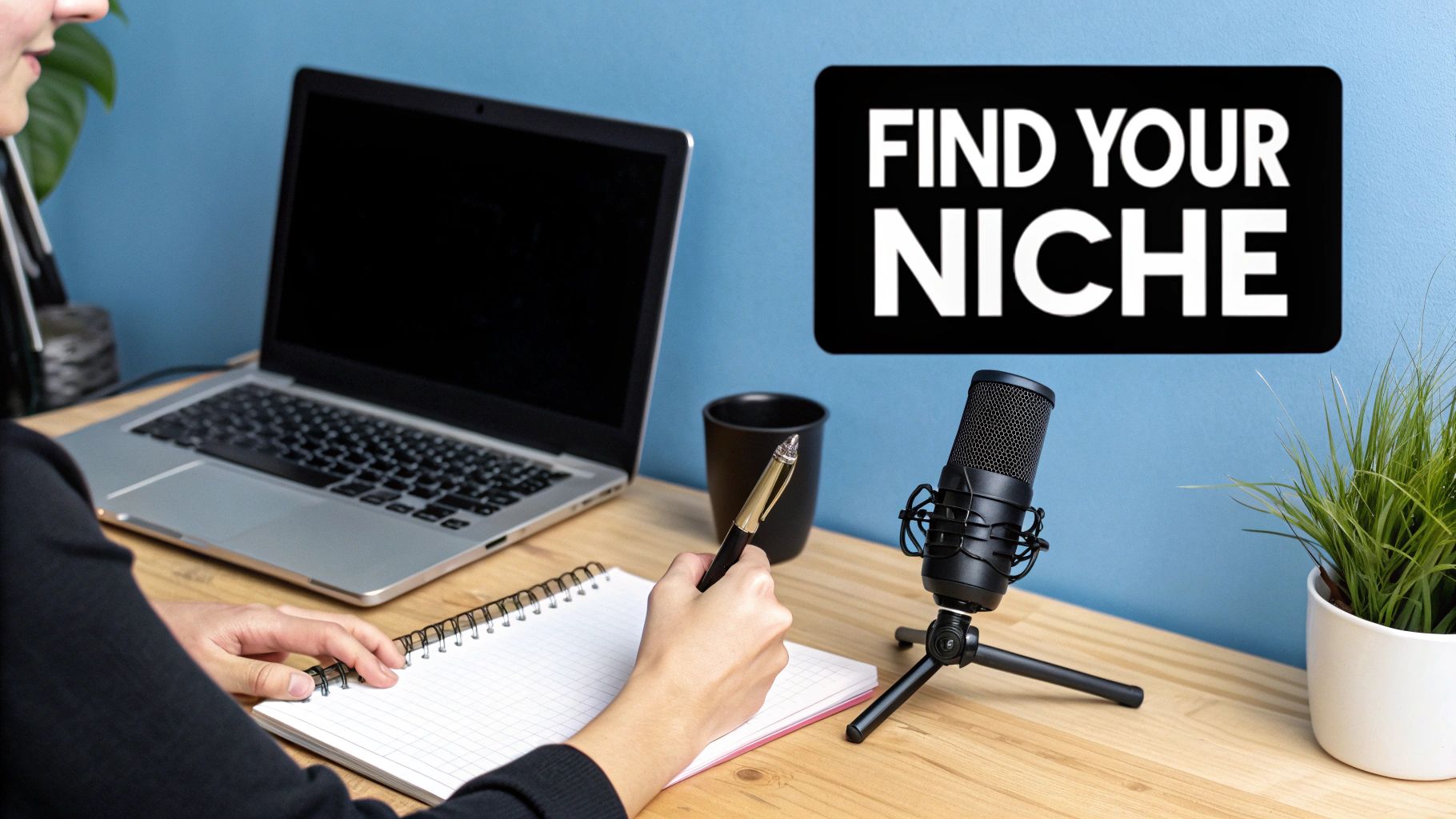
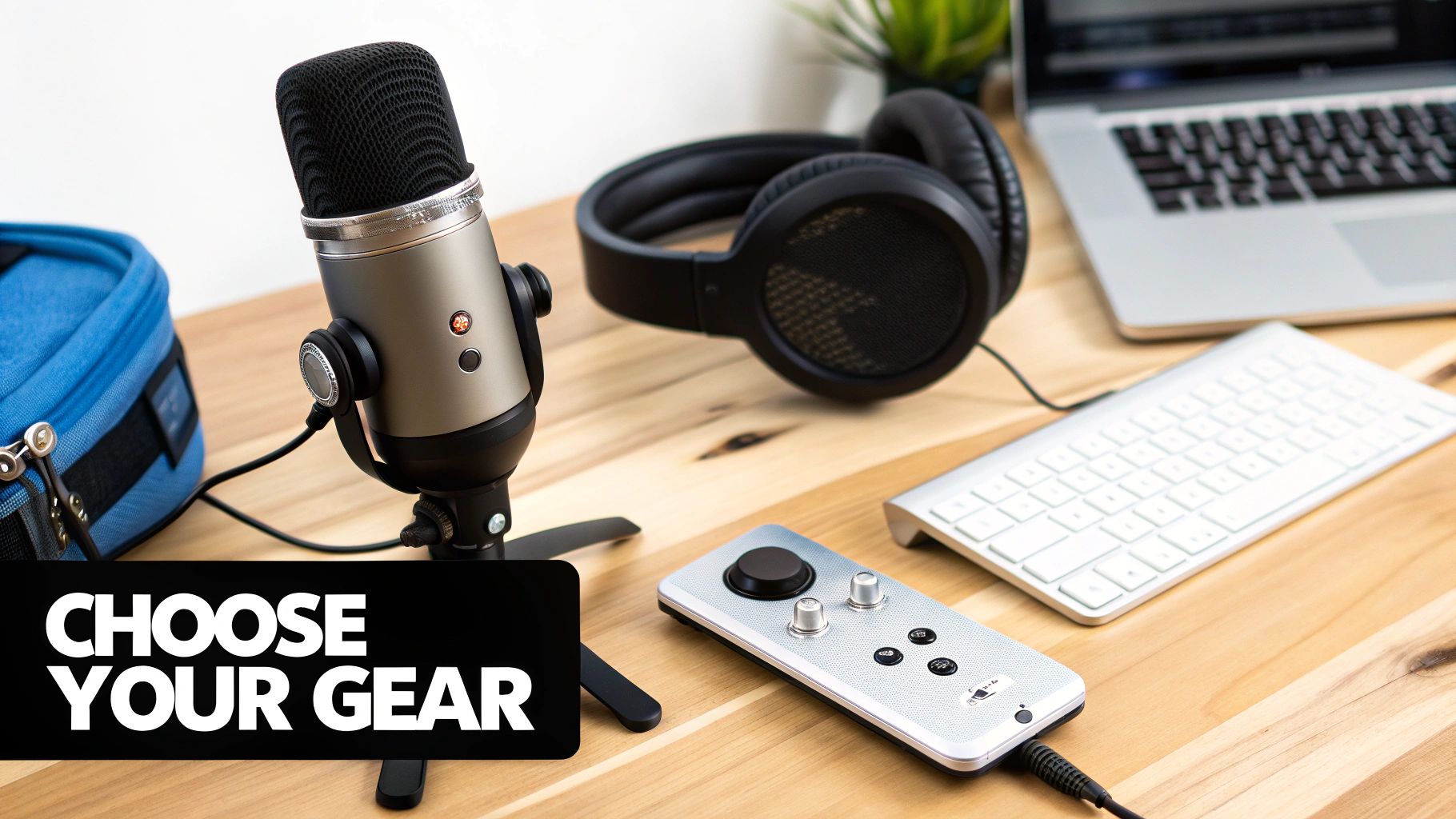
This is the single most important piece of hardware you'll buy. For new podcasters, the main choice is between a USB or an XLR microphone. The right one for you comes down to budget, how comfortable you are with tech, and where you see your show going in the future.
-
USB Microphones: These are the definition of plug-and-play. They connect right into your computer's USB port, making them a fantastic, no-fuss choice for solo hosts or anyone just getting started. You can get fantastic sound from a model like the Samson Q2U for around $70.
-
XLR Microphones: This is what the pros use. They require a separate piece of gear called an audio interface to connect to your computer. While it’s an extra step and cost, this setup gives you superior sound quality, more control, and the ability to easily record with multiple people in the same room.
For most beginners, a quality USB mic is the perfect starting point. It delivers excellent audio without the learning curve or extra expense of an interface. If you want to dive deeper into specific models, our detailed guide on the best microphone for podcasting breaks down all the best options.
To give you a clearer picture, here's a quick comparison of a few popular microphones that are perfect for those just starting out.
Beginner Podcasting Microphone Comparison
This table highlights some of the best entry-level mics, helping you find the right balance between cost, ease of use, and sound quality for your new show.
| Microphone Model | Type | Best For | Approximate Price |
|---|---|---|---|
| Samson Q2U | USB & XLR | All-around value and flexibility for beginners | $70 |
| Audio-Technica ATR2100x-USB | USB & XLR | Solo hosts wanting a clear, broadcast sound | $80 |
| Blue Yeti | USB | Solo hosts or roundtables needing multiple recording patterns | $100 |
| Rode PodMic | XLR | Those ready for an audio interface and a rich, warm tone | $100 (mic only) |
Ultimately, the best microphone is one that fits your budget and makes you sound great without a ton of hassle. Any of these options will give your podcast a professional edge right from the first episode.
Pro Tip: Spend the extra $10 on a pop filter or foam windscreen. Seriously. It clips onto your mic and kills those harsh "p" and "b" sounds (called plosives) that can make your audio sound amateurish. It's the cheapest, biggest upgrade you can make.
Finding a Good Recording Space at Home
You don't need a professional, soundproofed studio. Your biggest enemy at home is reverb—that echoey, hollow sound your voice makes when it bounces off hard surfaces like walls, desks, and wood floors.
The fix is to record in a space with lots of soft things to absorb the sound. A walk-in closet is a classic podcaster hack for a reason; all those clothes work as fantastic sound dampeners. If that’s not an option, a bedroom with a rug, curtains, and a duvet on the bed can work just as well. Think soft and cluttered, not empty and sparse.
Picking Your Podcasting Software
Once your mic is ready, you need software to actually record and edit your audio. This is often called a Digital Audio Workstation, or DAW. Luckily, some of the best options are completely free.
-
Audacity: This is the workhorse of beginner podcasting. It’s free, open-source, and has every feature you need to record, edit, and mix a great-sounding show. It has a bit of a learning curve, but there are endless tutorials online.
-
GarageBand: If you’re on a Mac, this is a no-brainer. It’s free, incredibly intuitive, and comes pre-installed. It's the perfect way to learn the fundamentals of audio editing.
-
Descript: This one is a game-changer for many creators. Descript transcribes your audio as you record, and you edit the audio by simply editing the text document. Want to cut a sentence? Just highlight and delete the words. It also has an amazing "Studio Sound" feature and can automatically remove all your "ums" and "uhs." Pricing starts around $12/month.
The podcasting space is more vibrant than ever. As of 2025, there are now over 4.52 million podcasts available, with a global audience of around 584.1 million listeners. With that much competition, starting with great audio isn't just an advantage—it's essential for getting noticed.
Choosing your initial gear is an exciting first step. Don't get paralyzed by all the options. Just start simple, prioritize clean sound, and pick the tools you feel comfortable using week after week.
Recording and Editing Your First Episode
Okay, you've got your gear and a decent space to record. Now for the fun part: actually making your podcast. This is where all that planning starts to pay off. The goal here isn't to be perfect right out of the gate. It's about creating a clean, professional, and genuinely engaging show that respects your listener's time.
The little things you do before you hit record can make a huge difference. Think of it like a chef prepping ingredients—a good setup leads to a better result. For instance, something as simple as how far you are from the microphone can completely change your sound. A good starting point is to speak 2-4 inches away, but play around with it to find what works best for your voice.
Beyond just having the right gear, learning how to improve audio quality during the recording itself is key. Here's a pro tip: try speaking slightly across the mic's surface, not directly into it. This technique, called speaking "off-axis," naturally softens those harsh "p" and "b" sounds (plosives) and gives you cleaner audio to work with from the jump.
From Outline to Audio
Even the most seasoned hosts don't just sit down and start talking. Rambling is one of the most common mistakes new podcasters make, but a simple outline is the perfect fix. It gives you structure without trapping you in a rigid script, which can make you sound robotic.
Think of your outline as a roadmap, not a word-for-word transcript. Just jot down your main talking points, any questions you have for a guest, or the transitions you want to make between segments. This keeps you focused and ensures you hit all your key points, helping you sound conversational and confident.
A great podcast episode feels like a spontaneous conversation, but it's almost always built on the foundation of a thoughtful outline. The structure is invisible to the listener but essential for the host.
Before you jump into the full recording, always record a quick test track or if you’re capturing video, use Canva’s screen recorder, so you can check levels, pacing, and any background noise. Just talk for 30 seconds or so and then listen back with your headphones. How's the volume? Can you hear the air conditioner humming in the background? This simple check can save you the heartache of discovering a fixable audio issue after you’ve already recorded an hour-long episode.
The Editing Workflow: What to Cut and What to Keep
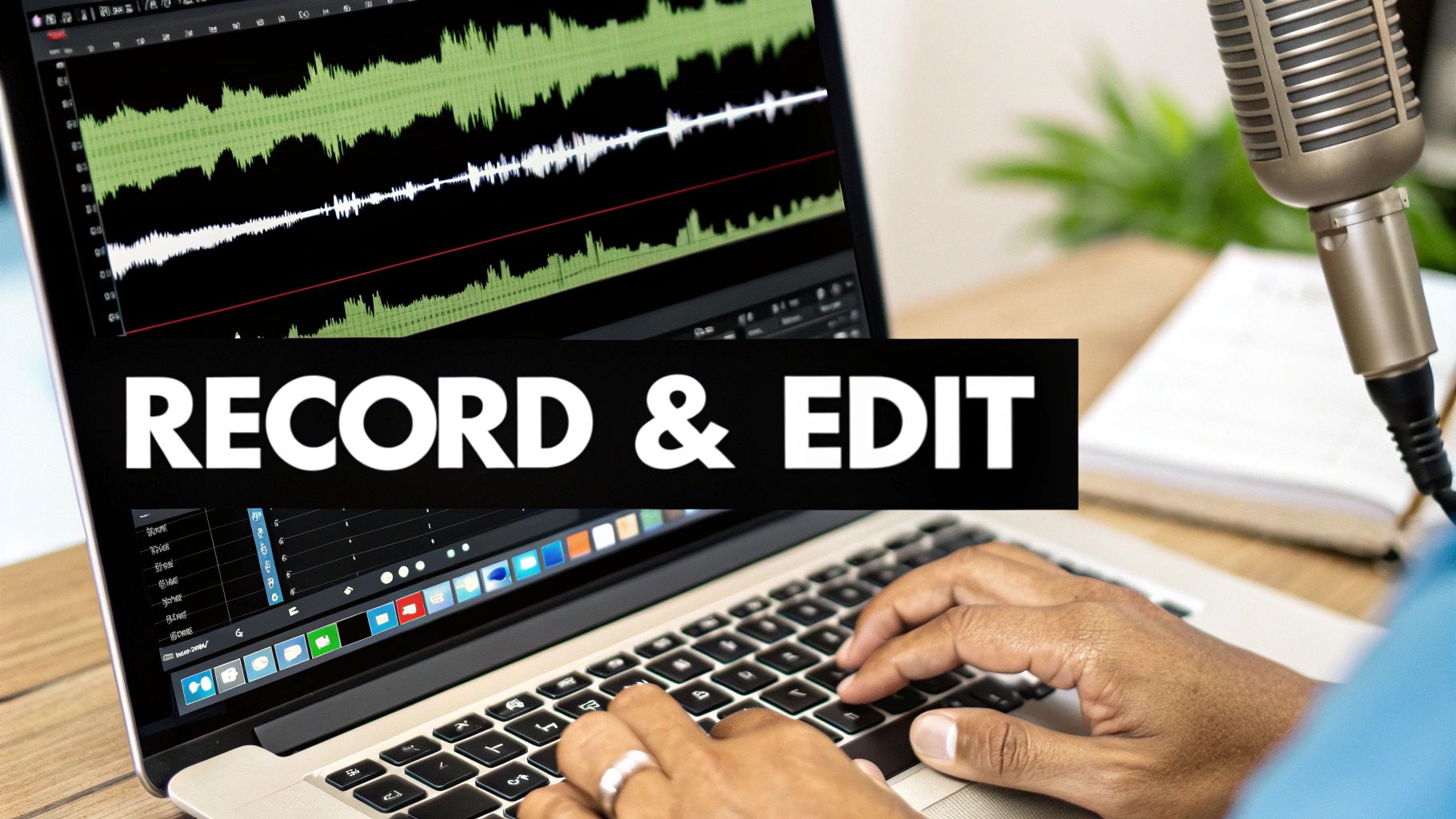
With your raw audio captured, it's time to head into editing. Don't feel like you need to become a master audio engineer overnight. For your first few episodes, the goal is simply to clean things up and make the show easy to listen to.
First, edit for content. Listen through the entire recording and make the big cuts. Did you go off on a tangent that doesn't really add anything? Did you repeat yourself? Get rid of those large chunks first to make the rest of the process much more manageable.
Next, it’s time to polish. This is where you get rid of the small distractions—the long, awkward silences, the endless "ums" and "uhs," and any distracting background noises that slipped through.
Here are the essential editing tasks for your first episode:
- Top and Tail Your Audio: This just means adding your intro music at the beginning and your outro music at the end. Use a gentle fade-in and fade-out to make the transitions feel smooth and professional.
- Cut the Fluff: Systematically go through and remove any big mistakes, false starts, and excessive filler words. This one step will instantly make your podcast sound more polished.
- Balance Your Levels: Make sure your voice, your guest's voice, and your music are all at a consistent volume. Nothing is more annoying for a listener than having to constantly adjust their volume.
The editing bay is where your show's personality really starts to shine. If you want to dive deeper into the technical side, our guide on how to edit podcast audio covers more advanced techniques. Just remember, a clean edit is a sign of respect for your audience.
Distributing Your Podcast to the World
You've done the hard work. Your episode is recorded, edited, and sounds amazing. That's a huge win, but now you have to get it to the people. This is where we turn that polished audio file into a real podcast that shows up on Apple Podcasts, Spotify, and everywhere else people listen.
This whole process is called distribution, and while it might sound a bit technical, it's mostly a one-time setup that's surprisingly straightforward.
A common misconception is that you can just upload your MP3 directly to Spotify. It doesn't quite work that way. First, you need a dedicated podcast host. Think of your host as the central hub for all your audio files. It’s a specialized service that stores your episodes and, more importantly, generates a unique link called an RSS feed. This RSS feed is the magic key that unlocks your podcast's distribution.
Why You Absolutely Need a Dedicated Podcast Host
If you're serious about podcasting, using a dedicated media host like Buzzsprout, Transistor, or Libsyn is non-negotiable. These platforms are built from the ground up to handle large audio files and deliver them quickly to listeners all over the world. They also give you the analytics you need to understand who's listening and where they're coming from.
When you're shopping around for a host, keep an eye out for these features:
- Rock-Solid Storage and Bandwidth: Your host has to be able to handle a sudden surge of thousands of downloads without breaking a sweat.
- Meaningful Analytics: Look for IAB-certified stats. This is the industry standard and ensures you're getting accurate data about your audience.
- A User-Friendly Dashboard: The last thing you want is to fight with a confusing interface. Uploading episodes and managing your show should be simple.
- A Built-in Website: Many hosts will give you a simple, customizable website for your show, which is a fantastic home base to send listeners to.
Your podcast host is the engine that powers your show's distribution. It works silently in the background, ensuring that every time you publish a new episode, it automatically appears for all your subscribers, no matter which app they use.
The Upload and Submission Workflow
Once you've picked a host and set up your account, you'll fall into a simple rhythm for every episode you release.
You'll start by uploading your final audio file (usually an MP3). As it's uploading, your host will prompt you to fill in the episode's metadata—this is the information listeners see in their podcast app.
- Episode Title: Make it catchy, but also tell people what it's about.
- Show Notes: This is your episode description. It's the perfect place for a quick summary, links to things you mentioned, and your contact info. Good show notes can also give you a nice SEO boost.
- Episode Artwork: While your show has its main cover art, you can also create unique art for specific episodes if you want to make them stand out.
Once that's filled out, you hit "publish." In the background, your host instantly updates your RSS feed with the new episode.
Getting Your Show into the Directories
This is the final piece of the puzzle, and the best part is you only have to do it once. After you submit your RSS feed to a directory, it will automatically check it for new episodes from then on. The two big ones you absolutely have to be on are Apple Podcasts and Spotify, which together account for a whopping 66.9% of all podcast downloads.
Here’s what that one-time submission process looks like:
- Grab Your RSS Feed URL: Your podcast host will have this link displayed prominently in your dashboard. Copy it.
- Create Your Directory Accounts: You'll need to sign up for a free account with services like Apple Podcasts Connect and Spotify for Podcasters.
- Submit the Feed: In each directory's dashboard, you'll find a field to submit your show. Just paste your RSS feed URL in there.
There’s usually a short review period—anywhere from a few hours to a couple of days—while each platform verifies your podcast. Once you're approved, you're officially live and discoverable by millions of listeners. From that moment forward, your only job is to focus on making great content and uploading it to your host.
Launching and Growing Your Audience
Hitting "publish" on your first episode is an incredible feeling, but it’s really just the beginning of a whole new chapter. A successful launch isn't about luck; it's the payoff from smart, deliberate promotion that paves the way for real, lasting growth.
Your initial goal isn't to rocket to the top of the charts overnight. The real win is building a small but dedicated base of listeners who are genuinely into your show. These are the people who will become your champions—they'll leave those crucial first reviews, share your episodes, and form the heart of your new community.
Building Pre-Launch Momentum
Believe it or not, the work of finding your audience starts before your first episode ever goes live. You need to build anticipation. Don't just drop your podcast into a void; give people a reason to be excited and waiting for it.
A brilliant way to do this is by creating audiograms. These are short, dynamic video clips that layer a compelling snippet of your audio over your podcast cover art, often with an animated waveform. They’re gold for social media—perfect for grabbing attention on Instagram, LinkedIn, or TikTok by offering a real taste of your show in a visually engaging package.
Think of your launch more like a "soft open" than a huge premiere. This mindset takes the pressure off, letting you find your groove, iron out any technical kinks, and build your confidence. You can quietly publish your first few episodes, then start promoting them as if they've already found an audience.
This pre-launch window is also the prime time to tap into your existing networks. Seriously, don't be shy about it.
- Get personal: Send a direct email or message to friends, family, and colleagues who you think would actually enjoy your content.
- Be specific with your ask: Instead of a vague "check out my podcast," give them a clear, easy action. Try, "Could you listen to the first 10 minutes and leave a rating on Apple Podcasts this Tuesday?"
- Use your own social media: Announce your upcoming show and lock in a launch date. This creates accountability for you and builds excitement for everyone else.
This initial boost from your inner circle is more important than you think. It drives those first few downloads and reviews, which are vital signals to podcast platforms that your show has potential.
Ongoing Promotion and Discoverability
Once you’re out in the world, your focus has to shift to consistent, ongoing promotion. This is a marathon, not a sprint. The trick is to find tactics that feel authentic to you and your show.
One of the most powerful—and surprisingly underused—strategies is cross-promotion. Find other podcasters in a similar niche whose listeners would probably dig your show. Reach out and propose a simple "promo swap," where you each run a short ad for the other's podcast. It’s a classic win-win, exposing your show to a brand new, highly targeted audience for free.
It's also essential to meet potential listeners where they already hang out.
- Join relevant communities: Find the Facebook groups, Reddit subreddits, or niche forums where your ideal listeners spend their time.
- Lead with value: Never just drop a link and disappear. Jump into conversations, answer questions, and become a helpful, recognized member of that community.
- Share your work contextually: When a topic comes up that you've covered in-depth on an episode, you can naturally share a link as a genuinely helpful resource.
The Power of Podcast SEO and Reviews
Finally, don't sleep on the power of search engine optimization (SEO) within the podcasting world. When someone searches for a topic on Spotify or Apple Podcasts, you want your show to be one of the first things they see.
Craft your episode titles to be descriptive and packed with keywords people are likely to search for. Ditch a vague title like "Episode 3: My Chat with Jane" for something like "How to Price Your Freelance Services with Jane Doe." That small change can make a massive difference in how easily you're found.
Your show notes are also prime real estate for keywords. Use them to summarize the episode and list the key topics you covered. This not only helps listeners decide if they want to tune in, but it also feeds the search algorithms more context about your content. Research shows that 62% of new listeners are more likely to even try a podcast if the cover art and description grab them, proving just how critical that first impression is.
Encouraging ratings and reviews is the last piece of the puzzle. Positive reviews are social proof; they tell potential listeners that your show is worth their time. They also factor into how visible your podcast is in the directories. At the end of every episode, include a brief, clear call to action asking your audience to leave a rating and review if they're enjoying the show. Getting just 5-10 reviews early on can give you a significant boost.
A Few Common Questions from New Podcasters
Jumping into the world of podcasting is exciting, but it almost always brings up a few nagging questions. Even the best-laid plans can leave you wondering about a handful of practical details. Let's clear up some of the most common hurdles new podcasters face so you can launch your show with confidence.
Think of this as the last bit of housekeeping before you open the doors and invite the world in.
How Often Should I Release New Episodes?
I'm going to say something that might sound counterintuitive: consistency beats frequency, every single time. Especially when you're just starting out. Listeners thrive on routine, and a predictable release schedule is how you build that "can't-miss" habit around your show. The most common cadence is weekly, which about 36% of podcasts aim for.
But honestly, a bi-weekly schedule (every two weeks) is a fantastic, and much more sustainable, goal for most newcomers.
The best schedule is the one you can actually stick to without burning out. It’s far better to deliver a great show every two weeks like clockwork than to promise a weekly show and constantly miss deadlines. Choose sustainable over ambitious at the start.
Ultimately, let your content be your guide. A deep-dive, heavily researched narrative show might only come out once a month. A daily news brief has to be, well, daily. Just pick a schedule, tell your audience what it is, and then stick to it.
Do I Need to Worry About Using Music?
Yes. A thousand times, yes. You absolutely cannot grab a popular song from your favorite artist and drop it into your podcast. That's a surefire way to get a takedown notice from platforms or, even worse, find yourself in legal hot water. The licensing is incredibly complex and expensive.
The good news is, there are fantastic, and legal, alternatives.
- Royalty-Free Music Libraries: This is the way to go. Platforms like Soundstripe or Epidemic Sound give you access to huge catalogs of great music for a reasonable subscription fee. And for sound effects, our own SFX Engine provides custom, royalty-free audio branding.
- Creative Commons Music: You can find artists who release their work under Creative Commons licenses. This music is often free to use, but you have to check the specific license terms. Some require you to give credit (attribution), while others might prohibit commercial use (NC).
A small investment in a royalty-free music subscription is one of the smartest, safest moves you can make. It protects your show and instantly makes it sound more professional.
When Should I Start Thinking About Monetization?
You should be thinking about it from day one, even if you don't actually do anything about it for months. Knowing how you eventually want to make money can shape your content and how you grow your audience. That said, please don't run ads on your first few episodes. It just feels off.
A solid benchmark to aim for is at least 1,000 downloads per episode within its first 30 days. That’s generally the minimum number advertisers want to see before they'll even consider a partnership. Until you hit that milestone, your one and only job is to build a dedicated, engaged audience. Your listeners are your most valuable asset—focus on serving them first.
Ready to give your podcast the professional audio branding it deserves? At SFX Engine, you can instantly generate custom, royalty-free sound effects and ambient tracks for your intros, outros, and transitions. Find the perfect sound for your show and start creating for free.