January 8, 2026 · Kuba Rogut
Building immersion isn't just an artistic flourish for your indie game—it's one of the sharpest tools in your kit for standing out. It’s about crafting a world so believable that players get lost in it, a world where the sound, visuals, and mechanics all pull in the same direction. For small teams, a truly immersive experience can be a force multiplier, turning a modest project into something people talk about for years.
With hundreds of new games hitting digital storefronts every week, how does a small studio even begin to make a dent? You don't need a bigger budget or a massive team. What you need is a world so compelling that players forget they’re holding a controller. That's the real power of immersion.
Immersion is what connects your game to a player's emotions. When someone feels truly present in the world you've built, they stick around longer, share it with their friends, and become genuine fans. This kind of deep engagement isn't just a vanity metric; it directly drives your game's visibility and success.
Thinking about immersion as a business strategy might feel a bit strange at first, but the numbers don't lie. Between 2018 and 2024, indie developers on PC saw their revenues grow at an annual rate of about 22%. That’s nearly three times faster than their AAA counterparts, even as platforms got more crowded. The games that break through are almost always the ones offering unique, immersive experiences players can’t get anywhere else. You can dig into more of this data in a recent gaming industry report.
This clear link between immersion and commercial success gives indie developers a real path forward.
In a market where the top 1.5% of indie releases capture more than half of total revenue, immersion is not just an artistic goal; it is one of the few levers that can move a game from invisible to indispensable.
To figure out what actually connects with players and what shatters the illusion, conducting user research is absolutely essential. It’s the only way to get direct, honest feedback on what's working.
Crafting an immersive experience isn't about one single thing; it's about getting four core pillars to work together in harmony. When you master the synergy between them, a good idea can transform into a captivating reality.
To break it down, here are the four pillars and what they mean for an indie team.
| Pillar | Core Function | Indie Dev Focus Area |
|---|---|---|
| Sound Design | Creates the invisible architecture of your world, setting the mood and providing feedback. | Using ambient soundscapes and reactive SFX to make environments feel alive and responsive. |
| Visual Storytelling | Uses art, lighting, and environmental details to convey narrative and evoke emotion. | Crafting a unique art style and using environmental clues to tell a story without words. |
| Gameplay Mechanics | Defines the player’s direct interaction with the game world and its systems. | Designing intuitive controls and meaningful feedback loops that feel satisfying and fair. |
| Narrative & UX | The story and how it's presented to the player, from UI to overarching plot. | Ensuring a clean, non-intrusive UI and a compelling hook that keeps players invested. |
Think of these pillars as the foundation of your game's world. If one is weak, the whole structure can feel wobbly. But when they all support each other, you create something solid, believable, and truly memorable for the player.
Think of sound as the invisible architecture of your game world. While stunning visuals might be what first catch a player's eye, it's the audio that truly sells the experience. It’s what makes an environment feel alive, an action feel weighty, and an emotional beat land with real impact. For any indie dev, smart sound design is one of the best bang-for-your-buck investments you can make when it comes to building immersion in indie games.
A great soundscape isn't just about filling the silence; it tells a story all on its own. The distant howl of wind can telegraph an approaching storm. The subtle creak of a floorboard can ratchet up the tension tenfold. Even the crisp clink of a potion bottle can make something as mundane as inventory management feel satisfyingly tangible. It’s about building a cohesive audio language that reinforces the reality you're trying to create.
This entire process is the bedrock of player retention. As you can see below, creating that initial sense of immersion is what pulls players in, leading to deeper engagement and, hopefully, more buzz for your game.
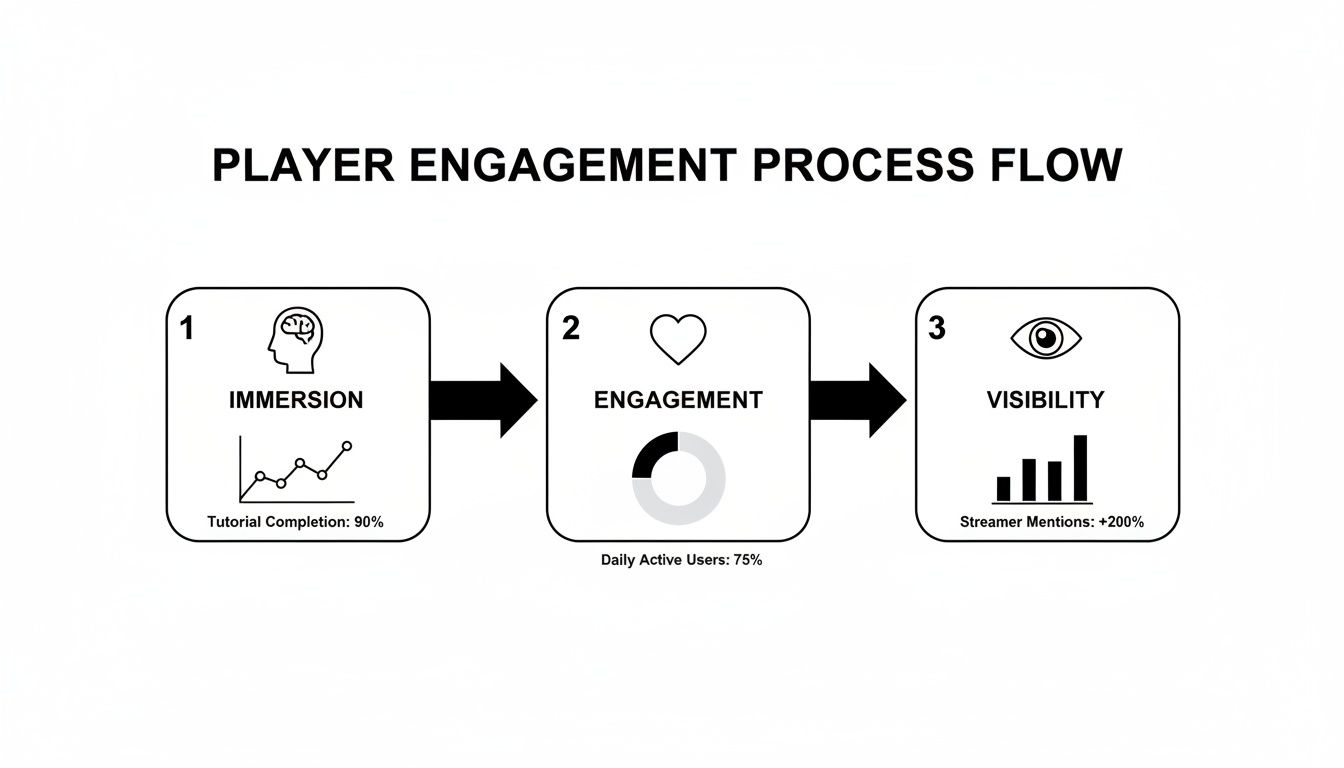
It all starts with building a captivating world. That's what gets people to stick around.
Ambient sound is your foundation. It’s the constant, underlying texture that defines a space before a single footstep is even taken. A sterile sci-fi corridor and a damp, echoing cave feel completely different, and that feeling starts with the ambient track.
But please, don't just use a single, repetitive loop. That's a surefire way to break the spell. Instead, think in layers.
Imagine you're designing the audio for a forest. You could build it like this:
This layered approach creates a soundscape that feels dynamic and alive, not like a cheap recording on a loop. The whole point is to avoid obvious repetition, which is the mortal enemy of the illusion you’re working so hard to create.
This is where the magic really happens. Dynamic sound effects are the ones that change based on what the player is doing or where they are. It’s how you make your world feel incredibly responsive and real.
Footsteps are the classic example, right? The sound should be completely different when walking on grass versus gravel, or wood versus stone. It’s a small thing, but players notice when it’s missing.
This principle applies to everything. A sword swing in a tight hallway should have a sharp reverb that's absent in an open field. A gunshot indoors needs to have a deafening crack and echo, while that same shot outdoors would sound flatter as the sound dissipates. These subtle shifts make every interaction feel more authentic.
A great exercise for any indie developer: list your game's core actions—walking, jumping, attacking—and then brainstorm how the sound for each could change across at least three different environments.
By implementing even simple reactive audio, you forge a direct link between the player and the world through auditory feedback. It grounds them in the space. For a more detailed breakdown of this workflow, check out our guide on how indie games do sound design.
In a sea of indie games, a memorable audio signature can make your project instantly recognizable. This "audio identity" is built from all the little custom sounds that are unique to your world, from the chime of picking up a collectible to the specific thrum of a magical portal. A distinctive audio palette makes a game stick in someone's memory, which is priceless for word-of-mouth.
You don't need a Hollywood Foley stage for this. You can get incredibly creative right from your desk.
Music is your most direct line to the player's emotions. Adaptive music takes this a step further by changing in real-time based on the player's situation, creating a score that perfectly mirrors the on-screen action. And I don't just mean crudely switching from an "exploration" track to a "combat" track.
A much more elegant approach is to build a musical system from stems, or layers, that can be faded in and out on the fly.
This creates a fluid emotional arc that makes moments of danger feel more threatening and victories feel more earned. It’s a complex technique to master, but it’s an unbelievably powerful tool for building immersion in indie games.
Let’s be real: you don’t need a AAA budget to pull players into your world. When you're an indie dev, your most powerful tools aren't raw graphical horsepower, but a strong artistic vision and clever environmental storytelling. The goal isn't to create a perfect world, but a believable one.
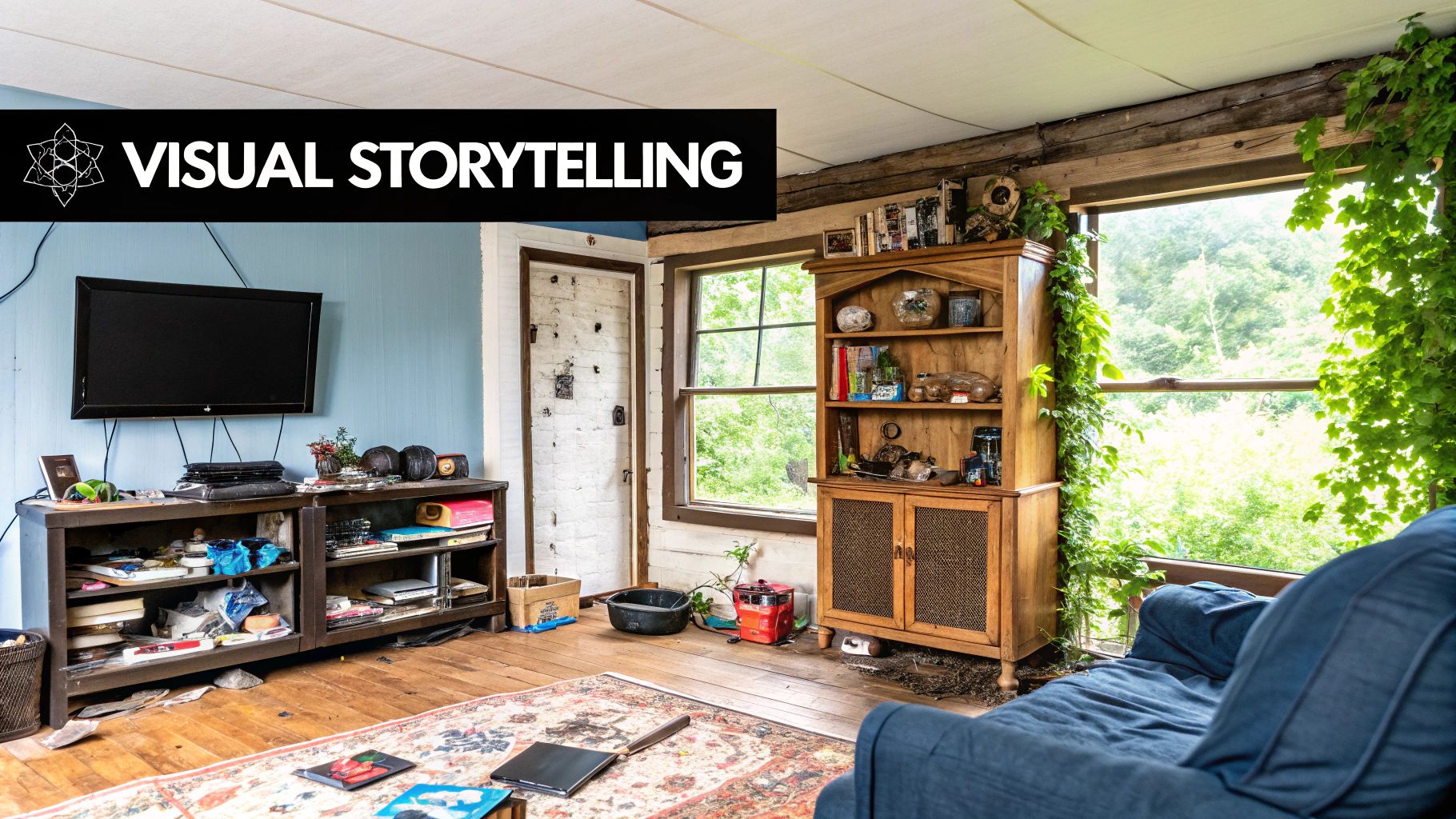
Forget photorealism. A game with a simple, consistent art style will always feel more immersive than one that feels like a mishmash of high-detail assets you bought from different stores. The secret is to aim for a stylized aesthetic that your small team can actually achieve and maintain.
Before you touch a single 3D model or fire up Aseprite, you need to define your game's visual language. Think of this as the set of unbreakable rules governing how your world looks, feels, and breathes—from its color palette to the very shape of its buildings.
I've seen so many indie projects stumble by mixing clashing styles, like placing pre-rendered 3D characters against hand-painted backgrounds. It's jarring, and it instantly shatters the player's sense of place. Your visual language needs to feel intentional and unified across every pixel.
Start by nailing down these core components:
Once you have these rules, tattoo them on your brain. Stick to them religiously. This is how you ensure every new asset, from a coffee cup to a skyscraper, feels like it truly belongs.
Lighting is easily one of the most powerful—and cost-effective—tools in your emotional toolkit. It’s more than just illumination; it directs the player's eye, sets the time of day, and can turn a sterile 3D space into a place with a real vibe.
Think about it: a single room can feel completely different just by changing the lights. The cold, blue glow from a computer monitor can make a space feel lonely and isolating. Swap that for the warm, flickering light of a fireplace, and that same room suddenly feels like a safe haven.
Don't just light a scene to make it visible. Light it to make the player feel something. In every area, ask yourself: what emotion am I trying to evoke here? Then, use color and shadow to make it happen.
Color psychology is your secret weapon here. Cool colors like blues and purples can suggest anything from sadness to high-tech sterility. Warm colors like reds and oranges can scream danger, passion, or comfort. Weaving these ideas into your design is a subtle but incredibly potent way to guide the player's emotional journey. This is a classic technique borrowed from filmmaking, which you can learn more about in our guide to video production best practices.
Environmental storytelling is the art of showing, not telling. It’s about leaving behind clues and little details that whisper about the world’s history, its inhabitants, and the events that transpired long before the player arrived. It’s what makes a world feel lived-in.
Instead of a pop-up telling the player "a great battle happened here," just show them. Let them discover the scorch marks on the walls, the overturned furniture, and the discarded weapons. This turns the player into an active participant, a detective piecing together the story on their own. That’s always more engaging.
Here's a quick checklist for making any space feel authentic:
Every tiny detail adds another layer of believability. It’s how you transform your game from a collection of digital assets into a place with a soul—a place that begs to be explored.
Immersion is a delicate thing. You can pour your heart into breathtaking visuals and a masterful soundscape, but it can all come crashing down with a single clunky control scheme or a confusing mechanic. The way a player actually interacts with your world is the final, most important bridge to believability. This is where we get tactile.
This isn't about building the most complex systems imaginable. Far from it. Some of the most immersive indie games ever made succeed because their mechanics are simple, intuitive, and perfectly aligned with the game's core fantasy. The goal is to make the player feel capable and present, not like they're fighting the controller.
Every single thing a player does needs to get a clear, satisfying reaction from the game world. This is the classic feedback loop, and it’s the absolute bedrock of engaging gameplay. When a player presses a button, the game has to acknowledge it in a way that feels right.
Take a simple action, like whacking an enemy with a sword. A weak attempt might just trigger a generic sound and tick down a health bar. A truly satisfying loop, however, is a symphony of feedback.
When all these elements fire in concert, the player doesn't just see an attack; they feel it. This multi-sensory reinforcement makes every interaction more potent, pulling the player deeper. We dive into the critical role of audio in our article explaining why sound effects matter in games.
Your user interface (UI) can be the biggest immersion-killer of them all. A screen cluttered with health bars, mini-maps, and quest markers is a constant, flashing reminder that "you are playing a game." The best UIs manage to give the player vital info without yanking their attention away from the world itself.
This is where diegetic UI really shines. A diegetic interface is one that exists within the game world, making it a natural part of the story instead of an overlay.
Think of a sci-fi survival game. Instead of a health bar, maybe the player's health is shown by cracks forming on their helmet's visor. In a fantasy RPG, a magical amulet around the character's neck could glow brighter as their mana recharges.
The ultimate goal for an immersive UI is to make it feel like an extension of the character, not a menu for the player. Ask yourself: how would the character in this world know this information?
Even when a traditional, non-diegetic UI is unavoidable, you can still minimize its intrusion. Make elements context-sensitive, fading them in only when needed. Keep on-screen displays clean and minimalist. Every single element on that screen should have to fight for its right to be there.
Nothing rips a player out of the moment faster than fighting with unintuitive controls. The controls are their hands, their eyes, their voice in your world. If they feel sluggish, inconsistent, or needlessly complex, that connection is severed instantly.
The key here is mapping your control scheme to player expectations. Most gamers have a built-in muscle memory for how certain genres "should" feel. A first-person shooter almost universally uses the left stick to move and the right to aim. If you're going to deviate from established conventions like that, you need a very good reason.
To make your controls feel amazing, stick to these principles:
By focusing on these pillars—satisfying feedback, an unobtrusive UI, and intuitive controls—you ensure that every moment a player spends in your game deepens their connection to it. You’ll turn a simple interactive experience into a truly immersive journey.
Let’s be honest: pouring your heart and soul into building an immersive game world can feel like a purely artistic pursuit. But it’s not just about critical acclaim or chasing some creative ideal. It's one of the smartest business decisions you can make as an indie developer.
In a market this crowded, a deeply engaging world directly impacts your bottom line. It influences how players behave, how storefront algorithms see your game, and ultimately, how much money you make long-term. Immersion isn't a luxury; it's your competitive edge.
The old rules of game discovery are dead. Storefronts like Steam no longer reward developers who just pump out games. Their algorithms have gotten smarter, and now they're laser-focused on one thing: sustained player engagement. The longer someone stays in your world, the more the platform will show your game to other people.
This has huge implications. Indies generate between USD 2–3 billion in a typical year, but the market is incredibly top-heavy. In 2024, the top 1.5% of indie games grabbed over 50% of all indie revenue. You can dig into more of these indie game market trends yourself, but the takeaway is clear: you need to be in that top sliver.
This creates a powerful cycle that can make or break your game:
Suddenly, your investment in cohesive art, atmospheric sound, and satisfying mechanics starts doing your marketing for you. It's organic reach, driven by quality.
A player who feels a real, genuine connection to your game’s world is gold. They're far more likely to stick around and become a long-term supporter, which is the foundation for a healthy revenue stream that goes way beyond that initial purchase. When players are truly invested, they want more of what you've built.
This is where the financial benefits really kick in. These are the fans who will happily buy:
Building a believable world isn't just about the initial sale. It's about creating an ecosystem where players are happy to keep spending money because they feel like they’re part of something special.
This deep engagement is also what turns a simple player base into a thriving community. Passionate fans become your evangelists. They create fan art, write wikis, and generate the kind of word-of-mouth buzz that no marketing budget can buy. This community is also your biggest asset if you decide to seek funding, a path many indies take. You can learn more from this in-depth guide to launching indie games on Kickstarter.
At the end of the day, the indie market often follows a 'winner-take-most' pattern. A tiny fraction of titles achieve massive, disproportionate success. What do these breakout hits almost always have in common? A masterfully executed, immersive experience that connects with players on a deep level.
Think about games like Hades, Stardew Valley, or Hollow Knight. They didn't blow up because of Super Bowl ads.
They succeeded because they built worlds so compelling, so cohesive, and so satisfying to simply exist in that players couldn't stop talking about them. Their incredible success was built on a foundation of meticulously crafted immersion.
So, start framing your work on atmospheric audio, cohesive art direction, and responsive gameplay not as expenses, but as strategic investments. Every single decision that deepens a player's connection to your world is a direct contribution to its commercial viability. It’s how you turn a small project into an unforgettable—and profitable—experience.
Even with a solid plan, actually building immersion in your indie game can throw some curveballs. Let's tackle some of the most common questions and sticking points that developers run into, with practical advice you can use right away.
These are the real-world problems that pop up, from shoestring budgets to avoiding those classic rookie mistakes.
This is a big one. For many small teams, a dedicated audio designer is a luxury you just don't have. But here's the good news: you don't need to be an audio wizard to build a soundscape that pulls players in. The trick is to start with good tools and keep things consistent.
AI-powered platforms have really changed the game here. You can now generate custom sounds just by describing what you want. Need the sound of rain drumming on a tin roof while a light wind rustles the trees nearby? You can get that in seconds.
To keep from getting overwhelmed, focus your energy on three main areas:
Remember, quality over quantity. A handful of well-designed, consistent sounds will do far more for immersion than a huge library of random, mismatched effects.
Hands down, the single biggest mistake is inconsistency. This is when different parts of your game feel like they were pulled from totally different worlds, which completely shatters the player's sense of place.
You see it all the time. A game might have this gorgeous, stylized low-poly art style, but then a massive, hyper-realistic explosion sound rips through the speakers. The audio and visuals are at war, and the player can feel it. Another classic example is mashing together art assets from different marketplace packs that just don't share a cohesive style.
Your most important job is to define a clear, unified creative vision early on. Every single decision—from the font on your UI to the sway of a character's walk to the background music—has to serve that one vision. A simple but consistent world is always, always more immersive than a complex and chaotic one.
When you're running lean, you have to be smart about where you spend your time and money. You want the biggest bang for your buck when it comes to immersion. For most indie projects, this means focusing on two things: sound design and environmental storytelling.
Sound is just incredibly efficient. It can establish a mood and make a world feel alive faster and cheaper than creating complex visual assets that might take weeks to model and texture. And as we just covered, generating high-quality custom audio is more accessible than it's ever been.
At the same time, lean heavily into environmental storytelling. This is all about placing details that hint at a deeper history without spelling it out. A forgotten diary on a desk, strange scorch marks on a wall, a half-eaten meal left on a table—these things tell stories without needing expensive cutscenes or character models. It’s a scrappy way to add incredible depth and reward players for exploring.
Crafting the right audio landscape is one of the most powerful tools in your immersion toolkit. At SFX Engine, we built a free AI-powered sound effect generator to help you create custom, royalty-free audio that fits your game's unique world. You can generate everything from ambient weather to dynamic Foley just by typing what you need. Start creating for free at sfxengine.com.