
How to Grow Podcast Audience: From Zero to Thousands
how to grow podcast audience: actionable strategies for production, distribution, and community building that attract loyal listeners.
Kuba RogutPublished 17 min read
If you want to grow your podcast, you need to start by creating a show people can't wait to share. It all comes down to three critical elements: carving out a specific niche, delivering top-notch audio, and having a ready-to-binge library of episodes right from the start. Get these fundamentals right, and you'll build the foundation for real, organic growth.
Build a Podcast People Actually Want to Share

Before you even think about promotion, you need a show that’s worth talking about. Word-of-mouth is still the most powerful engine in podcasting, but it only kicks in when your content is genuinely exceptional. This isn’t about marketing gimmicks; it's about smart planning and truly understanding who you're talking to.
So many podcasts stall because they try to be for everyone. The result? They end up resonating with no one. The first, most important step is to get specific. Really specific.
Define Your Ideal Listener Persona
Forget broad topics like "business." Instead, think "early-stage SaaS founders struggling to hire their first salesperson." That kind of focus lets you create content that feels tailor-made for a single person. Go ahead and build out an actual listener persona—give them a name, a job, and a problem you can solve.
- Who are they? Is it 28-year-old Alex, a developer trying to launch a side project? Or 45-year-old Sarah, a marketing director overwhelmed by new tech?
- What problem are they trying to solve? Your podcast should be the direct answer to a real challenge they’re facing right now.
- Where do they spend their time online? Knowing this will be a goldmine when you start promoting your show.
Every single decision—from episode topics to your tone—should be made with this person in mind. When you speak directly to someone's needs, you build a connection that turns listeners into loyal fans who share your show.
Develop a Unique and Bingeable Show Format
With over four million podcasts out there, a generic interview show just won't cut it. You need a format that helps you stand out. Think about what aligns with your niche and offers something fresh. Could you do deep-dive case studies? What about a solo narrative series or even a debate-style show?
Once you’ve landed on a format, plan out your first 10 episodes before you launch. Seriously, this is non-negotiable. When a new listener discovers your show, they need a backlog to sink their teeth into. If they only see one or two episodes, they’ll probably move on and forget you exist. A solid catalog proves you're committed and gives them enough material to get hooked.
Let's be honest: most podcasts stop growing because people stop recommending them. To make your show recommendable, it has to be more than just informative—it needs to be entertaining and solve a real problem for a specific person.
Prioritize Professional Audio Quality
Nothing makes a listener hit "stop" faster than bad audio. You don't need a state-of-the-art studio, but you absolutely have to nail the basics of clear, crisp sound. Listeners are surprisingly unforgiving here; fuzzy or echoey audio immediately signals that a show is amateur and not worth their time.
Here’s what to focus on:
- Get a Good Microphone: A quality USB mic like the Blue Yeti or Audio-Technica AT2020 is a massive upgrade from your computer’s built-in mic and will only set you back about $100.
- Record in a Quiet, Soft Space: Believe it or not, your room matters more than your gear. A small room with carpets, curtains, or even a walk-in closet filled with clothes will do a much better job of absorbing echo than a big, empty space.
- Master Basic Editing: Take the time to learn how to snip out long pauses, filler words (we all say "um" and "uh"), and distracting background noises. Respecting your listener's time is a huge part of creating a great experience.
If you’re just getting started, our complete guide on https://sfxengine.com/blog/how-to-start-a-podcast walks through all these technical details. At the end of the day, it's all about making compelling episodes. Learning how to create engaging content that connects with your audience from the very first minute is the real secret to growth.
Mastering Your Production and Audio Branding
You could have the most groundbreaking content in the world, but if it's buried under a layer of bad audio, nobody's going to stick around to hear it. Think about it—if your listeners are constantly adjusting the volume, straining to hear you over background hum, or wincing at harsh echoes, they'll be gone in a flash. Getting your production right isn't just a technical checkbox; it's a sign of respect for your audience.
But clean audio is just the starting point. The truly memorable shows have a distinct sonic identity. This is your audio branding—a unique sound profile that instantly tells people they're listening to your show. It’s the audio version of your logo, creating a polished, cohesive experience from the moment they hit play.
Crafting Your Sonic Identity
Your audio brand is really a collection of sounds that work together to set a mood and manage listener expectations. When you nail it, your podcast becomes instantly recognizable even before you start speaking.
Here are the core elements you’ll want to build:
- Intro and Outro Music: This is your theme song. It needs to match your show's vibe. Are you high-energy and motivational, or calm and introspective? Your music is the first clue.
- Sound Effects (SFX): Custom SFX are perfect for segment transitions or adding a little personality. A simple, unique sound can quickly become a signature part of your podcast.
- Consistent Vocal Processing: How you treat your voice in post-production—the EQ, compression, and leveling—should be the same in every single episode. This creates that familiar, reliable sound listeners come to expect.
Finding high-quality, royalty-free music and sound effects is easier than it's ever been. Platforms like SFX Engine let you find or even generate custom audio that fits your show perfectly, so you can sound professional without any copyright headaches.
Your audio brand is the first impression you make in every episode. A crisp intro, clean transitions, and consistent sound quality signal to a new listener that your show is worth their time. It builds trust before you’ve even said a word.
Streamlining Your Workflow with AI
Let's be honest, editing is where so many podcasters get stuck. Hunting down every "um" and "ah," balancing audio levels, and snipping out mistakes can eat up hours—time you could be spending on creating your next great episode. This is where smart automation can completely change the game.
AI-powered editing tools are making a huge difference in the podcasting world. They can automatically handle the most tedious editing tasks, slashing your post-production time. This isn’t just about efficiency; it's about growth. Recent data from Podcastatistics.com shows that in 2025, AI-driven recommendations fueled a 45% growth in listenership, while production costs fell by 20% thanks to AI automation.
Think about what these tools can do for you:
- Filler Word Removal: Automatically find and delete all the "ums," "ahs," and awkward pauses.
- Automatic Leveling: Ensures your voice, your co-host's, and any guests are all at a consistent, pleasant volume.
- AI-Generated Transcripts: Creates accurate transcripts you can use for show notes, which is a massive boost for your podcast's SEO and accessibility.
When you get all that time back, you can focus on the things that actually grow your show, like booking great guests, planning content, and promoting your episodes. For a deeper dive into the nuts and bolts of post-production, check out our guide on how to edit podcast audio. By bringing these tools into your workflow, you can produce a polished, professional show more efficiently, which is the key to publishing consistently and keeping your audience hooked.
Optimize Your Podcast for Maximum Discovery
You can create the most brilliant, share-worthy podcast on the planet, but if people can't find it, your growth is going to hit a wall. Fast. Getting your show in front of new listeners is less about luck and more about smart distribution and a solid grasp of Podcast SEO. It’s what turns your show from a hidden gem into a magnet for your ideal audience.
Think of platforms like Spotify and Apple Podcasts as search engines for audio. Just like Google, they rely on keywords and other signals to figure out what your show is about and who might like it. Your job is to feed them the right signals so they can do the heavy lifting for you. This all starts with your episode titles and show notes.
Crafting Magnetic and Searchable Titles
Your episode title is your first handshake with a potential listener. It has to do two things at once: make them curious and contain the exact words they're typing into the search bar. It's a delicate dance—you want to be compelling without being so vague that it's meaningless clickbait.
Ditch the generic "Episode 47 with Jane Doe" format. Instead, go for something that screams value. A title like "How Jane Doe Built a Seven-Figure Business with Zero Ad Spend" is a world apart. It's instantly more engaging and hits keywords like "seven-figure business" and "zero ad spend," telling listeners precisely what they'll get out of it.
A great episode title answers an unspoken question in the listener's mind. It promises a solution, a story, or an insight that feels directly relevant to their interests, making the decision to press play an easy one.
Writing Show Notes That Attract Listeners
Show notes are probably the single most underutilized tool for audience growth. Too many podcasters treat them as an afterthought, but they are prime real estate for keywords and context that both search algorithms and potential listeners crave.
Here’s a simple but effective approach to writing your show notes:
- Hook them with a summary: Kick things off with a short, punchy paragraph that summarizes the episode's biggest takeaways.
- Make it scannable: Use bullet points with timestamps to map out the key topics. This lets people jump right to the parts that interest them most.
- Weave in your keywords: Naturally work your primary and secondary keywords into the text. If the episode is about "financial planning for millennials," that phrase and related terms like "investing in your 20s" should pop up.
Getting this right is more important than ever. The podcasting world is exploding, with projections estimating over 651 million listeners by 2027. That's a massive market of people actively looking for new shows. You can dig into more of these trends over at Riverside.com.
The numbers below paint a clear picture of how the industry is evolving.
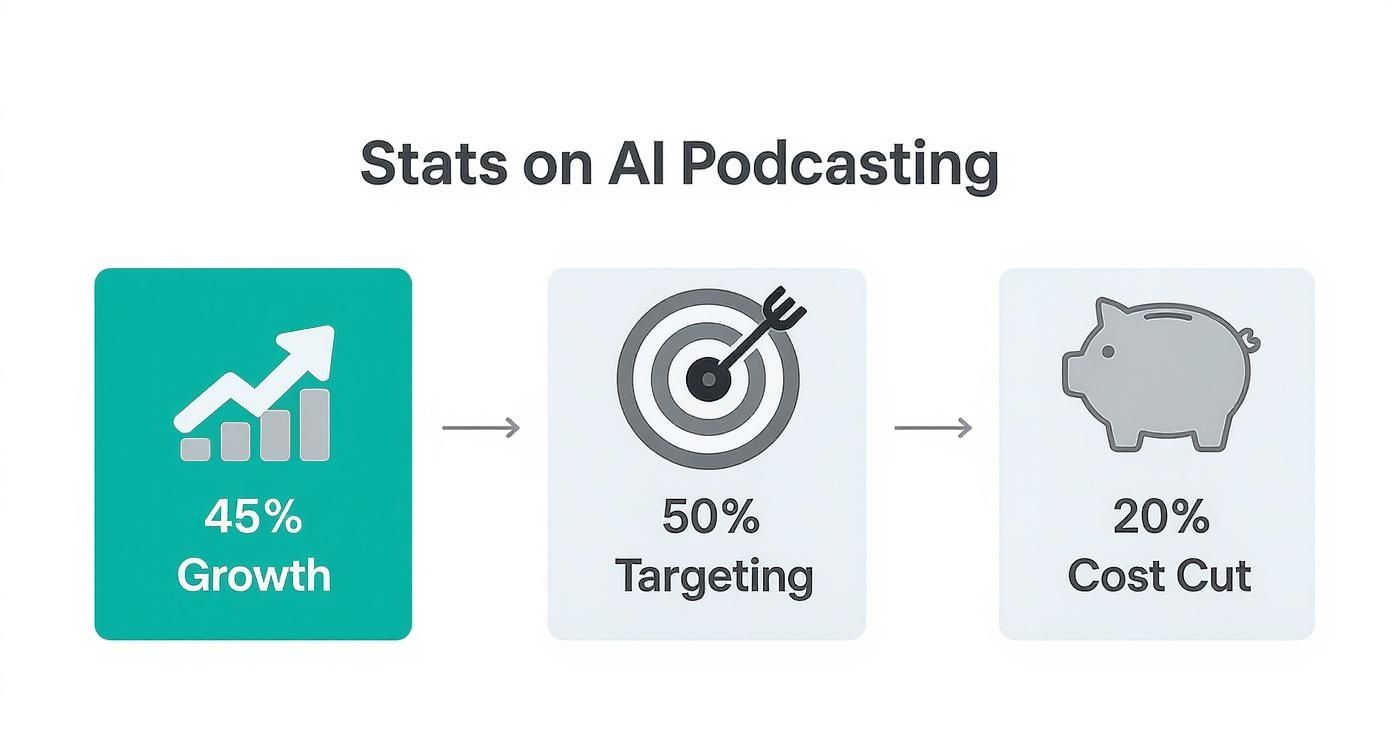
These stats show that as producing and targeting content becomes more efficient, it's fueling listener growth and opening up new doors for podcasters to connect with audiences.
Expanding Your Reach to New Platforms
To really grow your podcast, you have to meet listeners where they are. While getting your show into all the major podcast directories is non-negotiable, there's one platform that's an absolute discovery powerhouse: YouTube. It's the second-biggest search engine in the world, and a huge number of people now use it to consume podcasts.
You don't need a fancy video studio to get in on the action, either. Simply repurposing your audio for a video format is incredibly effective.
- Static-Image Videos: The absolute easiest way to start. Just upload your full audio episode with your podcast cover art as the background image.
- Audiograms: These are short, dynamic video clips that pair a snippet of your audio with a moving waveform and captions. They're perfect for teasing your full episodes on YouTube Shorts, Instagram Reels, and TikTok.
By putting your podcast on YouTube, you're tapping into a completely different discovery algorithm. This strategy not only introduces you to a new audience segment but also makes your content more shareable, creating more pathways for listeners to find—and get hooked on—your show.
Execute a Powerful Promotion Strategy
Making a great podcast is only half the job. Honestly, it's the easier half. If you want to grow your audience, you need a promotion plan that’s just as consistent and well-planned as your content. Without one, you’re basically just shouting into the void, hoping someone wanders by. A solid promotion strategy is what turns all your hard work into real, sustainable growth.
The key isn't to be everywhere all at once. It's about showing up in the right places with content that actually fits the platform. That means you've got to move beyond just dropping a link and praying for clicks.
Go Native on Social Media
Every social platform has its own vibe, its own culture. A one-size-fits-all post just gets scrolled past. Instead, you need to create content that feels like it belongs there. It shows you get the platform and respect the people using it.
Here’s a look at how you can switch things up for different channels:
- Instagram & TikTok: This is the home of the audiogram. Pull a powerful 30-second snippet from your episode, pair it with some dynamic waveforms and captions, and you've got a perfect Reel or Story.
- X (formerly Twitter): Grab a single, controversial quote or a mind-blowing statistic from your show. Turn it into a thread, ask a question at the end to get people talking, and then jump into the replies.
- LinkedIn: If your podcast leans into business or professional development, share a key insight from your latest episode. Frame it as a strategic takeaway or a lesson learned that your network can actually use.
Making all this custom content can feel like a full-time job, but there are some fantastic content creation tools for social media out there that can seriously streamline making clips, graphics, and audiograms.
Your Email List is Your Most Valuable Asset
Look, social media algorithms are fickle. They can change overnight. But your email list? That’s something you actually own. It’s a direct line to your biggest fans and an absolute must-have for growth.
Start building your list from day one. Offer something valuable in exchange for an email—maybe a bonus checklist, an extended interview clip, or a resource guide mentioned in the show. Use that list to announce new episodes, share behind-the-scenes stories, and even ask for feedback. This kind of direct conversation builds a much deeper bond than any social media post ever could.
Tap into New Audiences with Cross-Promotions
One of the single most effective ways to grow is to get in front of people who are already listening to podcasts. The easiest way to do that? Team up with other podcasters in your niche.
Appearing as a guest on another podcast is like getting a warm introduction to a room full of your ideal listeners. They already trust the host, and that trust extends to you, making them far more likely to check out your show.
Start by making a list of 5-10 podcasts that share a similar audience but aren't direct competitors. Then, build a real relationship first. Listen to their show, leave a thoughtful review, engage with them on social media. When you finally pitch them, frame it around the value you can bring to their audience, not just what you want to get out of it.
Consider Paid Ads for a Targeted Boost
Once you’ve got a good thing going and you really know who your ideal listener is, paid advertising can be like pouring gasoline on the fire. Platforms like Spotify, Overcast, and the usual social media sites let you target ads with incredible precision—down to demographics, interests, and even listening habits.
For example, you could run a campaign on Spotify that only targets users who follow specific podcasts in your genre. This makes sure your marketing dollars are being spent on people who are very likely to enjoy your show. Start with a small budget to see what works. Once you see a positive return in the form of new, engaged subscribers, then you can scale up. Understanding how podcasters are redefining global influence can also help you shape these campaigns for a wider reach.
Turn Your Listeners Into Vocal Advocates
Let's be honest, chasing download numbers alone is a hollow victory. The most powerful growth engine you'll ever have is good old-fashioned word-of-mouth, and that only kicks in when you stop treating people like listeners and start treating them like partners.
The goal is to transform your audience from passive consumers into passionate advocates for your show. This happens when they feel seen, heard, and genuinely connected to what you're creating. It’s not about just hoping they’ll share; it’s about building a system that makes them want to.
Make Specific, Actionable Asks
The classic "please rate and review" at the end of every episode? It’s background noise. Your audience has learned to tune it out. To get real results, you have to get specific and weave your requests directly into your content.
Instead of the same old tired plea, try integrating your calls-to-action right into the conversation:
- Ask for Topic Ideas: "Next month, we’re doing a deep dive on productivity hacks. What’s the one tool you absolutely can't live without? Send it my way, and I'll feature the best ones on the show."
- Request Specific Feedback: "I tried out that new 'lightning round' segment today. What did you think? Shoot me a quick email and let me know if it's a keeper."
- Pose a Direct Question: "Our guest just shared a pretty controversial take on remote work. Where do you stand? Head over to our latest Instagram post and drop your two cents in the comments."
This isn't just about getting engagement; it's about turning a one-way broadcast into a two-way conversation. That’s how you build real loyalty.
Build a Central Community Hub
A scattered audience can’t build momentum. To really cultivate that tribe-like feeling, you need to give your listeners a dedicated place to hang out, connect with each other, and talk directly with you. Think of it as your podcast’s clubhouse.
The key is to meet them where they already are. Don't try to force them onto a new platform they’ve never heard of.
- A Discord server works brilliantly for tech or gaming-focused shows where real-time chat is king.
- A private Facebook Group is a no-brainer if your audience is already there, making it easy to host discussions and polls.
- A dedicated Subreddit is perfect for niche topics where listeners are already accustomed to deep, threaded conversations on Reddit.
This hub does more than just build a community. It gives you an incredible feedback loop and an army of super-fans ready to rally behind every new episode you drop.
The real magic happens when your listeners start talking to each other, not just to you. A thriving community creates its own gravity, making your podcast an essential part of your audience’s weekly routine and social life.
The Power of Public Recognition
Everyone loves a shout-out. It’s human nature. One of the simplest, most powerful things you can do is acknowledge your listeners by name, right on the podcast.
Make it a regular segment. Take a minute to read a five-star review from Apple Podcasts or share a thoughtful email someone sent you. When you mention someone's name and what they said, you’re not just making their day; you're sending a powerful signal to everyone else that you're actually listening.
This simple act validates their effort and lights a fire under others to leave their own review or send that email, hoping for their own moment in the spotlight.
And believe me, people are listening deeply. Research on listenership trends shows that committed fans are becoming the norm. By 2025, it's projected that 34% of American podcast listeners will be consuming an average of 8.3 episodes per week. With weekly listeners already making up 40% of the US population over 12, fostering that deep engagement is how you win.
Common Questions Every Podcaster Asks About Growth
If you're trying to grow your podcast, you've probably asked yourself these questions. It's a universal part of the journey. You've poured your heart into creating a great show, and now you're wondering what it really takes to get traction. Let's get straight to the answers you're looking for.
How Long Does It Actually Take to See Real Growth?
This is the big one, isn't it? The honest, no-fluff answer is that it's a marathon, not a sprint. While you might hear stories about shows blowing up overnight, that's the exception, not the rule. For most of us, sustainable growth is a slow burn.
You should realistically expect to see a consistent, meaningful climb in your download numbers after at least six to nine months of putting out regular episodes and promoting them. The first few months are all about laying the groundwork—proving to your early listeners that you're showing up for them every single time with quality content. Growth really starts to snowball when those listeners start telling their friends and the podcast apps start recognizing your show as a go-to voice in your niche.
Don't let the initial slow pace get you down. Your job in the beginning is to build a fantastic, binge-worthy backlog and stick to your promotion plan. Consistency is your best friend; the audience will find you.
Should I Publish Weekly or Every Two Weeks?
The best release schedule is the one you can actually maintain without killing yourself or letting the quality slip. Consistency trumps frequency, every time. A rushed, sloppy weekly show will hemorrhage listeners way faster than a polished bi-weekly episode that delivers real value.
To figure out your cadence, think about this:
- Your Real-Life Bandwidth: Be honest. How much time can you realistically set aside for recording, editing, and creating promo materials each week?
- Your Listeners' Digestion Time: If you're covering deep, complex topics, a bi-weekly schedule gives your audience time to absorb everything. But if you’re covering current events or pop culture, weekly is probably the way to go to stay relevant.
- Your Show's Format: A heavily produced, narrative-style podcast is a beast to create. A bi-weekly or even monthly release might be the only practical option. A simple interview show? That's much easier to turn around weekly.
Whatever you choose, just be clear about it with your audience. Announce your schedule and stick to it. That's how you build trust.
When Is the Right Time to Start Monetizing?
Monetization should be in the back of your mind from day one, but it shouldn't be your focus. Trying to cash in too early, before you have a core group of loyal fans, can feel a bit desperate and might even turn off potential new listeners.
First, build the community. A solid benchmark is to start seriously exploring monetization options once you're consistently getting 1,000 to 5,000 downloads per episode within the first 30 days. That's the point where you have an audience that's substantial enough to interest advertisers, support a Patreon, or buy your merch. Your primary job at the start is growth. Monetization is the payoff for doing that job well.
At SFX Engine, we help podcasters create a signature sound that hooks listeners. If you want to elevate your show with professional, AI-generated custom audio, check out what we're building at https://sfxengine.com.