Door Opening Sound: Master the door opening sound for film and game
Learn how to capture, layer, and mix a door opening sound that tells a story for film, games, and interactive media.
Kuba RogutPublished 15 min read
A good door opening sound does so much more than just fill a moment of silence. It’s one of the most effective, yet subtle, tools we have for setting a scene, defining a space, and even telling the audience how to feel. Get it right, and you've instantly communicated setting and mood. A rusty, groaning hinge in a horror film and the clean, pneumatic hiss of a sci-fi airlock are worlds apart, and it all comes down to the sound.
Why a Door Opening Sound Is More Than Just Noise

Think about it. In a game or a film, the sound of a door is often your first real clue about the environment you’re about to step into. It’s a piece of world-building that works on an almost subconscious level, but it’s incredibly powerful.
That rickety screen door rattling on its hinges? It paints a totally different picture than the heavy, booming echo of a cathedral entrance. As sound designers, we use these auditory cues to guide the audience's expectations and build a real emotional connection. A slow, high-pitched creak puts everyone on edge, creating suspense, while a quick, slick latch click might suggest a modern, efficient, or even sterile environment.
The Storytelling Power of Sound
This is where sound design gets really fun and creative. While you can always grab a generic door opening sound from a library, designing one from scratch gives you complete control over the story you're telling. This process is about so much more than just sticking a microphone in front of a real door.
It's about building an entire experience by layering different sonic elements together. I always think about three key things:
- Material: Is it the heavy groan of old, weathered wood or the hollow clang of industrial metal?
- Mechanism: Are we hearing a simple handle turn, a complex bolt sliding into place, or a futuristic, sensor-triggered whoosh?
- Environment: The sound's reverb and decay tell us everything. Does the door open into a tiny closet or a vast, empty warehouse?
Sound design isn't just about what you hear; it's about what you feel. A single door opening can make an audience feel dread, relief, or curiosity before anything is even shown on screen.
Thankfully, you no longer need a multi-million dollar studio to do this effectively. With tools like AI sound generators, creating a high-quality, custom door opening sound has become incredibly straightforward. You can just describe the scene—for instance, "ancient stone tomb door scraping open in a dusty cavern"—to get a unique effect that fits perfectly. Of course, if you're keen on the hands-on recording process, our article on what is Foley sound is a great place to start.
Laying the Groundwork: Your Pre-Production Plan
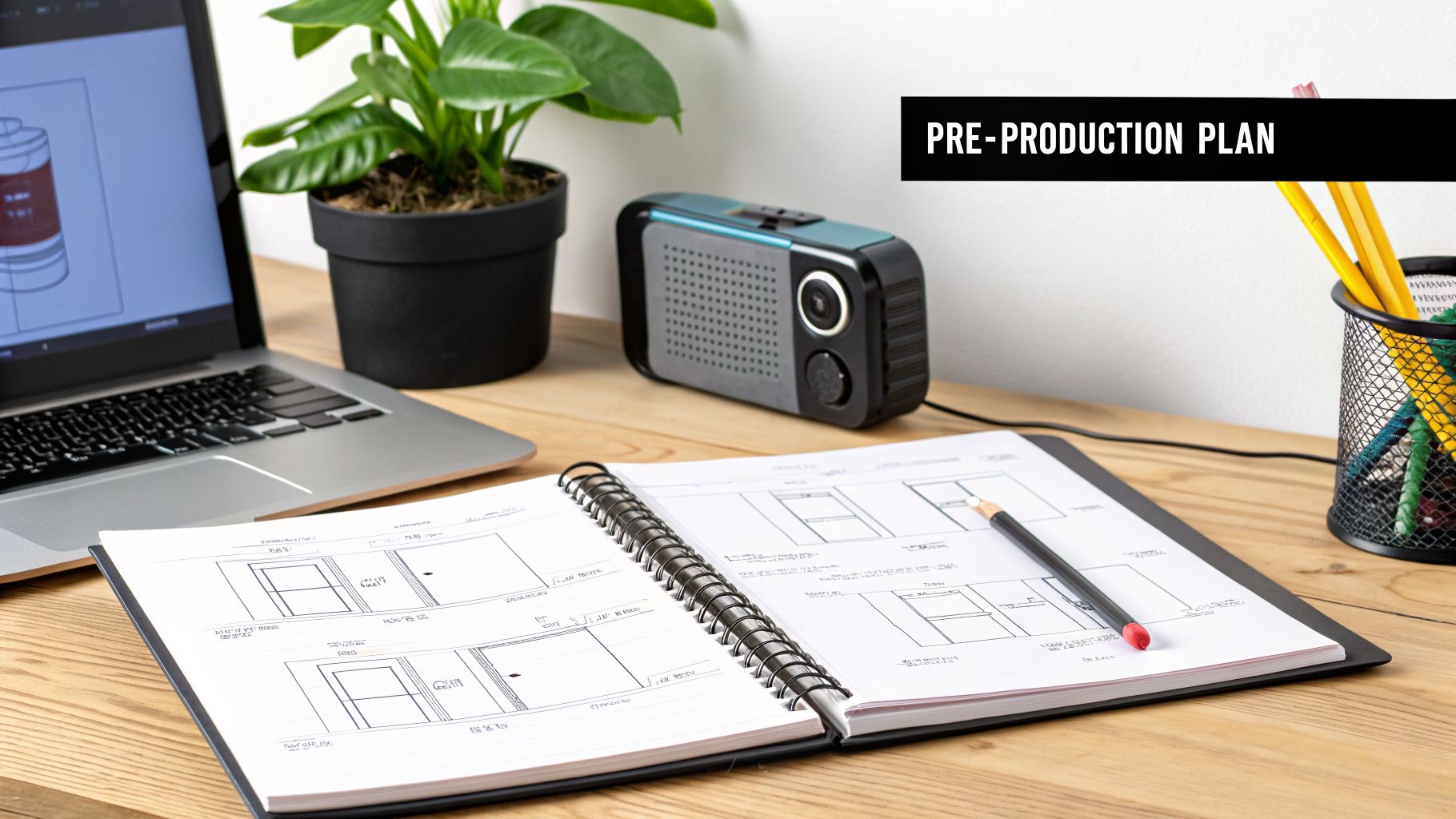
Before you touch a microphone or open your DAW, we need to talk about planning. I know it’s tempting to jump right in, but trust me—the work you do before you make any noise is what separates a forgettable, generic effect from an immersive door opening sound that truly sells the scene.
This is where you ask the big questions. A door is never just a door; it’s a gateway that tells a story. Think about where it leads. Is it opening to a sterile, high-tech lab or a forgotten, dusty crypt? That context changes everything. The lab door might have a quick pneumatic hiss and a clean magnetic thunk, while the crypt door needs a heavy, scraping groan and the haunting echo of a vast, empty chamber.
Define the Door's Physical Identity
Once you know the story, you can get specific about the door itself. This is my favorite part—it's like building a character profile. I find it really helps to jot down notes on a few key traits.
Think about these details:
- Material: Is it thick, heavy oak? Flimsy, rattling aluminum? Solid, unforgiving steel? The material is the soul of the sound, defining its core frequencies and texture.
- Size and Weight: A small locker door is going to have a quick, tinny latch click. A massive bank vault door, however, needs a deep, low-frequency groan and a heavy, resonant clunk to communicate its sheer mass.
- Condition: Is this door brand new and perfectly oiled, or is it ancient, weather-beaten, and caked in rust? Its condition adds all the character—the creaks, squeals, and rattles that make it feel real and unique.
Don’t forget the mechanism, either. A simple doorknob and latch sounds completely different from a complex hydraulic system or a sci-fi keypad lock. Each part of the process creates its own distinct sound that you’ll need to capture or build.
Build a Sonic Mood Board
With a clear picture of your door in mind, it's time to gather inspiration. Think of this as creating a sonic mood board. Hunt down existing sound effects, pull clips from films, or even find real-world recordings that have elements you like.
Your goal isn't to copy these sounds, but to deconstruct them. Listen for what makes them work—the low-end weight, the high-frequency detail of the latch, the specific reverberation of the space.
This process gives you a concrete target. It keeps you focused and ensures your final door opening sound is intentional and serves the story. This blueprint is your foundation for everything that comes next, from recording and layering to the final mix.
Sourcing and Recording Your Sonic Palette
Once you’ve got a plan, it's time to start collecting your raw audio. This is the fun part, where you get to decide if you want to capture real-world sounds yourself or tap into the power of digital tools. Honestly, the best results often come from a mix of both.
You might, for instance, record the physical click of a latch but use an AI generator to create a supernatural whoosh that you’d never find in reality. This hybrid approach gives you tremendous creative freedom, no matter your budget or what gear you have on hand.
Hands-On Foley Recording
There's something incredibly satisfying about recording your own sounds, a process known as Foley. It’s how you capture the unique grit, squeaks, and imperfections that make a sound feel truly grounded and real. You don't need a fancy studio—just a decent microphone and a bit of ingenuity.
Your microphone choice makes a big difference. A condenser microphone is brilliant for picking up the delicate, high-frequency details of a hinge creaking or a key scraping in a lock. For a more abstract texture, try a contact microphone. You can stick it directly onto the door to capture all the internal vibrations and resonances—sounds you literally can't hear with your own ears.
Of course, finding a perfectly quiet spot can be a challenge. If you find yourself recording in a noisy environment, a little extra planning and some cleanup in post-production can go a long way.
I’ve gotten some of my best material from the most unexpected sources. Twisting an old leather wallet makes a fantastic hinge creak, and dropping a heavy book on a wood floor can give you that perfect low-end "thump" for a massive door slamming shut.
Think like a performer and get creative with how you capture the sounds. Don't just open and close a door over and over.
- Break it down: Record each part of the sound separately. Get the handle turn, the latch click, and the door swing as isolated events. This gives you way more control later.
- Vary your performance: Capture the action at different speeds and intensities. Do it slowly, quickly, gently, and aggressively.
- Use props: Need the sound of a stone door? Scrape a cinder block on concrete. Looking for the intricate sound of a lock mechanism? Jingle and manipulate a set of old keys right next to the mic.
Using Sound Libraries and AI Generators
If you're short on time or don't have recording gear, sound libraries and AI generators are your secret weapon. They offer a vast palette of professionally produced sounds you can instantly layer and tweak.
This is exactly what tools like our SFX Engine were built for. Instead of spending hours hunting through a library for a sound that’s almost right, you can generate the perfect one from scratch just by describing it.
For example, you could start building your door sound with prompts like these:
heavy cast iron dungeon door scraping on a stone floorfuturistic sci-fi airlock door opening with a pneumatic hiss and beepold wooden cabin door creaking open with a rusty latch click
This approach is perfect for creating tons of variations quickly. You can generate the core sound components and then sprinkle in a few of your own recorded Foley details to make the final product feel completely custom.
2. Layering and Timing Your Sound
A convincing door opening sound is almost never a single recording. It's a performance, built piece by piece inside a digital audio workstation (DAW). The real magic begins when you stop thinking of it as one sound and start treating each element like a character in a short story.
Layering is how we build that story. A raw field recording of a door often sounds flat or lacks a certain oomph. By building the sound from separate components, you get total control over its personality, weight, and impact.
Building Your Sound from the Ground Up
Think of it like deconstructing the sound’s anatomy. A heavy oak door doesn't just make one noise; it’s a quick sequence of events. Each of those moments deserves its own track in your project.
To get a realistic, full-bodied door sound, you need a few essential layers working together.
Here’s a breakdown of the core components I always start with:
Essential Layers for a Realistic Door Sound
| Sound Layer | Sonic Purpose | Recording or Generation Tip |
|---|---|---|
| The Latch | Provides the initial sharp, mechanical transient—the click or clank. | Isolate the sound of a lock turning or a latch disengaging. A simple key-in-lock can work wonders. |
| The Weight | Communicates mass with a low-end thump or subtle bass swell. | Record a heavy book dropping on a carpet or generate a low-frequency sine wave with a quick fade-in. |
| The Texture | The "character" layer—the creak, groan, or scrape that tells a story. | This is where to get creative. Record an old chair, a rusty hinge, or drag furniture across the floor. |
| The Movement | A soft whoosh of air being displaced, adding realism and filling space. | Gently swing a blanket past your microphone or use a low-passed noise generator with volume automation. |
By separating these elements, you can mix and match to build any door imaginable, from a creaky cellar door to a futuristic airlock.
This process gives you the best of all worlds: the organic feel of real recordings, the speed of generated sounds, and the flexibility to blend them seamlessly.

A modern workflow really is a mix of all three. I'll often record my own Foley for the unique textures but lean on generated sounds for clean, fundamental elements like the latch click or the low-end weight.
The Critical Role of Timing
Once your layers are in the DAW, timing is everything. If they're not perfectly aligned, you just have a jumble of noise. Your job is to sequence them so they feel like a single, cohesive event.
It’s all about tiny offsets. Stagger the start of each layer by just a few milliseconds to mimic how the sound would unfold in the real world.
The latch click should fire first. Almost immediately after, the low-end thump kicks in as the door's weight shifts. The creak then unfolds as the door begins its swing, while the air whoosh swells and fades to match the motion. This careful orchestration is what sells the illusion.
This level of detail is more important than ever. With high-fidelity formats like 4K Dolby Atmos, audiences can hear every nuance. It's no surprise that door sounds in major films are layered 70% more frequently in the post-2010 era than they were before. This demand for hyper-detailed, royalty-free audio is a huge reason why AI generators and specialized libraries have become so essential.
The weight of a door is felt in the low frequencies, but its age is heard in the mids. Each layer has a specific job—the click provides the sharp transient, the groan adds character, and the low-end thump sells the mass.
By isolating, perfecting, and sequencing each component, you transform a simple effect into a powerful piece of sonic storytelling. For a deeper look at crafting those all-important textures, check out our guide on how to create the perfect creaking door sound effect.
Processing and Mixing Your Sound
Once your layers are recorded and perfectly timed, the real magic begins. This final mixing stage is where all those individual elements blend together into a single, cohesive sound. It’s what separates a decent door opening sound from a truly great one.
Think of this as the final 10% of polish. A few careful adjustments with EQ, compression, and reverb can add a surprising amount of impact, character, and realism, completely transforming how the sound feels to the listener.
Carving Out Space with EQ
Your first move is usually with an equalizer. EQ is all about creating clarity, ensuring each layer of your sound has its own space in the frequency spectrum so nothing turns to mud.
For instance, that sharp latch click needs to cut through everything else. I often give it a slight boost somewhere in the 2-5 kHz range to give it presence without making it painfully sharp. On the flip side, you can clean up your creak and scrape layers by using a high-pass filter. This rolls off the unnecessary low-end rumble, leaving plenty of room for the deep "thump" of the door's weight. If you're new to this, we have a guide that breaks down the difference and explains when to use EQ vs. compression.
Adding Punch with Compression
Next up is compression. This is your tool for controlling the dynamic range, essentially evening out the volume so the quietest parts aren't lost and the loudest parts don't clip. For a door sound, this is how you get that satisfying punch.
Set a fast attack on your compressor to tame the sharp transient of a latch click, making it sound solid instead of piercing. Or, try a slower attack. This lets the initial crack of the sound punch through before the compressor kicks in, which can make the whole event feel much more powerful and aggressive.
Think of compression as the glue holding your layers together. It smooths out the peaks and valleys, helping to meld the individual recordings into one unified and impactful sound event.
Getting this right is crucial, especially when you're mixing for games or film. It ensures your door sound has an impact without stomping all over the dialogue or music.
Placing the Door in an Environment
Finally, reverb and delay are what give your sound a sense of place. These effects tell the listener’s brain whether the door is in a tiny closet, a tiled bathroom, or a massive, empty warehouse. It’s all about simulating how sound bounces off surfaces.
- Short Reverb: A tight, quick decay time feels like a small, furnished room.
- Long Reverb: A long, cavernous reverb tail immediately paints a picture of a huge space, like a cathedral or an empty hangar.
- Slapback Delay: A single, fast echo gives the impression of a sound bouncing off a nearby hard wall—perfect for an alleyway or a concrete hallway.
Understanding acoustics is more important than ever. In fact, the global acoustic doors market was valued at USD 924.5 million in 2025 and is still growing, as detailed in a market analysis from Fact.MR. This shows a huge demand for spaces where sound is perfectly controlled, often using doors with high STC 40-50 ratings to block over 90% of mid-frequency sound. That same principle of acoustic control applies to the sounds we design.
Adapting Your Sound for Different Scenarios
If there’s one thing I’ve learned after designing hundreds of door sounds, it’s that there's no such thing as "just a door." A door opening is a narrative beat. Is it a rusty hinge in a haunted house, a sleek airlock on a starship, or a heavy vault door guarding a fortune? The sound tells the story long before the visuals do.
The real craft isn't just making a sound; it's making the right sound for the moment. This is where your approach has to be flexible. The demands of a film, for instance, are totally different from those of a video game. In a movie, you might spend a whole day perfecting one single, heroic creak for a critical scene. But in a game, if a player opens that same door 50 times, hearing the exact same creak will shatter the illusion faster than anything.
Tailoring Sound for Specific Door Types
Let's get practical and talk about a few classic door types. Think of these as sonic recipes—a starting point you can riff on.
-
The Haunted House Door: Forget subtlety. You want pure, drawn-out tension. My go-to is a long, high-pitched creak as the main element, usually from a recording of stressed wood or old, rusty metal. The key is to vary the timing and pitch so it feels agonizingly slow and unpredictable. I often tuck a very low, subtle groan underneath it all to give the door a sense of ancient, heavy dread.
-
The Sci-Fi Airlock: This is all about clean, precise, and technological sounds. I build these sequentially. It starts with a quick electronic chirp or beep to signal activation. That's immediately followed by a powerful, sharp hiss of depressurizing air. It all resolves with a satisfying, metallic clunk as the mag-locks retract. Sharp, clean, and no-nonsense.
-
The Bank Vault: This needs to sound impossibly heavy and secure, which means you need to own the low frequencies. I start with a deep, mechanical grind of massive gears turning. Then, I layer in a series of heavy, staggered clunks—not all at once!—as the locking bolts disengage. A final, heavy scrape of metal-on-metal as the colossal door begins to move sells the immense weight.
Game Audio vs. Film Audio
So you’ve just nailed that perfect bank vault sound. How you use it completely changes depending on the medium.
In a game, variety is king. You need to head off listener fatigue. This means creating multiple variations. Even subtle shifts in pitch, timing, or which layers are prominent can make the world feel dynamic. A project might require 10 slightly different versions of a simple wooden door creak, which the game engine can then trigger randomly. It’s a small detail that makes a world of difference to immersion.
For film, it's about a single, perfect performance. That one door opening might be a symphony of dozens of layered elements, all meticulously mixed and timed to the camera angle, the score, and the emotional state of the character. It’s less about quantity and all about singular, narrative impact.
The real art is knowing when to bend reality. A sound that's physically inaccurate but emotionally right for the scene is always the better choice. We're telling stories, not creating scientific documents.
This is also where real-world research comes in. You have to consider the door's material and purpose. For example, the soundproof door market is projected to grow from USD 1,020 million in 2024 to USD 1,388 million by 2033. Why does that matter to us? Because it reflects a real-world technology we need to emulate. A standard wooden door might peak at 80 dB, but a heavy steel door could hit 95 dB. A sound-dampened door, with its gaskets and seals, might only produce a quiet whoosh and a soft click, reducing noise by over 30 dB. Knowing these details, which you can find in various industry analyses, helps you build a believable world.
Mastering these nuances is what separates a good sound designer from a great one.
Ready to build your own custom sound effects? With SFX Engine, you can go from a simple text prompt to a fully-realized door sound in seconds. Design everything from a creaky cabin door to a futuristic blast door, all royalty-free. Give it a try for free and see what you can create.