What Is Sound Masking and How Does It Boost Workplace Focus
Discover what is sound masking and how it creates a more focused, private, and productive environment. Learn the science behind this powerful acoustic solution.
Kuba RogutPublished 16 min read
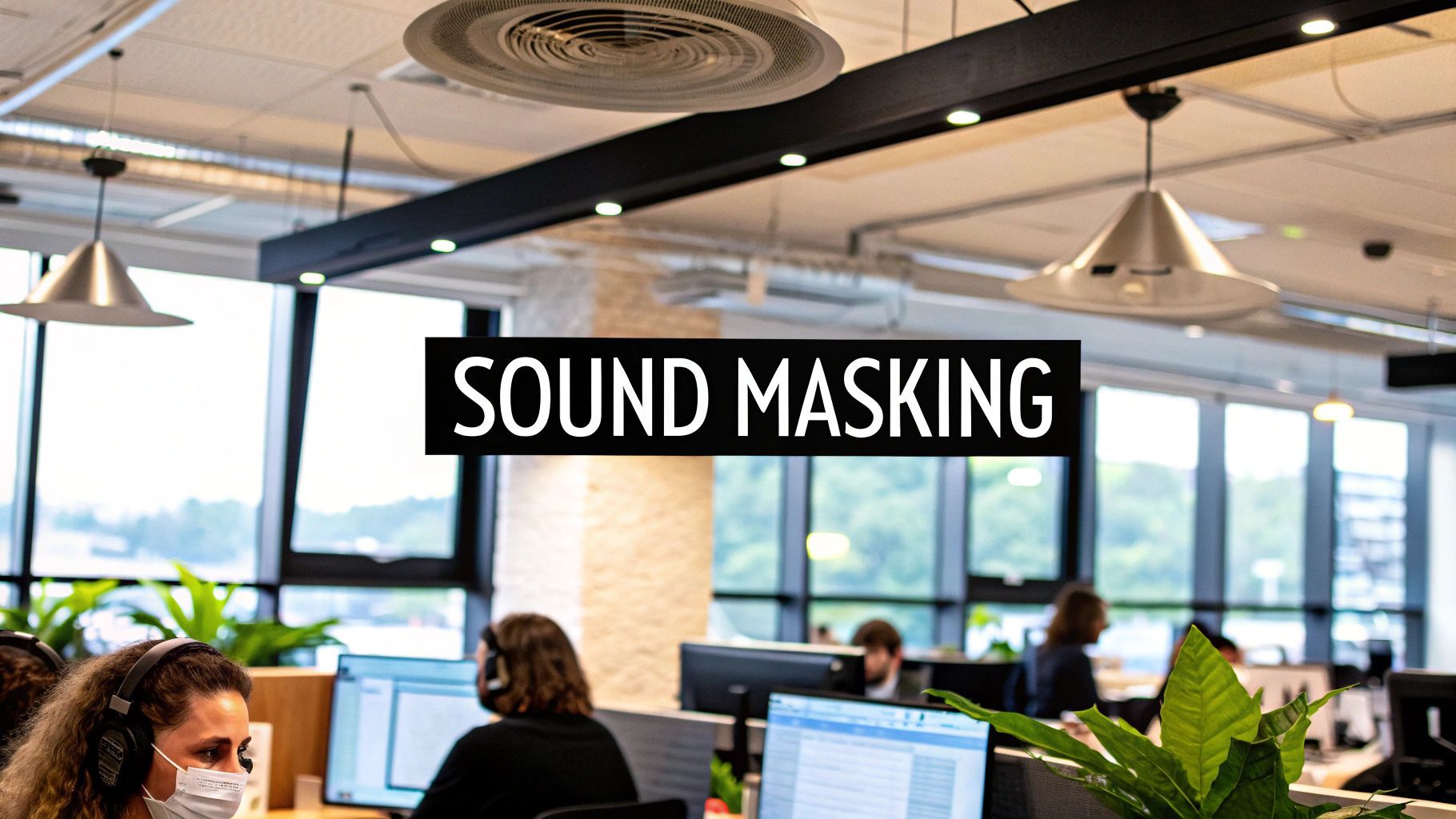
Ever tried to concentrate when you can hear every word of a conversation happening just a few feet away? It's nearly impossible. Your brain is hardwired to latch onto human speech, pulling your focus whether you want it to or not.
Sound masking is the art of solving that exact problem. It’s not about blocking sound or making a room silent. Instead, it’s the subtle introduction of a specially engineered background sound that gently raises the ambient noise level of a space.
Think of it this way: In a dead-quiet library, even a whisper can travel across the room and grab your attention. But if you’re next to a softly flowing fountain, that same whisper gets lost in the gentle, constant sound of the water. The whisper is still there, but it's no longer intelligible. It just becomes part of the background.
That’s the core principle of sound masking. It creates an “acoustic cushion” that makes distracting human speech fade into an uninteresting, un-distracting murmur.
The Art of Acoustic Privacy
This technique is a game-changer in modern acoustic design, especially in open-plan offices, healthcare clinics, and anywhere else that speech privacy and focus are paramount. It’s how you create a sense of confidentiality and concentration without having to build a single wall.
The goal isn't to add more noise, but to add the right kind of sound. This "sound floor" is carefully tuned to match the frequencies of human speech, effectively covering it up without being intrusive itself. When done right, you barely even notice it’s there—you just notice that you can finally get your work done.
A Recognized Solution for Focus and Confidentiality
This isn't just a clever trick; it's a well-documented and recognized acoustic strategy. Major standards organizations and regulatory bodies see sound masking as a legitimate tool for improving workplace environments.
For instance, healthcare facilities rely on these systems to help meet patient privacy requirements, ensuring sensitive conversations in examination rooms aren’t overheard in the waiting area. As noted in resources on building safety from IFMA's blog, it’s a critical component of a well-designed space.
Ultimately, the benefits are both subtle and incredibly powerful:
- Enhance Speech Privacy: It keeps confidential conversations private, preventing both accidental and intentional eavesdropping.
- Improve Concentration: Your brain doesn't have to work so hard to tune out nearby chatter, freeing up mental energy for deep focus.
- Decrease Noise-Related Stress: By creating a more consistent and less jarring soundscape, it can genuinely lower stress and reduce fatigue throughout the day.
To make this crystal clear, here’s a quick breakdown of the core ideas.
Sound Masking Key Concepts at a Glance
| Concept | Brief Explanation |
|---|---|
| Acoustic Cushion | Adding a subtle background sound to make other noises less noticeable, rather than trying to eliminate them. |
| Sound Floor | The baseline ambient sound level in a room. Sound masking raises this floor just enough to cover distractions. |
| Speech Intelligibility | How clearly words can be understood. The primary goal of sound masking is to reduce speech intelligibility. |
| Tuned Frequencies | The masking sound is engineered to specifically match the frequencies of human speech for maximum effectiveness. |
In short, sound masking is about controlling the acoustic environment to make it more comfortable, private, and productive for everyone in it.
The Science of Making Speech Uninteresting
Have you ever noticed how a conversation from across the room can completely derail your train of thought? It's not your fault. Our brains are hardwired for language. It’s an ancient survival skill, but in a modern office or studio, it’s also the reason a nearby chat is one of the most powerful distractions. Your brain automatically tries to decode it, even when you’re consciously trying to tune it out.
Sound masking plays a clever trick on this instinct. Instead of trying to cancel out noise, it introduces a gentle, unobtrusive background sound. Think of it as raising the "sound floor" of the room. This isn't just random noise; it's specifically engineered to match the frequencies of human speech.
The effect is surprisingly simple but profound. That distracting conversation is still there, but its clarity—what experts call Speech Intelligibility—is dramatically reduced. The sharp edges of the words soften and blur into the ambient sound, making the conversation acoustically "boring" to your brain, which can then let it go.
This diagram shows how this one core idea—sound masking—branches out to achieve its two main goals: better privacy and sharper focus.
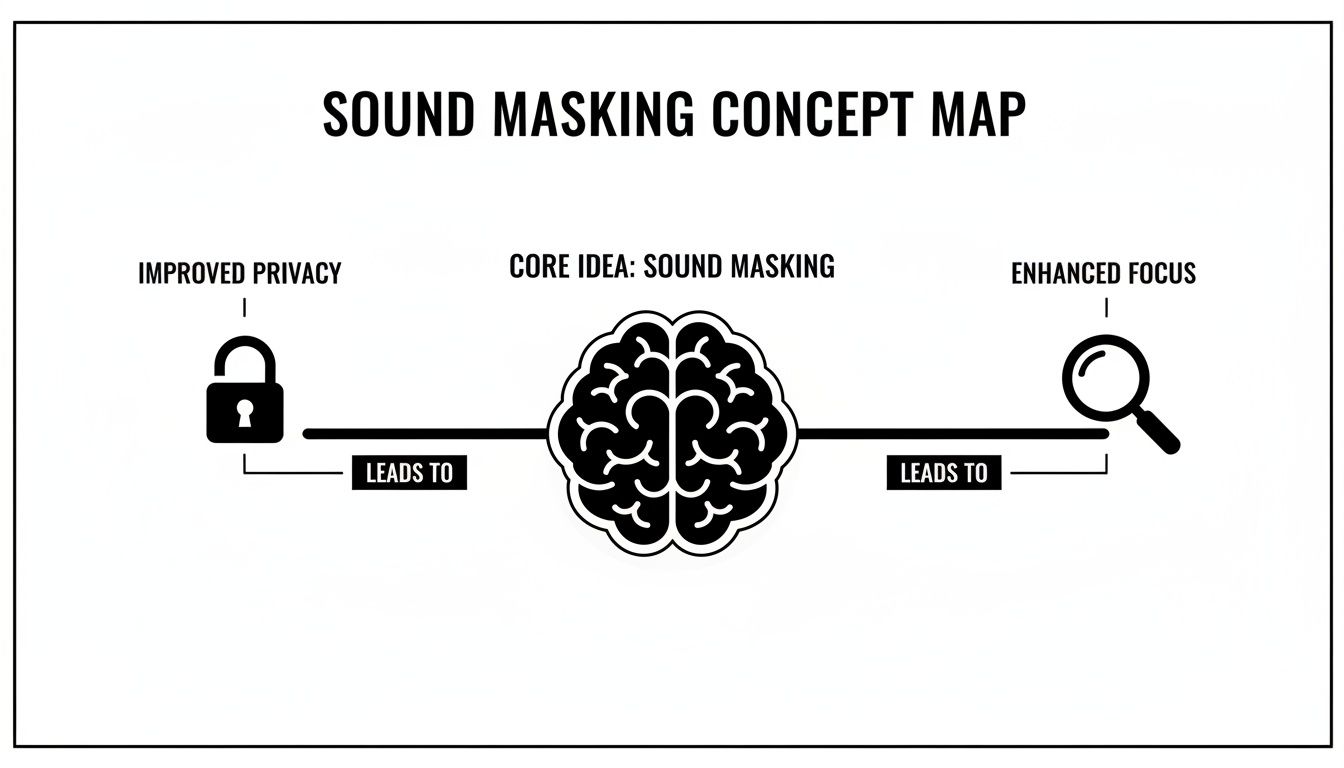
By turning clear, distracting speech into unintelligible background noise, sound masking gives your brain permission to disengage and get back to what you were actually trying to do.
Shrinking the Radius of Distraction
In acoustics, we measure how clearly speech can be understood with a metric called the Speech Transmission Index (STI). A high STI means you can hear every word of a conversation crystal clear. A low STI means the conversation is muffled and private. The entire goal of a sound masking system is to lower the STI in a space.
When you do that, you effectively shrink the "radius of distraction"—the physical distance at which a conversation can be overheard and understood. By raising the ambient sound floor, you can acoustically transform a big, noisy open-plan office into a collection of smaller, more focused zones without ever putting up a wall.
A key takeaway about sound masking is that it doesn't just make a space quieter; it makes it more acoustically comfortable. The aim isn't silence, but to reduce the noticeability of sound, turning jarring noises into a smooth, consistent hum.
This isn't just theory, either. One in-depth study on reducing workplace distractions found that a sound masking system reduced the radius of distraction from 13 meters all the way down to just 6 meters. That’s a 54% reduction in the area where conversations were intelligible. The result was a tangible shift in the office environment, helping people reclaim their focus and privacy.
Sound Masking vs. Soundproofing vs. White Noise
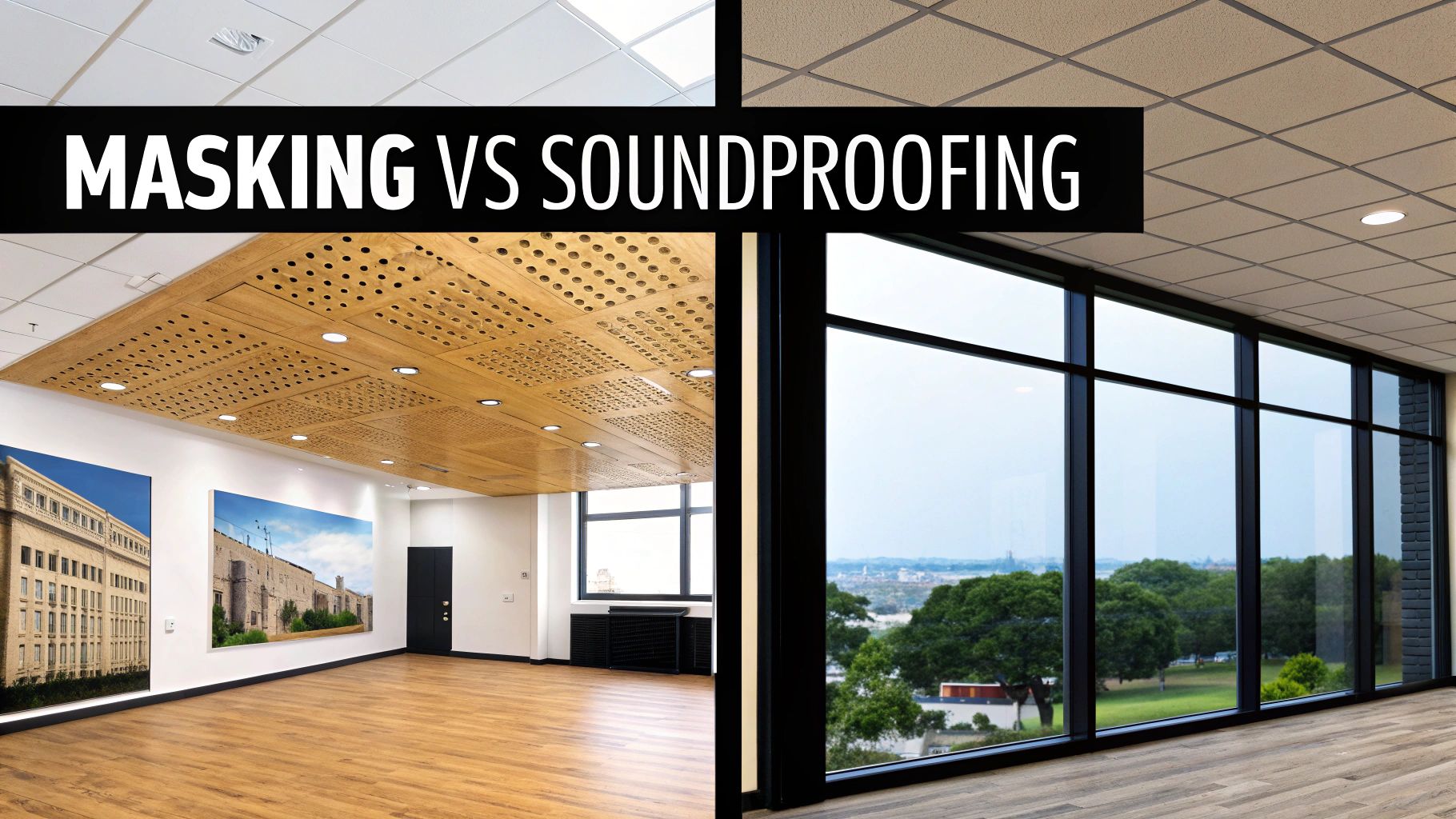
When you're dealing with noise problems, it's easy to get lost in the terminology. People often throw around terms like sound masking, soundproofing, and white noise as if they're the same thing. They aren't. Each one tackles acoustic challenges in a completely different way, and picking the right one depends entirely on what you're trying to achieve.
Let’s think of unwanted sound as a leaky pipe in your house. Each of these methods offers a distinct strategy for dealing with that annoying drip.
Soundproofing: The Structural Barrier
Soundproofing is the most literal solution—it's like grabbing a wrench and some sealant to physically patch the leaking pipe. The goal here is containment. You're using dense, heavy materials to build a physical barrier that stops sound from getting in or out of a space.
This is a construction-based approach. Think adding mass-loaded vinyl, installing double-paned windows, or building insulated, double-stud walls. It's incredibly effective for creating true acoustic isolation, but it's also expensive, disruptive, and often impractical for existing buildings, especially open-plan ones. If you need to build a recording studio or block out the rumbling of a nearby train, soundproofing is the only way to go. You can learn more about this in our guide on how to sound deaden a room.
White Noise: The Brute-Force Approach
If soundproofing is patching the pipe, white noise is like cranking up a loud faucet right next to it to drown out the dripping sound. It’s a harsh, static-like signal that blasts out equal energy across all audible frequencies.
While it can cover up other noises, many people find it grating and fatiguing. That constant, hissing quality can become just as distracting as the noise you were trying to get rid of in the first place. It's a brute-force tactic that often just trades one annoying sound for another.
Sound Masking: The Finesse Solution
Sound masking is the most elegant of the three. It’s not about blocking or drowning out the sound. Instead, it’s like introducing the gentle, constant sound of a babbling brook into the room. The original drip from the pipe is still there, but it now blends seamlessly into the background, becoming unnoticeable.
Unlike the harshness of white noise, sound masking uses a sound spectrum carefully engineered to match the frequencies of human speech. It doesn't block sound; it just makes nearby conversations less intelligible, causing them to fade into the ambient environment.
Sound masking adds to the environment, while soundproofing subtracts from it. Masking introduces a comfortable, engineered sound to cover distractions, whereas soundproofing uses physical mass to block sound transmission entirely.
This subtlety is what makes sound masking a fantastic solution for improving speech privacy and focus in places like open offices, clinics, or libraries without resorting to costly construction. It's a comfortable, barely-there, and highly effective way to manage the acoustics of a shared space.
Comparing Acoustic Treatment Methods
To make the differences even clearer, let's break them down side-by-side. Each method has its own strengths, weaknesses, and ideal scenarios.
| Feature | Sound Masking | Soundproofing | White Noise |
|---|---|---|---|
| Primary Goal | Reduce speech intelligibility, improve focus | Block sound transmission, create isolation | Drown out other sounds with a broad-spectrum noise |
| How it Works | Adds engineered ambient sound | Creates physical barriers with mass and density | Covers sound with a static, unfiltered signal |
| Sound Quality | Pleasant, like gentle airflow; designed to be ignored | No sound added, just silence | Harsh, static-like hiss; can be fatiguing |
| Best For | Open offices, clinics, libraries, shared workspaces | Recording studios, home theaters, confidential rooms | Simple noise coverage in non-critical environments |
| Cost | Moderate; scalable | High; involves construction | Low; often just a simple generator or app |
| Installation | Professional installation of speaker systems | Major renovation or construction work | Plug-and-play device or software |
| Flexibility | Highly flexible, can be tuned to the space | Inflexible once built | Limited; usually just on/off with volume control |
Ultimately, the right choice comes down to your specific problem. Are you trying to stop a conversation from being overheard, or are you trying to stop the sound of a jackhammer from getting inside? Understanding that distinction is the first and most important step in finding the right acoustic solution.
Key Benefits for Focus, Privacy, and Productivity
Knowing the science behind sound masking is interesting, but its real power is in the day-to-day difference it makes in a busy environment. By tweaking the acoustic landscape just enough, this technology delivers some serious upgrades in confidentiality, concentration, and just getting things done.
The most obvious win is enhanced speech privacy. Think about places where sensitive information is part of the job—HR, legal, or finance departments come to mind. Sound masking is a game-changer here. It stops private conversations about employee records or client details from unintentionally traveling across the room, essentially creating secure audio zones without building a single wall.
Boosting Deep Work and Reducing Mental Fatigue
Privacy is huge, but sound masking also takes on the number one enemy of focus: distracting chatter. Study after study points to coworker conversations as the top complaint in open-plan offices. One report found that a staggering 76% of employees named loud colleagues as their biggest distraction, while 68% felt they simply didn't have enough quiet time for focused work. You can find more details on how sound masking improves office productivity on infinitenetworksinc.com.
Sound masking gives employees back their cognitive resources. Instead of constantly fighting to ignore nearby conversations, the brain can disengage, allowing for sustained periods of 'deep work' that are crucial for complex problem-solving and creativity.
This reduction in mental strain has a ripple effect, benefiting both people and the business as a whole:
- Decreased Stress Levels: Constant interruptions can trigger stress hormones like cortisol and adrenaline, which can lead to anxiety and burnout over time. A calmer acoustic environment helps keep things more relaxed.
- Reduced Mental Fatigue: When your brain isn't working overtime just to filter out noise, you have more mental energy for the tasks that matter. People feel less drained at the end of the day, which is a big boost for well-being and job satisfaction.
- Increased Productivity: Fewer interruptions mean people can accomplish more. The same research suggests that a good sound masking system can claw back roughly 21 minutes of productive time per employee per day.
Of course, while sound masking is about adding a helpful sound to a space, sometimes the problem is removing unwanted sounds from a recording. If that's what you're dealing with, you might want to check out our guide on how to remove background noise from audio.
Ultimately, sound masking helps create an environment where focus is the default, not the exception. It can turn a space full of distractions into a place where great work happens.
Common Applications for Sound Masking
While the science behind sound masking is interesting, its real power shines through in how it solves everyday acoustic problems. This technology is surprisingly versatile, transforming spaces that are either too noisy or uncomfortably quiet into environments where people can focus and feel a sense of privacy.
The most classic example, of course, is the open-plan corporate office. The whole point here is to dial down the distraction level. By making nearby conversations less understandable, sound masking helps people stay in their creative flow instead of having their attention snagged by every phone call and chat happening around them.
Securing Confidentiality in Sensitive Industries
For some professions, acoustic privacy isn't just a nice-to-have; it's a non-negotiable legal and ethical mandate. In these situations, sound masking becomes an essential part of the toolkit.
- Healthcare Clinics and Pharmacies: Patient privacy is everything. Sound masking helps ensure conversations between a doctor and patient, or a pharmacist and a customer, don't leak into waiting rooms. This is a huge factor in maintaining HIPAA compliance.
- Law Offices and Financial Institutions: Think about the sensitive legal strategies or financial details discussed in these places. Masking technology creates a necessary shield of confidentiality around meeting rooms and private offices.
- Government and SCIF Facilities: When national security is on the line, preventing eavesdropping—both accidental and deliberate—is paramount. Sound masking is a direct and effective countermeasure.
Many of these professional spaces are now found in older buildings that have been given a new life. This presents unique acoustic challenges, a specialty often handled by Adaptive Reuse Architects who know how to retrofit these structures for modern sound control needs.
Sound masking is a versatile acoustic tool that adapts to the specific needs of an environment, whether the goal is boosting individual productivity in a creative agency or protecting classified information in a secure facility.
Enhancing Comfort in Public and Commercial Spaces
The benefits of sound masking extend well beyond the corporate and medical fields. In call centers, for example, it's used to cut down on the cacophony of agent "cross-talk," which helps reduce employee fatigue and mistakes.
Libraries and schools also use it to create better study environments. In a space that's dead silent, every cough, sniffle, or dropped pen can feel like a gunshot. A subtle masking sound smooths over these jarring noises, fostering a steady, calm atmosphere that's perfect for reading and deep concentration. It’s a simple but incredibly effective way to manage a soundscape for better focus and comfort.
How to Implement Sound Masking in Your Space
Bringing sound masking into your environment is more straightforward than you might think, with a couple of different paths you can take depending on your space and budget. Whether you're dealing with a huge open-plan office or a small home studio, there's a practical way to get it done. The key is understanding the two main approaches.
Professional Hardware Systems
For larger spaces like corporate offices, call centers, or healthcare facilities, a dedicated hardware system is the way to go. This is the professional-grade solution, and it usually involves three key pieces of equipment: a sound generator to create the masking audio, an amplifier to boost the signal, and a whole network of specialized speakers.
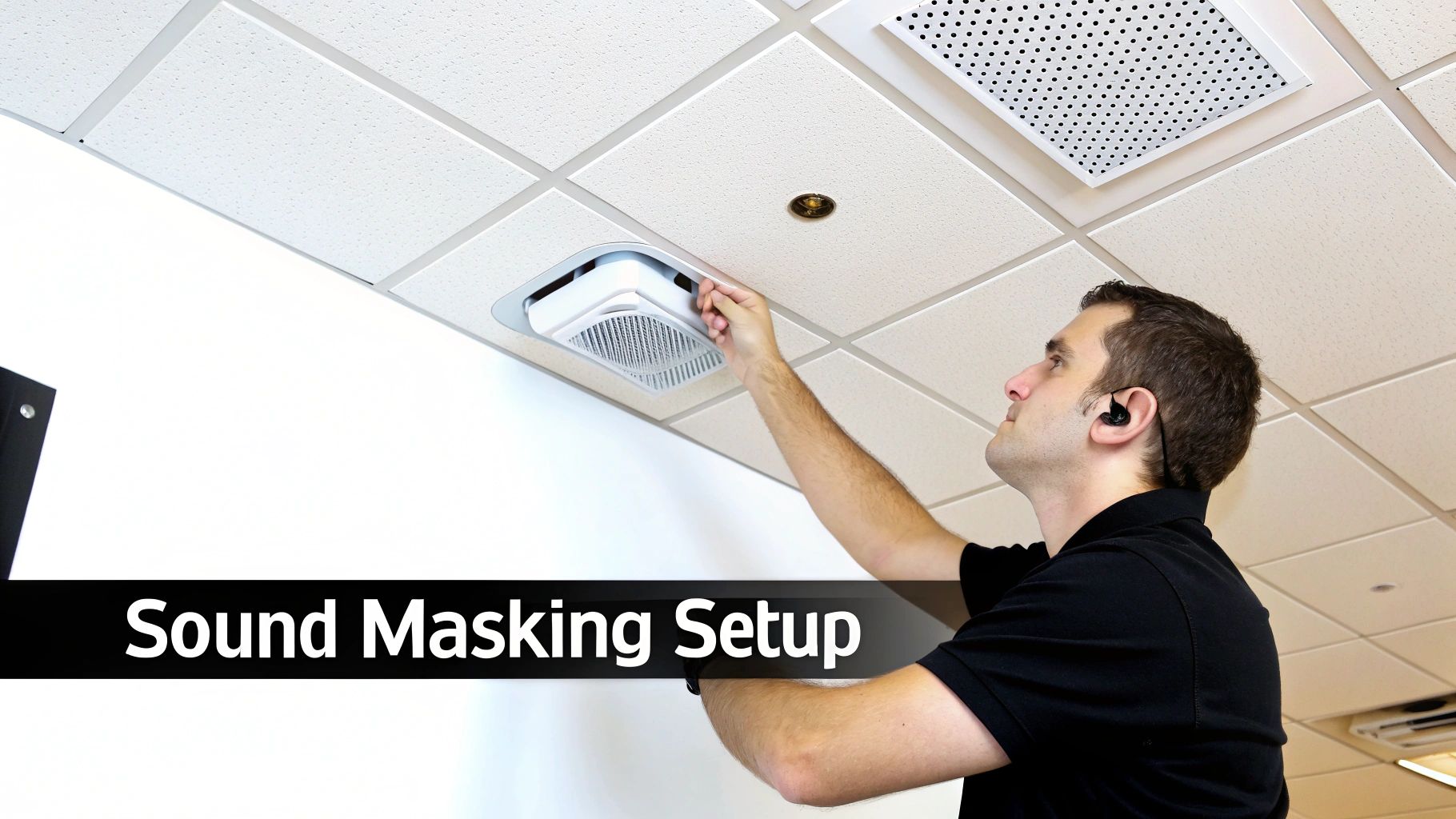
These speakers, often called emitters, are tiny and get installed by pros in a grid pattern above the ceiling tiles. This setup ensures the sound filters down evenly and indirectly, creating a consistent, immersive acoustic blanket. The goal is to make the sound so uniform that you can't pinpoint where it's coming from—that’s the sign of a top-notch installation.
Modern Solutions for Smaller Spaces
If you're outfitting a smaller office, a home studio, or just your personal workstation, a full-blown hardware system is probably overkill. A much more practical and budget-friendly route is to use high-quality audio files or specialized software played through a good set of speakers.
The trick here is all in the speaker placement. You don't want the masking sound to feel like it's blasting from a single box in the corner. Instead, try positioning your speakers so the sound bounces off walls and other surfaces first. This diffusion helps it fill the room more naturally, creating that ambient, "everywhere and nowhere" effect.
It’s also worth noting that your environment’s design plays a huge role. Thinking about how light and sound architecture affect cognitive performance can give you a more complete picture of how to create a truly productive workspace.
A really interesting development in this DIY space is the emergence of AI-powered sound generators. These tools let you generate completely unique, non-repeating soundscapes that are dialed in to exactly what you find comfortable, whether that's the gentle hum of an HVAC system or a soft, low rumble. This custom approach is a game-changer because it eliminates the annoying repetition you get from a simple looping audio file, making the sound far more effective and less distracting over time.
Of course, sometimes you need more than just adding sound; you might need to control it physically. For a deeper dive into that, check out our guide on acoustic treatment for home studios.
Pro Tip: If you're going the software route, make sure you use speakers that can handle low frequencies well. The best masking sounds have a lot of body in the lower end of the spectrum, and your standard laptop or phone speakers just can't reproduce that richness effectively.
Got Questions About Sound Masking? Let's Clear Things Up.
Even after you get the basic idea, a few practical questions always seem to pop up. Let's tackle some of the most common ones and cut through the confusion about what sound masking really is and how it works day-to-day.
So, Is It Just Playing Music or Nature Sounds?
Not at all. While you might use rain sounds or ambient music to cover up a noisy neighbor, that's not what we mean by true sound masking. Professional systems use a very specific, non-repeating audio signal that's been carefully engineered to match the frequencies of human speech.
Music has rhythm and melody—things your brain latches onto, which can become a whole new distraction. A real masking sound is designed to be completely uninteresting. The goal is for your brain to tune it out almost immediately, which is what makes it so effective for protecting speech privacy and helping you focus.
Can I Just Use This Instead of Soundproofing?
They're two different tools for two different jobs. Think of soundproofing as building a physical barrier to stop sound from getting in or out of a room. It's about construction—adding mass and sealing gaps—and it's absolutely essential for places like recording studios that need total acoustic isolation.
Sound masking, on the other hand, adds a subtle, controlled sound into a space to make conversations less intelligible from a distance. You'd soundproof a boardroom to keep secrets from leaking out, but you’d use sound masking inside an open-plan office to keep one team's chatter from distracting another.
Soundproofing is about containment—stopping sound from crossing a barrier. Sound masking is about comfort—making the existing environment less distracting and more private.
How Loud Does This Thing Have to Be?
This is the most surprising part for most people: it's incredibly quiet. A properly tuned sound masking system usually runs between 40 and 48 dBA. For context, a normal conversation is about 60 dBA, so the masking sound is significantly softer.
The whole point is for it to blend into the background so perfectly you don't even notice it's on. It just needs to be loud enough to subtly obscure distant chatter. If you walk into a room and can immediately pinpoint where the sound is coming from, it's almost certainly turned up too high.
Ready to create the perfect custom audio for your own projects? SFX Engine offers a free AI-powered sound effect generator that allows you to craft unique, royalty-free audio tailored to your exact needs. Explore SFX Engine today and hear the difference for yourself.